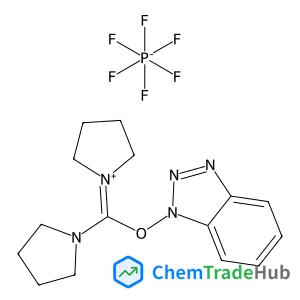
(1H-Benzotriazol-1-yloxy)(di-1-pyrrolidinyl)methylium hexafluorophosphate
CAS番号:
105379-24-6
分子式:
C15H21F6N5OP
Rachid Jellali, Michaël Alexandre, Christine Jérôme
Polydimethylsiloxanes (PDMSs) bearing photoreactive coumarin groups have been synthesized by amidation of a coumarin acid chloride derivative with various amine-functionalized PDMSs. Upon exposure to UV light having a wavelength of above 300 nm, multifunctional coumarin-PDMSs are transformed into covalent networks via [2 + 2] photocycloaddition of two coumarin moieties forming a cyclobutane ring. Taking advantage of the possible localized irradiation through a photomask, a novel concept to generate patterned PDMS films with various surface topologies was demonstrated. This concept is based on the combination of a low molar mass difunctional PDMS with a multifunctional PDMS of a high molar mass forming a photoreversible network allowing osmotic diffusion of a linear PDMS-coumarin of low molecular weight in a loosely crosslinked network. Advantageously, illumination by a light source at 254 nm induces the photocleavage of the cyclobutane cross-links offering some photo-induced reversibility to the PDMS network. These novel photo-responsive networks are interesting for several applications, in photo-adaptable biomedical implants (particularly photo-adjustable intra-ocular lenses), photo-tuneable patterned microsystems (e.g. for microfluidics) and photo-switchable controlled release systems.
Lingyun Zhu, Hua Geng, Yuanping Yi, Zhixiang Wei
DOI: 10.1039/C6CP07417K
Noah M. Johnson, Yuriy Y. Smolin, Daniel Hagaman, Masoud Soroush, Kenneth K. S. Lau, Hai-Feng Ji
DOI: 10.1039/C6CP07853B
Prasant Kumar Nayak, Judith Grinblat, Elena Levi, Mikhael Levi, Boris Markovsky, Doron Aurbach
DOI: 10.1039/C6CP07383B
Denis S. Grebenkov, Gleb Oshanin
DOI: 10.1039/C6CP06102H
Katharine Moore Tibbetts, Xiao-Jiang Feng, Herschel Rabitz
DOI: 10.1039/C6CP06187G
L. A. Ferreira, V. N. Uversky, B. Y. Zaslavsky
DOI: 10.1039/C6CP08214A
Jennifer Wilcox, David W. Ball
DOI: 10.1039/C6CP07116C
Yuri Mikhlin, Vladimir Nasluzov, Alexander Romanchenko, Yevgeny Tomashevich, Alexey Shor, Roberto Félix
DOI: 10.1039/C6CP07598C
Masashi Hattori, Keigo Kamata
DOI: 10.1039/C6CP06864B
2-溴-9,9-二苯基芴は、医薬品、工業材料、有機合成の研究分野で応用されます。特に、レーザー材料や機能性ポリマーの合成に使用されることがあります。また、蛍光色...
四氯化铱の市場は研究開発分野で注目されており、特にナノ技術や金属有機框架(MOFs)の分野での需要が増加傾向にあります。価格は安定しており、中国や韓国での生産が...
1-(4-溴-3-氟苯基)-2-氯乙酮 (CAS番号: 1260857-14-4) の廃棄物は専門的な廃棄処理が必要です。まず、廃棄物は密閉された容器に収集し、...
苦参酚Kは、CAS番号101236-49-1を持つ化合物で、主に天然由来の生薬から抽出されます。この化合物は、抗炎症作用や抗癌作用を持つことが報告されています。
POTASSIUM (1-(TERTBUTOXYCARBONYL)AZETIDIN-3-YL)TRIFLUOROBORATE を含む廃棄物は、まず安全なエント...
4-庚基-4’-聯苯羧酸は、特殊化学品や合成化学の分野で用いられる化学物質ですが、市場動向としては、研究開発の進展とともに需要が増加しています。また、環境配慮型...
6-ブロモ-3-メトキシ-1-フェニル-1H-インドゾールを含む廃棄物は、適切な化学廃棄処理が必要です。通常、廃棄物は密閉容器に収集され、専門の廃棄処理業者に引...
4,4-二甲基-2-吡咯烷酮は医薬、ポリマー、センサー、半導体などの業界で広く使用されています。特に溶媒としての性能が高く評価されています。

Polymer Chemistry welcomes submissions in all areas of polymer science that have a strong focus on macromolecular chemistry. Manuscripts may cover a broad range of fields, yet no direct application focus is required.
![1-Naphthalenesulfonic acid, 2-[(2-hydroxy-1-naphthalenyl)azo]-, bariumsalt (2:1) structure](https://static.chemtradehub.com/structs/110/1103-38-4-0b33.webp "1-Naphthalenesulfonic acid, 2-[(2-hydroxy-1-naphthalenyl)azo]-, bariumsalt (2:1) structure")
![4-{2-[4-(2-Methyl-2-propanyl)phenyl]ethoxy}quinazoline structure](https://static.chemtradehub.com/structs/120/120928-09-8-d3db.webp "4-{2-[4-(2-Methyl-2-propanyl)phenyl]ethoxy}quinazoline structure")