


![N-[(6-Bromo-3-pyridinyl)methyl]ethanamine structure](https://static.chemtradehub.com/structs/120/120740-05-8-ca55.webp "N-[(6-Bromo-3-pyridinyl)methyl]ethanamine structure")
Miyaura borylation/Suzuki–Miyaura coupling (MBSC) sequence of 4-bromo-2,4′-bithiazoles with halides: straightforward access to a heterocylic cluster of d-series of thiopeptide GE2270
文献情報
出版日
2018-01-02
DOI
10.1039/C7OB02866K
インパクトファクター
3.876
著者
Pierrik Lassalas, Christophe Berini, Jean-Baptiste E. Y. Rouchet, Jonathan Hédouin, Francis Marsais, Cédric Schneider, Christine Baudequin, Christophe Hoarau
原文を見る
要旨
Herein, palladium-catalyzed Miyaura borylation of 4-bromo-2,4′-bithiazoles followed by Suzuki–Miyaura cross-coupling reaction (named the MBSC process) with (hetero)aryl- and alkenyl halides is reported. This methodology offers rapid access to various 2′,4-disubstituted 2,4′-bithiazole features including naturally-occurring 4-alkenylated and 4-pyridinylated 2,4′-bithiazoles. To prove its application, a concise approach for the synthesis of a heterocyclic cluster of the thiopeptide D-series antibiotic GE2270 is reported through a late-stage MBSC strategy.
おすすめジャーナル

Journal of Peptide Science

Russian Chemical Bulletin

Russian Journal of Applied Chemistry

Journal of Natural Medicines

Nature Medicine

Russian Journal of Organic Chemistry

Current Opinion in Solid State & Materials Science

Russian Journal of Bioorganic Chemistry

Crystallography Reports

Saudi Pharmaceutical Journal
関連文献
Internal energy deposition and ion fragmentation in atmospheric-pressure mid-infrared laser ablation electrospray ionization
Peter Nemes, Hehua Huang, Akos Vertes
2011-12-22
Paper
DOI: 10.1039/C2CP23411D
Investigation of band offsets of interface BiOCl:Bi2WO6: a first-principles study
2011-12-07
Paper
DOI: 10.1039/C2CP23186G
Al2O3(110) surface as a template for the ordered growth of Ni and Co nanoclusters
Krithika Venkataramani, Thomas N. Jensen, Stig Helveg, Michael Reichling, Flemming Besenbacher, Jeppe V. Lauritsen
2012-01-09
Paper
DOI: 10.1039/C2CP22712F
Reorganization energy and pre-exponential factor from temperature-dependent experiments in electron transfer reactions. A typical example: the reduction of tert-nitrobutane
Cyrille Costentin, Cyril Louault, Marc Robert, Vincent Rogé, Jean-Michel Savéant
2011-12-16
Communication
DOI: 10.1039/C2CP23050J
On the analyses of fluorescence depolarisation data in the presence of electronic energy migration. Part II: Applying and evaluating two-photon excited fluorescence
Oleg Opanasyuk, Therese Mikaelsson, Linus Ryderfors, Emad Mukhtar, Lennart B.-Å. Johansson
2011-11-30
Paper
DOI: 10.1039/C2CP23177H
23Na double-rotation NMR of sodium nucleotides leads to the discovery of a new dCMP hendecahydrate
Frédéric A. Perras, Ilia Korobkov, David L. Bryce
2012-02-01
Communication
DOI: 10.1039/C2CP40273D
An innovative computational comparison of exact and centrifugal sudden quantum properties of the N + N2 reaction
Ernesto Garcia, Antonio Laganà, Dimitris Skouteris
2011-12-20
Paper
DOI: 10.1039/C2CP22922F
こちらもおすすめ
化合物よくある質問
カルボニル基が付いた5-氰基-1-{[(2-メチル-2-プロpanyl)オキシ]カーボンイル}1H-吲哚-2-イリド-2-ボリン酸はどのように保存すればよいですか?
カルボニル基が付いた5-氰基-1-{[(2-メチル-2-プロpanyl)オキシ]カーボンイル}1H-吲哚-2-イリド-2-ボリン酸は、直射日光を避けて室温(15...
475102-15-9(5-Cyano-1-{[(2-meth...
化合物よくある質問
tert-ブチル2-クロロメチルピリジン-3-基炭酸エステルの市場動向や研究トレンドはどうですか?
この化合物は合成化学分野において、特にピリジン化合物の合成や改良に用いられます。最近の研究では、ピリジン化合物の新規合成法や特性の改良が注目されています。市場動...
1203498-98-9tert-Butyl 2-chloro-...
化合物よくある質問
聚二季戊四醇六丙烯酸酯はどの業界で使用されていますか?
聚二季戊四醇六丙烯酸酯は、医薬品、ポリマー、センサー、半導体などの業界で広く使用されています。特にポリマー業界では硬化剤として、医薬分野では医療機器の製造に使用...
29570-58-93-(Acryloyloxy)-2-({...
化合物よくある質問
1-氯-5-硝基异喹啉の市場動向や研究トレンドはどうですか?
1-氯-5-硝基异喹啉は、薬理学や合成化学の研究分野で注目されています。市場動向としては、その生物学的な活性や合成可能性を評価する研究が増えています。また、代替...
58142-97-51-Chloro-5-nitroisoq...
化合物よくある質問
2-チロール-5-メチルスルフェニル-3-trifルオルメチルベンゼンはどのように合成されますか?
2-チロール-5-メチルスルフェニル-3-trifルオルメチルベンゼンは、トリフルオロメチル化反応と硫化反応を経て合成されます。通常、トリフルオロメチル化剤と硫...
957066-04-51-Chloro-4-(methylsu...
化合物よくある質問
p-トールイルマグネシウムブロミドの物理化学的性質は何ですか?
p-トールイルマグネシウムブロミドのCAS番号は4294-57-9です。この化合物は白色の結晶性粉末で、分子量は204.32です。溶剤中で良好に溶解しますが、水...
4294-57-9p-Tolylmagnesium bro...
化合物よくある質問
1-(5-甲基-2-硫化素基)プロパン-1-酮の市場動向や研究トレンドはどうですか?
1-(5-甲基-2-硫化素基)プロパン-1-酮の市場動向は、化学産業全体の需要に影響を受けますが、最近では pharmaceutical 分野での応用が注目され...
59303-13-81-(5-Methyl-2-thieny...
化合物よくある質問
十一碳烯酰甘氨酸を取り扱う際の実験室安全事項は何ですか?
十一碳烯酰甘氨酸は吸入や皮膚から吸収されることがあり、取り扱う際には防塵マスクと手袋を使用してください。ドラフトチャンバーを用いて漏洩を処理し、適切なSDS(S...
54301-26-7N-10-Undecenoylglyci...
化合物よくある質問
1H,1H-全氟-3,6-二氧杂葵-1-醇を取り扱う際の実験室安全事項は何ですか?
この化合物は吸入や皮膚吸収による毒性があるため、防塵マスク、ゴーグル、防護手袋を使用する必要があります。ドラフトチャンバーでの操作が必要です。漏洩時には即座に換...
152914-73-32,2-Difluoro-2-[1,1,...
化合物よくある質問
3-(4-(フルオロメチルオキシ)フェニル)-1,2,4-オキサジアゾール-5-カルボハイドライドは安全ですか?
安全性は化合物の使用方法によります。直接的な毒性は報告されていませんが、吸入や皮膚接触には注意が必要です。適切な防護服を着用し、換気を図ることを推奨します。
883028-82-83-(4-(Trifluorometho...
掲載誌
Organic & Biomolecular Chemistry

CiteScore:
3.4
自己引用率:
10.3%
年間論文数:
1041
Organic & Biomolecular Chemistry (OBC) publishes original and high impact research and reviews in organic chemistry. We welcome research that shows new or significantly improved protocols or methodologies in total synthesis, synthetic methodology or physical and theoretical organic chemistry as well as research that shows a significant advance in the organic chemistry or molecular design aspects of chemical biology, catalysis, supramolecular and macromolecular chemistry, theoretical chemistry, mechanism-oriented physical organic chemistry, medicinal chemistry or natural products. Articles published in the journal should report new work which makes a highly-significant impact in the field. Routine and incremental work is generally not suitable for publication in the journal. More details about key areas of our scope are below. In all cases authors should include in their article clear rationale for why their research has been carried out.
おすすめ化合物
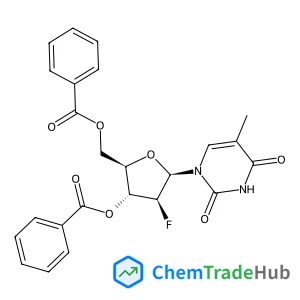
1-(3',5'-Di-O-benzoyl-2'-deoxy-2'-fluoro-b-D-arabinofuranosyl)thymine
CAS番号:
97614-47-6
分子式:
C24H21FN2O7
![N-[4-(Cyanoethynyl)phenyl]-16-oxo-4,7,10,13-tetraoxa-17-azahenicos-1-yn-21-amide structure](https://static.chemtradehub.com/structs/218/2183440-36-8-68cb.webp "N-[4-(Cyanoethynyl)phenyl]-16-oxo-4,7,10,13-tetraoxa-17-azahenicos-1-yn-21-amide structure")
![Ethanone, 1-[4-chloro-2-(methylthio)-5-pyrimidinyl]- structure](https://static.chemtradehub.com/structs/661/66116-82-3-863e.webp "Ethanone, 1-[4-chloro-2-(methylthio)-5-pyrimidinyl]- structure")
おすすめサプライヤー





免責事項
このページに表示される学術雑誌情報は、参考および研究目的のみを目的としています。当社は雑誌出版社とは提携しておらず、投稿の取り扱いも行っておりません。出版に関するお問い合わせは、各雑誌出版社に直接ご連絡ください。
表示されている情報に誤りがある場合は、support@chemtradehub.com までご連絡ください。迅速に確認し、対応いたします。