


Design of a substrate-tailored peptiligase variant for the efficient synthesis of thymosin-α1
文献情報
出版日
2018-01-04
DOI
10.1039/C7OB02812A
インパクトファクター
3.876
著者
Ana Toplak, Henriëtte J. Rozeboom, Hein J. Wijma, Peter J. L. M. Quaedflieg, Jan H. van Maarseveen, Dick B. Janssen, Timo Nuijens
原文を見る
要旨
The synthesis of thymosin-α1, an acetylated 28 amino acid long therapeutic peptide, via conventional chemical methods is exceptionally challenging. The enzymatic coupling of unprotected peptide segments in water offers great potential for a more efficient synthesis of peptides that are difficult to synthesize. Based on the design of a highly engineered peptide ligase, we developed a fully convergent chemo-enzymatic peptide synthesis (CEPS) process for the production of thymosin-α1via a 14-mer + 14-mer segment condensation strategy. Using structure-inspired enzyme engineering, the thiol-subtilisin variant peptiligase was tailored to recognize the respective 14-mer thymosin-α1 segments in order to create a clearly improved biocatalyst, termed thymoligase. Thymoligase catalyzes peptide bond formation between both segments with a very high efficiency (>94% yield) and is expected to be well applicable to many other ligations in which residues with similar characteristics (e.g. Arg and Glu) are present in the respective positions P1 and P1′. The crystal structure of thymoligase was determined and shown to be in good agreement with the model used for the engineering studies. The combination of the solid phase peptide synthesis (SPPS) of the 14-mer segments and their thymoligase-catalyzed ligation on a gram scale resulted in a significantly increased, two-fold higher overall yield (55%) of thymosin-α1 compared to those typical of existing industrial processes.
おすすめジャーナル

Journal of Peptide Science

Journal of Saudi Chemical Society

Russian Journal of Bioorganic Chemistry

Nature Medicine

Russian Journal of Applied Chemistry

Acta Materialia

Russian Journal of Organic Chemistry

Current Opinion in Solid State & Materials Science

Saudi Pharmaceutical Journal

Crystallography Reports
関連文献
Computational study of methyl group dynamics in the hydroquinoneclathrate of acetonitrile
Alexandra Nemkevich, Ben Corry, Mark A. Spackman
2011-12-06
Communication
DOI: 10.1039/C2CP23384C
Density minimum of confined water at low temperatures: a combined study by small-angle scattering of X-rays and neutrons
M. Erko, D. Wallacher, A. Hoell, T. Hauß, I. Zizak, O. Paris
2012-01-23
Paper
DOI: 10.1039/C2CP24075K
An innovative computational comparison of exact and centrifugal sudden quantum properties of the N + N2 reaction
Ernesto Garcia, Antonio Laganà, Dimitris Skouteris
2011-12-20
Paper
DOI: 10.1039/C2CP22922F
Photophysics of indole-2-carboxylic acid in an aqueous environment studied by fluorescence spectroscopy in combination with ab initio calculations
Annemarie Huijser, Michał F. Rode, Alice Corani, Andrzej L. Sobolewski, Villy Sundström
2012-01-10
Paper
DOI: 10.1039/C2CP22958G
Surface state engineering of molecule–molecule interactions
Geoffrey Rojas, Scott Simpson, Xumin Chen, Donna A. Kunkel, Justin Nitz, Jie Xiao, Peter A. Dowben, Eva Zurek, Axel Enders
2012-02-20
Paper
DOI: 10.1039/C2CP40254H
Reversible formation of a PdCx phase in Pd nanoparticles upon CO and O2 exposure
Olivier Balmes, Andrea Resta, Didier Wermeille, Roberto Felici, Maria E. Messing, Knut Deppert, Zhi Liu, Michael E. Grass, Hendrik Bluhm, Richard van Rijn, Joost W. M. Frenken, Rasmus Westerström, Sara Blomberg, Johan Gustafson, Jesper N. Andersen, Edvin Lundgren
2012-02-24
Paper
DOI: 10.1039/C2CP22873D
A method for finding the ridge between saddle points applied to rare event rate estimates
Jón Bergmann Maronsson, Hannes Jónsson, Tejs Vegge
2011-12-22
Paper
DOI: 10.1039/C2CP23421A
Potential-induced phase transition of low-index Au single crystal surfaces in propylene carbonate solution
Youn-Geun Kim, Kazuhiro Sato, Junji Inukai, Kingo Itaya
2011-11-23
Paper
DOI: 10.1039/C2CP23171A
Design of energy band alignment at the Zn1−xMgxO/Cu(In,Ga)Se2 interface for Cd-free Cu(In,Ga)Se2 solar cells
Chang-Soo Lee, Liudmila Larina, Young-Min Shin, Essam A. Al-Ammar, Byung Tae Ahn
2012-03-01
Paper
DOI: 10.1039/C2CP40355B
こちらもおすすめ
化合物よくある質問
カルボニル基が付いた5-氰基-1-{[(2-メチル-2-プロpanyl)オキシ]カーボンイル}1H-吲哚-2-イリド-2-ボリン酸はどのように保存すればよいですか?
カルボニル基が付いた5-氰基-1-{[(2-メチル-2-プロpanyl)オキシ]カーボンイル}1H-吲哚-2-イリド-2-ボリン酸は、直射日光を避けて室温(15...
475102-15-9(5-Cyano-1-{[(2-meth...
化合物よくある質問
tert-ブチル2-クロロメチルピリジン-3-基炭酸エステルの市場動向や研究トレンドはどうですか?
この化合物は合成化学分野において、特にピリジン化合物の合成や改良に用いられます。最近の研究では、ピリジン化合物の新規合成法や特性の改良が注目されています。市場動...
1203498-98-9tert-Butyl 2-chloro-...
化合物よくある質問
聚二季戊四醇六丙烯酸酯はどの業界で使用されていますか?
聚二季戊四醇六丙烯酸酯は、医薬品、ポリマー、センサー、半導体などの業界で広く使用されています。特にポリマー業界では硬化剤として、医薬分野では医療機器の製造に使用...
29570-58-93-(Acryloyloxy)-2-({...
化合物よくある質問
1-氯-5-硝基异喹啉の市場動向や研究トレンドはどうですか?
1-氯-5-硝基异喹啉は、薬理学や合成化学の研究分野で注目されています。市場動向としては、その生物学的な活性や合成可能性を評価する研究が増えています。また、代替...
58142-97-51-Chloro-5-nitroisoq...
化合物よくある質問
2-チロール-5-メチルスルフェニル-3-trifルオルメチルベンゼンはどのように合成されますか?
2-チロール-5-メチルスルフェニル-3-trifルオルメチルベンゼンは、トリフルオロメチル化反応と硫化反応を経て合成されます。通常、トリフルオロメチル化剤と硫...
957066-04-51-Chloro-4-(methylsu...
化合物よくある質問
p-トールイルマグネシウムブロミドの物理化学的性質は何ですか?
p-トールイルマグネシウムブロミドのCAS番号は4294-57-9です。この化合物は白色の結晶性粉末で、分子量は204.32です。溶剤中で良好に溶解しますが、水...
4294-57-9p-Tolylmagnesium bro...
化合物よくある質問
1-(5-甲基-2-硫化素基)プロパン-1-酮の市場動向や研究トレンドはどうですか?
1-(5-甲基-2-硫化素基)プロパン-1-酮の市場動向は、化学産業全体の需要に影響を受けますが、最近では pharmaceutical 分野での応用が注目され...
59303-13-81-(5-Methyl-2-thieny...
化合物よくある質問
十一碳烯酰甘氨酸を取り扱う際の実験室安全事項は何ですか?
十一碳烯酰甘氨酸は吸入や皮膚から吸収されることがあり、取り扱う際には防塵マスクと手袋を使用してください。ドラフトチャンバーを用いて漏洩を処理し、適切なSDS(S...
54301-26-7N-10-Undecenoylglyci...
化合物よくある質問
1H,1H-全氟-3,6-二氧杂葵-1-醇を取り扱う際の実験室安全事項は何ですか?
この化合物は吸入や皮膚吸収による毒性があるため、防塵マスク、ゴーグル、防護手袋を使用する必要があります。ドラフトチャンバーでの操作が必要です。漏洩時には即座に換...
152914-73-32,2-Difluoro-2-[1,1,...
化合物よくある質問
3-(4-(フルオロメチルオキシ)フェニル)-1,2,4-オキサジアゾール-5-カルボハイドライドは安全ですか?
安全性は化合物の使用方法によります。直接的な毒性は報告されていませんが、吸入や皮膚接触には注意が必要です。適切な防護服を着用し、換気を図ることを推奨します。
883028-82-83-(4-(Trifluorometho...
掲載誌
Organic & Biomolecular Chemistry

CiteScore:
3.4
自己引用率:
10.3%
年間論文数:
1041
Organic & Biomolecular Chemistry (OBC) publishes original and high impact research and reviews in organic chemistry. We welcome research that shows new or significantly improved protocols or methodologies in total synthesis, synthetic methodology or physical and theoretical organic chemistry as well as research that shows a significant advance in the organic chemistry or molecular design aspects of chemical biology, catalysis, supramolecular and macromolecular chemistry, theoretical chemistry, mechanism-oriented physical organic chemistry, medicinal chemistry or natural products. Articles published in the journal should report new work which makes a highly-significant impact in the field. Routine and incremental work is generally not suitable for publication in the journal. More details about key areas of our scope are below. In all cases authors should include in their article clear rationale for why their research has been carried out.
おすすめ化合物
![N-[(6-Bromo-3-pyridinyl)methyl]ethanamine structure](https://static.chemtradehub.com/structs/120/120740-05-8-ca55.webp "N-[(6-Bromo-3-pyridinyl)methyl]ethanamine structure")
![Ethanone, 1-[4-chloro-2-(methylthio)-5-pyrimidinyl]- structure](https://static.chemtradehub.com/structs/661/66116-82-3-863e.webp "Ethanone, 1-[4-chloro-2-(methylthio)-5-pyrimidinyl]- structure")
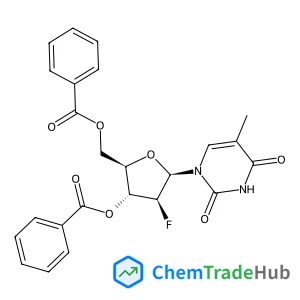
1-(3',5'-Di-O-benzoyl-2'-deoxy-2'-fluoro-b-D-arabinofuranosyl)thymine
CAS番号:
97614-47-6
分子式:
C24H21FN2O7
おすすめサプライヤー




免責事項
このページに表示される学術雑誌情報は、参考および研究目的のみを目的としています。当社は雑誌出版社とは提携しておらず、投稿の取り扱いも行っておりません。出版に関するお問い合わせは、各雑誌出版社に直接ご連絡ください。
表示されている情報に誤りがある場合は、support@chemtradehub.com までご連絡ください。迅速に確認し、対応いたします。