












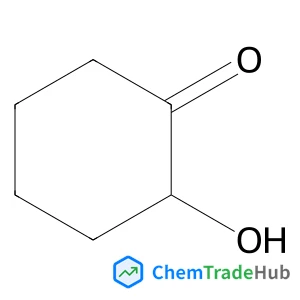
Acid-catalyzed reaction of 2-hydroxycyclobutanone with benzylic alcohols
文献情報
出版日
2017-11-10
DOI
10.1039/C7OB02545A
インパクトファクター
3.876
著者
Alberto Martis, Alberto Luridiana, Angelo Frongia, Massimiliano Arca, Giorgia Sarais, David J. Aitken, Regis Guillot, Francesco Secci
原文を見る
要旨
The acid-promoted syntheses of 2-(benzyloxy)cyclobutanones and bis(benzyloxy)dioxatricyclo decanes were achieved starting from 2-hydroxycyclobutanone and variously functionalized benzyl alcohols. The reaction sequences afforded the desired products in good to high yields and in a solvent-dependent chemoselective fashion.
関連文献
The one-electron reduction of dithiolate and diselenolate ligands
Eric A. C. Bushnell, Thomas D. Burns, Russell J. Boyd
2014-04-25
Paper
DOI: 10.1039/C4CP01105H
Probing crystal structure and mesoscale assembly of cellulose microfibrils in plant cell walls, tunicate tests, and bacterial films using vibrational Sum Frequency Generation (SFG) spectroscopy
Christopher M. Lee, Kabindra Kafle, Yong Bum Park, Seong H. Kim
2014-04-24
Paper
DOI: 10.1039/C4CP00515E
Dynamic control of Förster energy transfer in a photonic environment
Frank Schleifenbaum, Andreas M. Kern, Alexander Konrad, Alfred J. Meixner
2014-05-01
Paper
DOI: 10.1039/C4CP01306A
Theoretical study of thermoelectric properties of few-layer MoS2 and WSe2
Wen Huang, Chee Kwan Gan, Gengchiau Liang
2014-04-14
Paper
DOI: 10.1039/C4CP00487F
Electron transport in MoWSeS monolayers in the presence of an external electric field
Nourdine Zibouche, Pier Philipsen, Thomas Heine, Agnieszka Kuc
2014-04-11
Paper
DOI: 10.1039/C4CP00966E
A quasi-classical trajectory study of the OH + SO reaction: the role of ro-vibrational energy
W. A. D. Pires, J. D. Garrido, M. A. C. Nascimento, M. Y. Ballester
2014-05-02
Paper
DOI: 10.1039/C4CP01363H
Synergistic contributions by decreasing overpotential and enhancing charge-transfer in α-Fe2O3/Mn3O4/graphene catalysts with heterostructures for photocatalytic water oxidation
Shunli Yin, Xiaomei Wang, Zhigang Mou, Yijie Wu, Hui Huang, Mingshan Zhu, Yukou Du, Ping Yang
2014-03-11
Paper
DOI: 10.1039/C4CP00384E
Effect of post-treatments on the photocatalytic activity of Sm2Ti2S2O5 for the hydrogen evolution reaction
Wen Zhao, Fuxiang Zhang, Takashi Hisatomi, Kazunari Domen
2013-12-06
Paper
DOI: 10.1039/C3CP54668C
Experimental determination of electrostatic properties of Na–X zeolite from high resolution X-ray diffraction
2014-03-31
Paper
DOI: 10.1039/C3CP55397C
Optical response of quantum-sized Ag and Au clusters – cage vs. compact structures and the remarkable insensitivity to compression
Robert L. Whetten, Xóchitl López-Lozano
2014-05-07
Paper
DOI: 10.1039/C4CP01277A
こちらもおすすめ
化合物よくある質問
2-氟-4-イオドベンzo酸エチルエステルを取り扱う際の実験室安全事項は何ですか?
2-氟-4-イオドベンzo酸エチルエステルは有機溶媒を用いた反応であり、ドラフトチャンバーでの操作が必要です。漏洩時にはSDS参照の安全措置を講じ、PPE(防護...
205750-82-9Benzoic acid, 2-fluo...
化合物よくある質問
血根碱の主な用途は何ですか?
血根碱は主に医薬分野で利用され、抗炎症や抗がん剤としての潜在的な効果が研究されています。また、化学研究や薬物開発において、新しい薬剤設計の参考となる化合物として...
2447-54-313-Methyl[1,3]benzod...
化合物よくある質問
Methyl 3-methoxythiophene-2-carboxylateの主な用途は何ですか?
Methyl 3-メトキシスチフェン-2-カルボン酸メチルエステルは、薬品合成、染料製造、以及合成中間体としての用途が広がっています。
62353-75-7Methyl 3-methoxythio...
化合物よくある質問
丹磺酰-L-亮氨酸はどのように保存すればよいですか?
丹磺酰-L-亮氨酸は乾燥した場所で、直射日光から保護し、低温(室温以下)で保存してください。密閉容器に入れて保管することをおすすめします。
1100-22-7N-{[5-(Dimethylamino...
化合物よくある質問
5-(苄氧基)ピラミジン-4-アミンの代替品はありますか?
5-(苄氧基)ピラミジン-4-アミンの代替品として、6-メトキシピラミジンや5-フェニルピラミジンなどが挙げられます。これらの化合物は、5-(苄氧基)ピラミジン...
92289-50-45-benzyloxypyrimidin...
化合物よくある質問
8-ヒドロキシノルデコペントアセートの物理化学的性質は何ですか?
8-ヒドロキシノルデコペントアセートはCAS番号84807-87-4の化合物で、分子量は750.02 uです。これは油溶性で、水に溶けにくい特徴があります。反応...
84807-87-4(5Z,8Z,11Z,13E,15S)-...
化合物よくある質問
tert-ブチル(エス)-1-ヒドロキシペンタ-4-エン-2-イルカルバamateの主な用途は何ですか?
tert-ブチル(エス)-1-ヒドロキシペンタ-4-エン-2-イルカルバamateは主に医薬品の合成材料や分析化学の試薬として使用されます。
116613-81-12-Methyl-2-propanyl ...
化合物よくある質問
ブコール-L-2-フローヨルブリンについて適切な法規ガイドラインは何ですか?
ブコール-L-2-フローヨルブリン(CAS番号: 1196107-73-9)は、GHS(グローバルハザードアサessmentシステム)に基づく危害分類と表示が求...
1196107-73-92-Bromo-13,13-dimeth...
化合物よくある質問
6-ブロモ-N-環丙基-2-ピリジニニメタンの市場動向や研究トレンドはどうですか
6-ブロモ-N-環丙基-2-ピリジニニメタンは、薬理学研究や合成化学に使用される化合物であり、特に抗ウイルス薬や抗がん薬の開発に注目されています。市場では、薬物...
959237-20-86-Bromo-N-cyclopropy...
化合物よくある質問
RS-AMPÀはどのように保存すればよいですか?
RS-AMPÀは、遮光容器に保存し、室温(15〜25℃)で保管することが推奨されます。高湿や熱は物質を劣化させるため、湿度は50%以下に保つことが重要です。また...
74341-63-2(RS)-AMPA
掲載誌
Organic & Biomolecular Chemistry

CiteScore:
3.4
自己引用率:
10.3%
年間論文数:
1041
Organic & Biomolecular Chemistry (OBC) publishes original and high impact research and reviews in organic chemistry. We welcome research that shows new or significantly improved protocols or methodologies in total synthesis, synthetic methodology or physical and theoretical organic chemistry as well as research that shows a significant advance in the organic chemistry or molecular design aspects of chemical biology, catalysis, supramolecular and macromolecular chemistry, theoretical chemistry, mechanism-oriented physical organic chemistry, medicinal chemistry or natural products. Articles published in the journal should report new work which makes a highly-significant impact in the field. Routine and incremental work is generally not suitable for publication in the journal. More details about key areas of our scope are below. In all cases authors should include in their article clear rationale for why their research has been carried out.
おすすめ化合物
![2-Hydroxy-4-[({[(4-methylphenyl)sulfonyl]oxy}acetyl)amino]benzoic acid structure](https://static.chemtradehub.com/structs/501/501919-59-1-579f.webp "2-Hydroxy-4-[({[(4-methylphenyl)sulfonyl]oxy}acetyl)amino]benzoic acid structure")
2-Hydroxy-4-[({[(4-methylphenyl)sulfonyl]oxy}acetyl)amino]benzoic acid
CAS番号:
501919-59-1
分子式:
C16H15NO7S
おすすめサプライヤー






免責事項
このページに表示される学術雑誌情報は、参考および研究目的のみを目的としています。当社は雑誌出版社とは提携しておらず、投稿の取り扱いも行っておりません。出版に関するお問い合わせは、各雑誌出版社に直接ご連絡ください。
表示されている情報に誤りがある場合は、support@chemtradehub.com までご連絡ください。迅速に確認し、対応いたします。