












Kinetics of the a-C3H5 + O2 reaction, investigated by photoionization using synchrotron radiation
文献情報
出版日
2018-01-11
DOI
10.1039/C7CP07893E
インパクトファクター
3.676
著者
D. Schleier, P. Constantinidis, N. Faßheber, I. Fischer, G. Friedrichs, P. Hemberger, E. Reusch, B. Sztáray, K. Voronova
原文を見る
要旨
The kinetics of the combustion-relevant reaction of the allyl radical, a-C3H5, with molecular oxygen has been studied in a flow tube reactor at the vacuum ultraviolet (VUV) beamline of the Swiss Light Source storage ring, using the CRF-PEPICO (Combustion Reactions Followed by Photoelectron Photoion Coincidence Spectroscopy) setup. The ability to measure threshold photoelectron spectra enables a background-free detection of reactive species as well as an isomer-specific analysis of reaction products. Allyl was generated by direct photodissociation of allyl iodide at 266 nm and 213 nm and indirectly by the reaction of propene with Cl atoms, which were generated by photolysis from oxalyl chloride at 266 nm. Experiments were conducted at room temperature at low pressures between 0.8 and 3 mbar using Ar as the buffer gas and with excess O2 to maintain nearly pseudo-first-order reaction conditions. Whereas allyl was detected by photoionisation using synchrotron radiation, the main reaction product allyl peroxy was not observed due to dissociative ionisation of this weakly bound species. From the concentration–time profiles of the allyl signal, second-order rate constants between 1.35 × 1011 cm3 mol−1 s−1 at 0.8 mbar and 1.75 × 1011 cm3 mol−1 s−1 at 3 mbar were determined. The rates obtained for the different allyl radical generation schemes agree well with each other, but are about a factor of 2 higher than the ones reported previously using He as a buffer gas. The discrepancy is partly attributed to the higher collision efficiency of Ar causing a varying fall-off behavior. When allyl is produced by the reaction of propene with Cl atom, an unexpected product is observed at m/z = 68, which was identified as 1,3-butadienal in the threshold photoelectron spectrum. It is formed in a secondary reaction of allyl with the OCCl radical, which is generated in the 266 nm photolysis of oxalyl chloride.
関連文献
Real time monitoring of the minute dynamic variation at the crude oil–water interface
Ziling Ding, Yan Xiong
2018-01-26
Paper
DOI: 10.1039/C7CP07491C
Molecular dynamics simulations of the structure of mixtures of protic ionic liquids and monovalent and divalent salts at the electrochemical interface
Víctor Gómez-González, Borja Docampo-Álvarez, J. Manuel Otero-Mato, Oscar Cabeza, Luis J. Gallego, Luis M. Varela
2018-04-26
Paper
DOI: 10.1039/C8CP01180J
Facile preparation of a nano-imprinted polymer on magnetite nanoparticles for the rapid separation of lead ions from aqueous solution
Delong Kong, Ning Qiao, Nian Wang, Zhuo Wang, Qi Wang, Zhiyong Zhou, Zhongqi Ren
2018-04-19
Paper
DOI: 10.1039/C8CP01163J
An organoferroelasticity driven by molecular conformational change
Sajjad Husain Mir, Satoshi Takamizawa
2017-12-04
Communication
DOI: 10.1039/C7CP07206F
Aerogen bonds formed between AeOF2 (Ae = Kr, Xe) and diazines: comparisons between σ-hole and π-hole complexes
Wiktor Zierkiewicz, Mariusz Michalczyk, Steve Scheiner
2018-01-10
Paper
DOI: 10.1039/C7CP08048D
Strain-induced modulations of electronic structure and electron–phonon coupling in dense H3S
Chang Liu, Hang Zhai, Ying Sun, Weiguang Gong, Yan Yan, Quan Li, Weitao Zheng
2018-01-29
Paper
DOI: 10.1039/C8CP00205C
Halogen-like properties of the Al13 cluster mimicking astatine
B. Molina, J. R. Soto, J. J. Castro
2018-04-04
Communication
DOI: 10.1039/C8CP00494C
Study of low temperature chlorine atom initiated oxidation of methyl and ethyl butyrate using synchrotron photoionization TOF-mass spectrometry
Joseph Czekner, Craig A. Taatjes, David L. Osborn, Giovanni Meloni
2018-02-01
Paper
DOI: 10.1039/C7CP08221E
Patterned polyaniline encapsulated in titania nanotubes for electrochromism
Haiming Lv, Yi Wang, Lei Pan, Leipeng Zhang, Hangchuan Zhang, Lei Shang, Huiying Qu, Na Li, Jiupeng Zhao, Yao Li
2018-01-25
Paper
DOI: 10.1039/C7CP07617G
こちらもおすすめ
化合物よくある質問
2-ヒドロキシ-5-ニトロベンジンブロモイドの代替品はありますか?
2-ヒドロキシ-5-ニトロベンジンブロモイドは特定の化学反応に適しているため、代替品は限られています。しかし、同様の構造を持つ2-ヒドロキシ-4-ニトロベンジン...
772-33-82-(Bromomethyl)-4-ni...
化合物よくある質問
N-(2-ブロモフェニル)-1-チロール-3-オキソ-3-(ピペリジニル)プロペン-2-イル)ベンゼンアミドを取り扱う際の実験室安全事項は何ですか?
N-(2-ブロモフェニル)-1-チロール-3-オキソ-3-(ピペリジニル)プロペン-2-イル)ベンゼンアミドは有毒で、皮膚や粘膜に刺激を与える可能性があります。...
1800044-77-2N-[(1Z)-1-(2-Bromoph...
化合物よくある質問
1,3プロパンジオール,2-[2-(2アミノ-6クロロ-9Hピリミジン-9-イル)エチル-1,1,2,2-D4]-2,3-ジアセタートの市場動向や研究トレンドはどうですか?
この化合物は、新規治療薬の開発に注目されています。市場では、その有効性と安全性が評価され、研究分野では、分子生物学と医薬化学の新たな発見が期待されています。
1020718-81-31,3-Propanediol, 2-[...
579-44-2Ethanone, 2-hydroxy-...
化合物よくある質問
Succinimidyl-alanyl-phenylalanyl-prolyl-phenylalanine 4-nitroanilide はどの業界で使用されていますか?
Succinimidyl-alanyl-phenylalanyl-prolyl-phenylalanine 4-nitroanilide は主に医薬品開発やポ...
128802-73-3succinimidyl-alanyl-...
化合物よくある質問
メチル6-アミノ-5-クロロピリジン-2-カーボイル酸について、適用される法規ガイドラインは何ですか?
メチル6-アミノ-5-クロロピリジン-2-カーボイル酸(CAS番号: 1256794-05-4)の使用には、GHS( Globally Harmonized S...
1256794-05-4Methyl 6-amino-5-chl...
化合物よくある質問
エチル4-(シクロ Pentagonyl)アミノ-2-メチル硫化基ピリミジン-5-カルボキシレートを取り扱う際の実験室安全事項は何ですか?
取り扱いには、耐薬品性の容器を使用し、通気性の良い場所で操作することを推奨します。漏れ時は、SDS(安全データシート)を参照して適切な措置を取ること。手洗いと洗...
211245-62-4ethyl 4-(cyclopentyl...
化合物よくある質問
(S)-3-ベンZYルピペリジン塩酸塩とは何ですか?
(S)-3-ベンZYルピペリジン塩酸塩は、CAS番号1258940-00-9で表される化合物です。これは、(S)-3-苯基哌啶的盐酸盐であり、主に医薬品の原料と...
1258940-00-9(S)-3-Phenylpiperidi...
化合物よくある質問
3,5-二甲基金剛胺の主な用途は何ですか?
3,5-二甲基金剛胺は、主に医薬品の原料として使用され、また抗うつ薬や抗アルツハイマー薬の開発に利用されます。さらに、化粧品や食品添加物の製造でも重要な役割を果...
19988-45-52-(2,3-Dihydroxyphen...
化合物よくある質問
ビス(4-メチル-2-ペンチル)フェニルカルボン酸エステルの代替品はありますか?
ビス(4-メチル-2-ペンチル)フェニルカルボン酸エステル (CAS番号: 1398066-13-1) の代替品には、ビス(2-エチルヘキシル)フェノールカルボ...
1398066-13-1Bis(4-methyl-2-penty...
掲載誌
Physical Chemistry Chemical Physics

CiteScore:
5.5
自己引用率:
10.3%
年間論文数:
3036
Physical Chemistry Chemical Physics (PCCP) is an international journal co-owned by 19 physical chemistry and physics societies from around the world. This journal publishes original, cutting-edge research in physical chemistry, chemical physics and biophysical chemistry. To be suitable for publication in PCCP, articles must include significant innovation and/or insight into physical chemistry; this is the most important criterion that reviewers and Editors will judge against when evaluating submissions. The journal has a broad scope and welcomes contributions spanning experiment, theory, computation and data science. Topical coverage includes spectroscopy, dynamics, kinetics, statistical mechanics, thermodynamics, electrochemistry, catalysis, surface science, quantum mechanics, quantum computing and machine learning. Interdisciplinary research areas such as polymers and soft matter, materials, nanoscience, energy, surfaces/interfaces, and biophysical chemistry are welcomed if they demonstrate significant innovation and/or insight into physical chemistry. Joined experimental/theoretical studies are particularly appreciated when complementary and based on up-to-date approaches.
おすすめ化合物
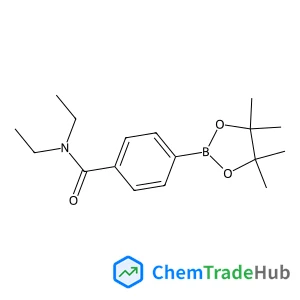
N,N-Diethyl-4-(4,4,5,5-tetramethyl-1,3,2-dioxaborolan-2-yl)benzamide
CAS番号:
325142-99-2
分子式:
C17H26BNO3
おすすめサプライヤー






免責事項
このページに表示される学術雑誌情報は、参考および研究目的のみを目的としています。当社は雑誌出版社とは提携しておらず、投稿の取り扱いも行っておりません。出版に関するお問い合わせは、各雑誌出版社に直接ご連絡ください。
表示されている情報に誤りがある場合は、support@chemtradehub.com までご連絡ください。迅速に確認し、対応いたします。