


Singlet–triplet energy gaps and the degree of diradical character in binuclear copper molecular magnets characterized by spin-flip density functional theory
文献情報
出版日
2018-01-22
DOI
10.1039/C7CP07356A
インパクトファクター
3.676
著者
Natalie Orms, Anna I. Krylov
原文を見る
要旨
Molecular magnets, defined here as organic polyradicals, can be used as building blocks in the fabrication of novel and structurally diverse magnetic light-weight materials. We present a theoretical investigation of the lowest spin states of several binuclear copper diradicals. In contrast to previous studies, we consider not only the energetics of the low-lying states (which are related to the exchange-coupling parameter within the Heisenberg–Dirac–van-Vleck model), but also the character of the diradical states themselves. We use natural orbitals, their occupations, and the number of effectively unpaired electrons to quantify bonding patterns in these systems. We compare the performance of spin-flip time-dependent density functional theory (SF-TDDFT) using various functionals and effective core potentials against the wave function based approach, equation-of-motion spin-flip coupled-cluster method with single and double substitutions (EOM-SF-CCSD). We find that SF-TDDFT paired with the PBE50 and B5050LYP functionals performs comparably to EOM-SF-CCSD, with respect to both singlet–triplet gaps and states' characters. Visualization of frontier natural orbitals shows that the unpaired electrons are localized on copper centers, in some cases exhibiting slight through-bond interaction via copper d-orbitals and p-orbitals of neighboring ligand atoms. The analysis reveals considerable interactions between the formally unpaired electrons in the antiferromagnetic diradicaloids, meaning that they are poorly described by the Heisenberg–Dirac–van-Vleck model. Thus, for these systems the experimentally derived exchange-coupling parameters are not directly comparable with the singlet–triplet gaps. This explains systematic discrepancies between the computed singlet–triplet energy gaps and the exchange-coupling parameters extracted from experiment.
おすすめジャーナル

Advances in Colloid and Interface Science

Ferroelectrics

Biopolymers

Chemistry of Natural Compounds

Cement and Concrete Research

Chemistry of Heterocyclic Compounds

Bulletin of the Chemical Society of Japan

Anti-Corrosion Methods and Materials

Chemical & Pharmaceutical Bulletin

Journal of the Chinese Chemical Society
関連文献
Correlating high temperature thin film ionomer electrode binder properties to hydrogen pump polarization
Gokul Venugopalan, Deepra Bhattacharya, Subarna Kole, Cameron Ysidron, Polyxeni P. Angelopoulou, Georgios Sakellariou, Christopher G. Arges
2021-05-13
Communication
DOI: 10.1039/D1MA00208B
Switching and tuning organic solid-state luminescence via a supramolecular approach
Savarimuthu Philip Anthony, Sunil Varughese, Sylvia M. Draper
2009-11-04
Communication
DOI: 10.1039/B914027A
Effects of acidity and immiscibility of lactam-based Brønsted-acidic ionic liquids on their catalytic performance for esterification
Hancheng Zhou, Jing Yang, Linmin Ye, Haiqiang Lin, Youzhu Yuan
2010-02-19
Paper
DOI: 10.1039/B921081D
Nanomaterials: stimulants for biofuels and renewables, yield and energy optimization
Yogendra Kumar, Prerna Yogeshwar, Sushant Bajpai, Pooja Jaiswal, Shalu Yadav, Diksha Praveen Pathak, Muskan Sonker, Saurabh Kr Tiwary
2021-07-15
Review Article
DOI: 10.1039/D1MA00538C
Atomic spectrometry update. Environmental analysis
Owen T. Butler, Jennifer M. Cook, Chris F. Harrington, Steve J. Hill, John Rieuwerts, Douglas L. Miles
2005-12-22
Atomic Spectrometry Update
DOI: 10.1039/B516025C
Novel 3D-networked melamine–naphthalene–polyamic acid nanofillers doped in vinyl ester resin for higher flame retardancy
Ravi Kumar Cheedarala, M. N. Prabhakar, Beom Gon Cho, Young Bin Park, Jung Il Song
2021-05-11
Paper
DOI: 10.1039/D1MA00048A
Straightforward radical organic chemistry in neat conditions and “on water”‡
Nelly Shapiro, Maria Kramer, Israel Goldberg, Arkadi Vigalok
2010-02-09
Communication
DOI: 10.1039/B922475K
こちらもおすすめ
化合物よくある質問
4-アミノフェノール酸ナトリウム水和物とは何ですか?
4-アミノフェノール酸ナトリウム水和物は、CAS番号206557-08-6の化合物で、4-アミノフェノールとナトリウムが結合した塩と水和物です。この化合物は、白...
206557-08-64-Aminobenzoic acid ...
化合物よくある質問
Methyl 3-methyl-N-{[(2-methyl-2-propanyl)oxy]carbonyl}-L-histidinateの代替品はありますか?
この化合物は特定の合成プロセスに使用される可能性がありますが、代替品として、他の类似的な化合物、例えばMethyl 3-methyl-N-{[(2-methyl...
72212-51-2Methyl 3-methyl-N-{[...
化合物よくある質問
4-Boc-2-哌嗪甲酸の市場動向や研究トレンドはどうですか?
4-Boc-2-哌嗪甲酸は、薬品開発や合成化学分野で広く使用されており、その需要は継続的に推移しています。特に、新薬開発における合成化学分野での需要が高まってい...
192330-11-3(2R)-4-[(tert-butoxy...
化合物よくある質問
4,4'-二羟甲基联苯の物理化学的性質は何ですか?
4,4'-二羟甲基联苯のCAS番号は1667-12-5です。この化合物は白色の結晶粉末で、分子量は154.20です。水にわずかに溶けますが、アルコールや有機溶媒...
1667-12-54,4'-Biphenyldiyldim...
化合物よくある質問
5-甲硫基戊腈はどの業界で使用されていますか?
5-甲硫基戊腈は医薬品産業で使用される可能性があります。また、ポリマー合成の触媒として、センサー製造の一部として、半導体製造のプロセス改善に使用される可能性があ...
59121-25-45-(Methylsulfanyl)pe...
化合物よくある質問
CAS番号1311961-50-8の化合物はどのように合成されますか?
この化合物は、1-abieta-8,11,13-trien-19-イルと6'-メトキシシンコナナン-9-基を含有する窒素含有化合物から合成されます。一般的な合成...
1311961-50-81-Abieta-8,11,13-tri...
化合物よくある質問
6-ブロモベンジジミダゾール-2-カルビルデオキシドはどのように保存すればよいですか?
6-ブロモベンジジミダゾール-2-カルビルデオキシドは、避光・乾燥した容器(密閉容器)で-20℃~4℃の低温で保存してください。高温や直射日光、湿気は避けてくだ...
885280-26-25-Bromo-1H-benzimida...
化合物よくある質問
Boc-N-甲基氨甲环酸とは何ですか?
621-65-8のCAS番号を持つBoc-N-甲基氨甲环酸は、化学式C7H13NO5を有する化合物です。この化合物は白色の結晶性粉末で、吸湿性があります。
621-65-83-Hydroxy-1,2-propan...
化合物よくある質問
乙基三氟硼酸钾はどのように合成されますか?
乙基三氟硼酸钾は、トリフLUオール酸カリウムとエチルブロミドを反応させて合成されます。この反応は高い選択性と収率を持ち、触媒を用いることで効率的に進行します。
882871-21-8Potassium ethyltrifl...
化合物よくある質問
2-フロウロ-5-クロロ-4-アミノフェノールはどのように保存すればよいですか?
2-フロウロ-5-クロロ-4-アミノフェノールは、直射日光を避けて冷却された暗所で保存し、密閉容器に保管してください。温度は常温か低温が適しています。
847872-10-04-Amino-5-chloro-2-f...
掲載誌
Physical Chemistry Chemical Physics

CiteScore:
5.5
自己引用率:
10.3%
年間論文数:
3036
Physical Chemistry Chemical Physics (PCCP) is an international journal co-owned by 19 physical chemistry and physics societies from around the world. This journal publishes original, cutting-edge research in physical chemistry, chemical physics and biophysical chemistry. To be suitable for publication in PCCP, articles must include significant innovation and/or insight into physical chemistry; this is the most important criterion that reviewers and Editors will judge against when evaluating submissions. The journal has a broad scope and welcomes contributions spanning experiment, theory, computation and data science. Topical coverage includes spectroscopy, dynamics, kinetics, statistical mechanics, thermodynamics, electrochemistry, catalysis, surface science, quantum mechanics, quantum computing and machine learning. Interdisciplinary research areas such as polymers and soft matter, materials, nanoscience, energy, surfaces/interfaces, and biophysical chemistry are welcomed if they demonstrate significant innovation and/or insight into physical chemistry. Joined experimental/theoretical studies are particularly appreciated when complementary and based on up-to-date approaches.
おすすめ化合物
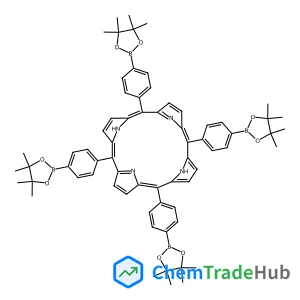
5,10,15,20-tetrakis(4-boronic acid pinacol ester phenyl) porphyrin
CAS番号:
1332748-00-1
分子式:
C68H74B4N4O8
おすすめサプライヤー







免責事項
このページに表示される学術雑誌情報は、参考および研究目的のみを目的としています。当社は雑誌出版社とは提携しておらず、投稿の取り扱いも行っておりません。出版に関するお問い合わせは、各雑誌出版社に直接ご連絡ください。
表示されている情報に誤りがある場合は、support@chemtradehub.com までご連絡ください。迅速に確認し、対応いたします。