












Investigating gas sorption in an rht-metal–organic framework with 1,2,3-triazole groups
文献情報
出版日
2017-10-19
DOI
10.1039/C7CP06128E
インパクトファクター
3.676
著者
Katherine A. Forrest, Tony Pham, Brian Space
原文を見る
要旨
Simulations of CO2 and H2 sorption were performed in an rht-metal–organic framework (MOF) that consists of Cu2+ ions coordinated to 5,5′,5′′-(4,4′,4′′-(benzene-1,3,5-triyl)tris(1H-1,2,3-triazole-4,1-diyl))triisophthalate (BTTI) linkers; it is referred to as Cu–BTTI herein. This MOF was previously synthesized and reported by three different experimental groups [Zhao et al., Sci. Rep., 2013, 3, 1149; Schröder et al., Chem. Sci., 2013, 4, 1731–1736; Hupp et al., Energy Environ. Sci., 2013, 6, 1158–1163]. This MOF is notable for the presence of open-metal sites and nitrogen-rich regions through the copper paddlewheel ([Cu2(O2CR)4]) clusters and 1,2,3-triazole groups, respectively, which allows this material to display remarkable CO2 and H2 sorption properties. All three groups report distinct experimental and theoretical gas sorption results for the MOF. In contrast to the force fields utilized in the aforementioned studies, our simulations include explicit many-body polarization interactions, which was important to reproduce sorption onto the open-metal sites. Simulations using polarizable potentials for the MOF and sorbates generated sorption isotherms and isosteric heat of adsorption (Qst) values that are outstanding agreement with the corresponding experimental data for all three groups; this is in contrast to the theoretical results presented in the respective original references. The simulations carried out in the previous studies often looked reasonable but they missed a key feature of the sorption process that lead to unreliable results. Analysis of the radial distribution function (g(r)) about the open-metal sites and examination of the modeled structure reveal that the CO2 and H2 molecules prefer to sorb onto two unique types of Cu2+ ions that exhibit the highest partial positive charges. Sorption was also observed within the corners of the truncated tetrahedral (T-Td) cages and onto the 1,2,3-triazole groups of the linkers for both sorbates. Overall, this study demonstrates how utilizing a classical polarizable force field led to the reproduction of experimental observables and allowed for an accurate description of the sorption mechanism in this MOF that is an important member of the rht-MOF family.
関連文献
Abnormal separation of the silicon–oxygen bond in the liquid layering transition of silicon dioxide in a nanoslit
Zhichao Wang, Tao Li, Yunrui Duan, Weikang Wu, Zhenyang Zhao, Yao Liu, Hui Li
2018-01-02
Paper
DOI: 10.1039/C7CP06843C
The role of nitric acid in atmospheric new particle formation
Ling Liu, Hao Li, Haijie Zhang, Jie Zhong, Yang Bai, Maofa Ge, Zesheng Li, Yu Chen, Xiuhui Zhang
2018-05-30
Paper
DOI: 10.1039/C8CP02719F
Effect of transition-metal-ion dopants on the oxygen evolution reaction on NiOOH(0001)
Alexander J. Tkalych, John Mark P. Martirez, Emily A. Carter
2018-07-03
Paper
DOI: 10.1039/C8CP02849D
Theoretical evidence of low-threshold amplified spontaneous emission in organic emitters: transition density and intramolecular vibrational mode analysis
Lin Ma, Yue Yu, Bo Jiao, Xun Hou
2018-07-04
Paper
DOI: 10.1039/C8CP01448E
Ethanol synthesis from syngas over Cu(Pd)-doped Fe(100): a systematic theoretical investigation
Wei Wang, Ye Wang
2017-11-13
Paper
DOI: 10.1039/C7CP06693G
Effect of PCL end-groups on the self-assembly process of Pluronic in aqueous media
Natalie Gjerde, Kaizheng Zhu, Bo Nyström, Kenneth D. Knudsen
2018-01-04
Paper
DOI: 10.1039/C7CP07240F
Revisiting the catalytic mechanism of Mo–Cu carbon monoxide dehydrogenase using QM/MM and DFT calculations
Kai Xu, Hajime Hirao
2018-05-10
Paper
DOI: 10.1039/C8CP00858B
Anomalies in the low frequency vibrational density of states for a polymer with intrinsic microporosity – the Boson peak of PIM-1
Reiner Zorn, Huajie Yin, Wiebke Lohstroh, Wayne Harrison, Peter M. Budd, Brian R. Pauw, Martin Böhning, Andreas Schönhals
2017-12-13
Paper
DOI: 10.1039/C7CP07141H
Hierarchical formation of Fe-9eG supramolecular networks via flexible coordination bonds
Chi Zhang, Lei Xie, Yuanqi Ding, Chunxue Yuan, Wei Xu
2018-01-05
Paper
DOI: 10.1039/C7CP08278A
Evolution of the topological properties of two-dimensional group IVA materials and device design‡
2018-01-05
Paper
DOI: 10.1039/C7CP07420D
こちらもおすすめ
化合物よくある質問
環戊烷-1,3-二甲酸甲酯はどのように合成されますか?
環戊烷-1,3-二甲酸甲酯は、環戊烷と塩酸によるヒンデンブルク反応を経由して合成されます。この反応では、環戊烷が塩酸と作用し、1,3-ジカルボキシ基が導入されま...
2435-36-1Dimethyl 1,3-cyclope...
化合物よくある質問
4-メトキシ-1,2,3-スチアゼ-3,5-ジオンとは何ですか?
4-メトキシ-1,2,3-スチアゼ-3,5-ジオンは、CAS番号107843-77-6の化合物で、(E)-ベンジル3-(3,4-ジヒドロキシフェニル) acry...
107843-77-6(E)-Benzyl 3-(3,4-di...
化合物よくある質問
プロスタグランジンA2について「に適用される法規ガイドラインは何ですか?'
プロスタグランジンA2 (CAS番号: 41691-92-3) は、化学物質の安全管理に関する規制として、GHS (危険物質の国際的ハザード分類・ラベル付けシス...
41691-92-316,16-DIMETHYL PROST...
化合物よくある質問
4-アミノ-1-ナフタレン sulfonic 酸についての物理化学的性質は何ですか?
4-アミノ-1-ナフタレン sulfonic 酸のCAS番号は84-86-6です。この化合物は結晶性で、分子量は212.15 g/molです。アルコールや水など...
84-86-64-Amino-1-naphthalen...
化合物よくある質問
N-GlcNAc-生物素を取り扱う際の実験室安全事項は何ですか?
N-GlcNAc-生物素は吸収性があり、皮膚や目への接触を避けることが重要です。PPE(個体保護具)は使用し、ドラフトチャンバーは必要に応じて使用します。漏洩時...
1272755-69-72-Acetamido-2-deoxy-...
化合物よくある質問
3-アミノメチルフローラノピペリジン-1-カルボニル酸テルブチルエステルとは何ですか?
CAS番号1209781-11-2の3-アミノメチルフローラノピペリジン-1-カルボニル酸テルブチルエステルは、有機化合物の一種で、化学式はC10H17FNO3...
1209781-11-22-Methyl-2-propanyl ...
化合物よくある質問
6-溴-1-甲基-1H-ベンゾ[d][1,2,3]三氮唑はどのように合成されますか?
6- bromo-1-methyl-1H-benzotriazoleは、ブロモフリオリンと1-メチル-1H-ベンゾ[d][1,2,3]三氮唑の反応により合成され...
944718-32-56-Bromo-1-methyl-1H-...
化合物よくある質問
4-硫代尿苷はどのように合成されますか?
4-硫代尿苷は、尿素とD-リボシルヒドロキシアルデヒドを用いてスルホン化反応を経て合成されます。通常は塩酸ヒドロキシチオニルスルホン酸などの触媒を使用し、選択性...
6741-73-71-(4-thio-beta-D-rib...
化合物よくある質問
ブレインナトリユリックペプチド32ラットとは何ですか?
ブレインナトリユリックペプチド32ラット(CAS番号: 133448-20-1)は、心臓で作られるホルモンの一つで、心不全の診断や予後評価に使用されます。
133448-20-1Brain Natriuretic Pe...
化合物よくある質問
1-(3-氮杂啶)-4-羟基哌啶双盐酸盐の物理化学的性質は何ですか?
CAS番号810680-60-5の1-(3-氮杂啶)-4-羟基哌啶双盐酸盐は、白色の結晶性粉末である。分子量は360.84 g/molで、水に溶けやすい。反応活...
810680-60-51-(3-Azetidinyl)-4-p...
掲載誌
Physical Chemistry Chemical Physics

CiteScore:
5.5
自己引用率:
10.3%
年間論文数:
3036
Physical Chemistry Chemical Physics (PCCP) is an international journal co-owned by 19 physical chemistry and physics societies from around the world. This journal publishes original, cutting-edge research in physical chemistry, chemical physics and biophysical chemistry. To be suitable for publication in PCCP, articles must include significant innovation and/or insight into physical chemistry; this is the most important criterion that reviewers and Editors will judge against when evaluating submissions. The journal has a broad scope and welcomes contributions spanning experiment, theory, computation and data science. Topical coverage includes spectroscopy, dynamics, kinetics, statistical mechanics, thermodynamics, electrochemistry, catalysis, surface science, quantum mechanics, quantum computing and machine learning. Interdisciplinary research areas such as polymers and soft matter, materials, nanoscience, energy, surfaces/interfaces, and biophysical chemistry are welcomed if they demonstrate significant innovation and/or insight into physical chemistry. Joined experimental/theoretical studies are particularly appreciated when complementary and based on up-to-date approaches.
おすすめ化合物
![N-[(5,6-Dichloro-1H-benzimidazol-2-yl)methyl]-9-(1-methyl-1H-pyrazol-4-yl)-2-(4-morpholinyl)-9H-purin-6-amine structure](https://static.chemtradehub.com/structs/238/2387704-62-1-25f4.webp "N-[(5,6-Dichloro-1H-benzimidazol-2-yl)methyl]-9-(1-methyl-1H-pyrazol-4-yl)-2-(4-morpholinyl)-9H-purin-6-amine structure")
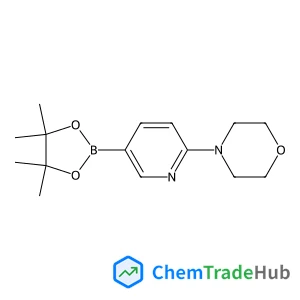
4-(5-(4,4,5,5-tetramethyl-1,3,2-dioxaborolan-2-yl)pyridin-2-yl)morpholine
CAS番号:
485799-04-0
分子式:
C15H23BN2O3
おすすめサプライヤー







免責事項
このページに表示される学術雑誌情報は、参考および研究目的のみを目的としています。当社は雑誌出版社とは提携しておらず、投稿の取り扱いも行っておりません。出版に関するお問い合わせは、各雑誌出版社に直接ご連絡ください。
表示されている情報に誤りがある場合は、support@chemtradehub.com までご連絡ください。迅速に確認し、対応いたします。