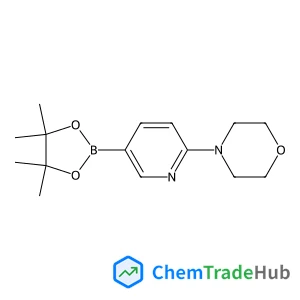
4-(5-(4,4,5,5-tetramethyl-1,3,2-dioxaborolan-2-yl)pyridin-2-yl)morpholine
CAS番号:
485799-04-0
分子式:
C15H23BN2O3
Ricardo D. S. Santos, Marcos V. dos S. Rezende
A systematic theoretical study was performed on trivalent and divalent rare-earth (RE) dopant ions in the LiSrPO4 structure, using atomistic simulations based on lattice energy minimization. It was found that RE3+ and RE2+ ions are most energetically favorable for incorporation at the Sr site. For RE3+ ion incorporation, charge compensation by vacancies or anti-site defects are both probable. In order to investigate the reduction–doping process (Europium reduction), two schemes (open atmosphere and H2 reducing atmosphere) were considered. A H2 reduction atmosphere was found to be the most effective agent for Eu reduction. Results reveal that the most probable charge compensation mechanism and the host site preference for rare-earth doping ions play important roles in the investigation of the mechanism of the luminescence properties of LiSrPO4.

Journal of Heterocyclic Chemistry

Kinetics and Catalysis

Proceedings of the National Academy of Sciences of the United States of America

Fibre Chemistry

Science Progress

Planta Medica

Journal of Medicinal Chemistry

Organic Preparations and Procedures International

Journal of Organometallic Chemistry

Pharmacological Reviews
R. Bohinc, J. Hoszowska, J.-Cl. Dousse, W. Błachucki, F. Zeeshan, Y. Kayser, M. Nachtegaal, A. B. Pinar
DOI: 10.1039/C7CP05001A
Benjamin Bouvier, Christine Cézard
DOI: 10.1039/C7CP04529H
Charuni M. Gunathunge, Vincent J. Ovalle, Matthias M. Waegele
DOI: 10.1039/C7CP06087D
L. Silva-Dias, A. López-Castillo
DOI: 10.1039/C7CP04674J
J. Alberto Rodríguez-Velamazán, Olivier Roubeau, Roberta Poloni, Elsa Lhotel, Elías Palacios, Miguel A. González, José A. Real
DOI: 10.1039/C7CP06310E
Shirui Luo, Jarrod Schiffbauer
DOI: 10.1039/C7CP05905A
DOI: 10.1039/C7CP06386E
Nikoleta Kotsina
DOI: 10.1039/C7CP05426B
Mikhail A. Grin, Marina A. Zakharko, Dmitriy A. Pritmov, Andrey F. Mironov, Antonina N. Arkhipova, Yuri V. Fedorov, Gediminas Jonusauskas, Raisa I. Yakubovskaya, Natalia B. Morozova
DOI: 10.1039/C7CP04449F
環戊烷-1,3-二甲酸甲酯は、環戊烷と塩酸によるヒンデンブルク反応を経由して合成されます。この反応では、環戊烷が塩酸と作用し、1,3-ジカルボキシ基が導入されま...
4-メトキシ-1,2,3-スチアゼ-3,5-ジオンは、CAS番号107843-77-6の化合物で、(E)-ベンジル3-(3,4-ジヒドロキシフェニル) acry...
プロスタグランジンA2 (CAS番号: 41691-92-3) は、化学物質の安全管理に関する規制として、GHS (危険物質の国際的ハザード分類・ラベル付けシス...
4-アミノ-1-ナフタレン sulfonic 酸のCAS番号は84-86-6です。この化合物は結晶性で、分子量は212.15 g/molです。アルコールや水など...
N-GlcNAc-生物素は吸収性があり、皮膚や目への接触を避けることが重要です。PPE(個体保護具)は使用し、ドラフトチャンバーは必要に応じて使用します。漏洩時...
CAS番号1209781-11-2の3-アミノメチルフローラノピペリジン-1-カルボニル酸テルブチルエステルは、有機化合物の一種で、化学式はC10H17FNO3...
6- bromo-1-methyl-1H-benzotriazoleは、ブロモフリオリンと1-メチル-1H-ベンゾ[d][1,2,3]三氮唑の反応により合成され...
4-硫代尿苷は、尿素とD-リボシルヒドロキシアルデヒドを用いてスルホン化反応を経て合成されます。通常は塩酸ヒドロキシチオニルスルホン酸などの触媒を使用し、選択性...
ブレインナトリユリックペプチド32ラット(CAS番号: 133448-20-1)は、心臓で作られるホルモンの一つで、心不全の診断や予後評価に使用されます。
CAS番号810680-60-5の1-(3-氮杂啶)-4-羟基哌啶双盐酸盐は、白色の結晶性粉末である。分子量は360.84 g/molで、水に溶けやすい。反応活...

Physical Chemistry Chemical Physics (PCCP) is an international journal co-owned by 19 physical chemistry and physics societies from around the world. This journal publishes original, cutting-edge research in physical chemistry, chemical physics and biophysical chemistry. To be suitable for publication in PCCP, articles must include significant innovation and/or insight into physical chemistry; this is the most important criterion that reviewers and Editors will judge against when evaluating submissions. The journal has a broad scope and welcomes contributions spanning experiment, theory, computation and data science. Topical coverage includes spectroscopy, dynamics, kinetics, statistical mechanics, thermodynamics, electrochemistry, catalysis, surface science, quantum mechanics, quantum computing and machine learning. Interdisciplinary research areas such as polymers and soft matter, materials, nanoscience, energy, surfaces/interfaces, and biophysical chemistry are welcomed if they demonstrate significant innovation and/or insight into physical chemistry. Joined experimental/theoretical studies are particularly appreciated when complementary and based on up-to-date approaches.
![N-[(5,6-Dichloro-1H-benzimidazol-2-yl)methyl]-9-(1-methyl-1H-pyrazol-4-yl)-2-(4-morpholinyl)-9H-purin-6-amine structure](https://static.chemtradehub.com/structs/238/2387704-62-1-25f4.webp "N-[(5,6-Dichloro-1H-benzimidazol-2-yl)methyl]-9-(1-methyl-1H-pyrazol-4-yl)-2-(4-morpholinyl)-9H-purin-6-amine structure")