












Novel benzodithiophene-based polymer acceptors for efficient organic solar cells
文献情報
出版日
2017-08-08
DOI
10.1039/C7CP04372D
インパクトファクター
3.676
著者
Quan-Song Li, Ze-Sheng Li
原文を見る
要旨
All polymer organic solar cells afford unique potentials due to the tunable chemical and electronic properties of both polymer donors and polymer acceptors. Compared with the rapid development of polymer donors, the development of polymer acceptors lags far behind. To seek high-performance polymer acceptors used in organic solar cells, based on the experimentally reported D–A polymer acceptor (NDI2OD-T2)n (P1), a series of novel acceptors, designated as (BDTNDI2OD-T2)n(P2), (BDTNDTI)n(P3), (BDTNDI2OD-Tz2)n(P4), and (BDTNDTzI)n(P5), were designed by introduction of a benzodithiophene (BDT) unit and the nitrogen atom in the bridged thiophene ring. The density functional theory (DFT) and time-dependent density functional theory (TDDFT) methods were applied to study the effect of the BDT unit and the nitrogen atom on the geometrical, optical, electronic, and charge transport properties. The obtained results show that incorporation of the electron-donating BDT unit into P1 and the replacement of a carbon atom by the nitrogen atom in the bridged thiophene ring are effective strategies to lower the lowest unoccupied molecular orbital (LUMO) energy and exciton binding energy, and enhance light-absorbing capacity and electron mobility. Moreover, among the investigated molecules, P2 and P5 exhibit stronger and broader light absorption, higher light absorption efficiency and exciton separation ability as well as electron mobility; therefore they are recommended as promising polymer acceptors for future high-efficiency organic solar cells.
関連文献
Thermosensitive spontaneous gradient copolymers with block- and gradient-like features
Ihor Kulai, Jens Ulbrich, Ramiro Guerrero-Santos, Mathias Destarac, Simon Harrisson
2017-04-19
Paper
DOI: 10.1039/C7PY00495H
Selective solvent-induced reconstruction in confined space: one-dimensional mesoporous block copolymer structures in cylindrical nanopores
Chun-Wei Chang, Mu-Huan Chi, Hao-Wen Ko, Chien-Wei Chu, Zhi-Xuan Fang, Yi-Hsuan Tu, Jiun-Tai Chen
2017-05-10
Communication
DOI: 10.1039/C7PY00579B
Surface-initiated polymerization-induced self-assembly of bimodal polymer-grafted silica nanoparticles towards hybrid assemblies in one step
Yang Zheng, Yucheng Huang, Zaid M. Abbas, Brian C. Benicewicz
2016-08-15
Communication
DOI: 10.1039/C6PY01319H
Stereochemical effects on the mechanical and viscoelastic properties of renewable polyurethanes derived from isohexides and hydroxymethylfurfural
Robert J. Kieber, III, Samantha A. Silver, Justin G. Kennemur
2017-07-24
Paper
DOI: 10.1039/C7PY00949F
Formation of polyoxazoline-silica nanoparticles via the surface-initiated cationic polymerization of 2-methyl-2-oxazoline
G. Bissadi, R. Weberskirch
2016-07-22
Paper
DOI: 10.1039/C6PY01034B
Mussel-inspired multifunctional supramolecular hydrogels with self-healing, shape memory and adhesive properties
Wei Lu, To Ngai, Xiaoxia Le, Jing Zheng, Ning Zhao, Youju Huang, Xiufang Wen, Jiawei Zhang, Tao Chen
2016-08-04
Communication
DOI: 10.1039/C6PY01112H
Photoresponsive liquid crystalline polymer single-chain nanoparticles
Weizheng Fan, Xia Tong, Guo Li, Yue Zhao
2017-05-09
Paper
DOI: 10.1039/C7PY00668C
Well-defined triblock copolymers of polyethylene with polycaprolactone or polystyrene using a novel difunctional polyhomologation initiator
Reem A. Alshumrani, Nikos Hadjichristidis
2017-08-04
Paper
DOI: 10.1039/C7PY01079F
Enhanced stability of conductive polyacetylene in ladder-like surface-grafted brushes
Michał Szuwarzyński, Karol Wolski, Szczepan Zapotoczny
2016-08-22
Paper
DOI: 10.1039/C6PY00977H
A three-dimensional porphyrin-based porous organic polymer with excellent biomimetic catalytic performance
Wei Zhu, Zheng-Dong Ding, Xuan Wang, Tao Li, Rui Shen, Yunxing Li, Zaijun Li, Xuehong Ren, Zhi-Guo Gu
2017-07-05
Communication
DOI: 10.1039/C7PY00876G
こちらもおすすめ
28770-01-62-(2-Isopropyl-1,3-o...
化合物よくある質問
「邻羟基阿托伐他汀内酯标准品」に適用される法規ガイドelinesは何ですか?
CAS番号163217-74-1の「邻羟基阿托伐他汀内酯标准品」は、GHS分類では危険物に分類されず、主にREACH規則とFDA/EPAの管理対象となります。R...
163217-74-1ortho-Hydroxy Atorva...
化合物よくある質問
メチル(3R)-3-アミノ-2,3-ジヒドロ-1-ベンゾファンラニン-5-カルボイル酸塩塩酸塩の主な用途は何ですか?
メチル(3R)-3-アミノ-2,3-ジヒドロ-1-ベンゾファンラニン-5-カルボイル酸塩塩酸塩は、医薬品や合成化学の研究に広く用いられます。また、特定の薬物の前...
2241594-15-8Methyl (3R)-3-amino-...
化合物よくある質問
トランス-4-メチルピロリジン-3-オール塩酸塩はどのように合成されますか?
トランス-4-メチルピロリジン-3-オール塩酸塩は、4-メチルピロリジンの塩酸塩化によって合成されます。一般的な合成方法では、4-メチルピロリジンを塩酸に加えて...
265108-42-7trans-4-Methylpyrrol...
化合物よくある質問
硫雜環丁烷-1,1-二氧化物は安全ですか?
硫雜環丁烷-1,1-二氧化物は安全ではありません。毒性は報告されていませんが、高温下で分解し、可燃性があるため、高圧ガスは注意が必要です。密閉した容器で保管し、...
5687-92-3Thietane 1,1-dioxide
6054-10-02H, 8H-Benzo[1,2-b
化合物よくある質問
9-ヒドロキシエリプチシネ塩酸塩はどのように合成されますか?
9-ヒドロキシエリプチシネ塩酸塩は、エリプチシネから塩酸を添加することで合成されます。選択性は高いですが、収率は約70%です。
52238-35-49-Hydroxyellipticine...
化合物よくある質問
5-塩素-2-(メチルアミノ)フェニル-(2-塩素フェニル)メタン酮の物理化学的性質は何ですか?
5-塩素-2-(メチルアミノ)フェニル-(2-塩素フェニル)メタン酮のCAS番号は5621-86-3です。この化合物は白色の結晶性粉末で、分子量は415.03で...
5621-86-3[5-Chloro-2-(methyla...
化合物よくある質問
1-[2-(4-甲氧基-苯氧基)-乙基]-哌嗪はどのように保存すればよいですか?
1-[2-(4-甲氧基-苯氧基)-乙基]-哌嗪は、直射日光を避けて暗所に、室温(15-25℃)で保管し、密閉容器に入れることで安定性を保つことができます。
117132-44-21-[2-(4-Methoxy-phen...
化合物よくある質問
2-[3-(4-甲氧基フェニル)プロピル]-4,4,5,5-四メチル-1,3,2-ドイボロロールアンの主な用途は何ですか?
2-[3-(4-甲氧基フェニル)プロピル]-4,4,5,5-四メチル-1,3,2-ドイボロロールアンは、医薬品の合成、有機合成化学、および新材料の研究で使用され...
1073371-72-82-[3-(4-Methoxypheny...
掲載誌
Physical Chemistry Chemical Physics

CiteScore:
5.5
自己引用率:
10.3%
年間論文数:
3036
Physical Chemistry Chemical Physics (PCCP) is an international journal co-owned by 19 physical chemistry and physics societies from around the world. This journal publishes original, cutting-edge research in physical chemistry, chemical physics and biophysical chemistry. To be suitable for publication in PCCP, articles must include significant innovation and/or insight into physical chemistry; this is the most important criterion that reviewers and Editors will judge against when evaluating submissions. The journal has a broad scope and welcomes contributions spanning experiment, theory, computation and data science. Topical coverage includes spectroscopy, dynamics, kinetics, statistical mechanics, thermodynamics, electrochemistry, catalysis, surface science, quantum mechanics, quantum computing and machine learning. Interdisciplinary research areas such as polymers and soft matter, materials, nanoscience, energy, surfaces/interfaces, and biophysical chemistry are welcomed if they demonstrate significant innovation and/or insight into physical chemistry. Joined experimental/theoretical studies are particularly appreciated when complementary and based on up-to-date approaches.
おすすめ化合物
![1-[(4-Methylphenyl)sulfonyl]-3-(4,4,5,5-tetramethyl-1,3,2-dioxaborolan-2-yl)-1H-pyrrolo[2,3-b]pyridine-5-carbonitrile structure](https://static.chemtradehub.com/structs/143/1434747-57-5-fc0d.webp "1-[(4-Methylphenyl)sulfonyl]-3-(4,4,5,5-tetramethyl-1,3,2-dioxaborolan-2-yl)-1H-pyrrolo[2,3-b]pyridine-5-carbonitrile structure")
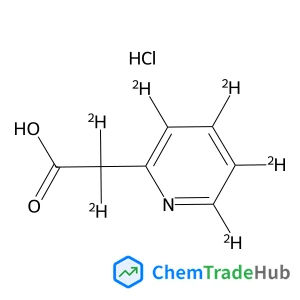
2,2-dideuterio-2-(3,4,5,6-tetradeuterio-2-pyridyl)acetic acid;hydrochloride
CAS番号:
1329799-67-8
分子式:
C7H2ClD6NO2
おすすめサプライヤー



免責事項
このページに表示される学術雑誌情報は、参考および研究目的のみを目的としています。当社は雑誌出版社とは提携しておらず、投稿の取り扱いも行っておりません。出版に関するお問い合わせは、各雑誌出版社に直接ご連絡ください。
表示されている情報に誤りがある場合は、support@chemtradehub.com までご連絡ください。迅速に確認し、対応いたします。