












Unveiling universal trends for the energy level alignment in organic/oxide interfaces
文献情報
出版日
2017-08-08
DOI
10.1039/C7CP03853D
インパクトファクター
3.676
著者
José I. Martínez, Fernando Flores, José Ortega, Sylvie Rangan, Charles M. Ruggieri, Robert A. Bartynski
原文を見る
要旨
In this perspective we present a comprehensive analysis of the energy level alignment at the interface between an organic monolayer (organic = perylenetetracarboxylic dianhydride, PTCDA, zinc tetraphenylporphyrin, Zn-TPP, and tetracyanoquinodimethane, TCNQ) and a prototypical oxide surface, TiO2(110), looking for universal behaviours. PTCDA shows a physisorbed interaction with TiO2 and a small interface dipole potential with its highest occupied molecular orbital (HOMO) energy level located in the oxide energy gap and the lowest occupied molecular orbital (LUMO) energy level located above the oxide conduction band minimum, EC. We analyse how the interface barrier depends on an external bias potential between the organic layer and the oxide surface, Δ, and find for this interface that the screening parameter S = d|(EC − HOMO)|dΔ is close to 1. In the second case, the Zn-TPP monolayer shows a moderate chemisorbed interaction with some charge transfer from the molecule to the oxide and a significant interface dipole potential, in such a way that S decreases to around 0.8. In the TCNQ/TiO2(110) case, the TCNQ molecules present a strong chemical interaction with the oxide; the LUMO energy level is located in the oxide energy gap in such a way that one electron is transferred from the oxide to the organic molecule; we also find that in this case S ≈ 0.5. All these cases can be integrated within a universal behaviour when (EC − HOMO) is calculated as a function of Δ; that function presents a zig-zag curve with a central part having an S-slope, and two plateaus associated with either the LUMO or the HOMO energy levels crossing the oxide Fermi level. In these plateaus, a Coulomb blockade regime arises and a pace charge layer develops in the oxide surface.
関連文献
Direct planting of ultrafine MoO2+δ nanoparticles in carbon nanofibers by electrospinning: self-supported mats as binder-free and long-life anodes for lithium-ion batteries
Xiaoxiao Liu, Henghui Xu, Yunhui Huang, Xianluo Hu
2016-06-27
Paper
DOI: 10.1039/C6CP01806H
Adsorption and interaction of CO2 on rutile TiO2(110) surfaces: a combined UHV-FTIRS and theoretical simulation study
Yunjun Cao, Shujun Hu, Min Yu, Shishen Yan, Mingchun Xu
2015-08-18
Paper
DOI: 10.1039/C5CP04013B
Strong electric fields at a prototypical oxide/water interface probed by ab initio molecular dynamics: MgO(001)
Sara Laporte, Fabio Finocchi, Lorenzo Paulatto, Marc Blanchard, Etienne Balan, François Guyot, Antonino Marco Saitta
2015-07-13
Paper
DOI: 10.1039/C5CP02097B
Energy landscapes of a hairpin peptide including NMR chemical shift restraints
Joanne M. Carr, Chris S. Whittleston, David C. Wade, David J. Wales
2015-07-17
Paper
DOI: 10.1039/C5CP01259G
Exploring the core level shift origin of sulfur and thiolates on Pd(111) surfaces
Roberto Carlos Salvarezza, Pilar Carro
2015-08-03
Paper
DOI: 10.1039/C5CP04180E
Solving local structure around dopants in metal nanoparticles with ab initio modeling of X-ray absorption near edge structure
Janis Timoshenko, Atal Shivhare, Robert W. J. Scott, Deyu Lu, Anatoly I. Frenkel
2016-06-30
Paper
DOI: 10.1039/C6CP04030F
Nanostructured water and carbon dioxide inside collapsing carbon nanotubes at high pressure
Wenwen Cui, Alfonso San-Miguel
2016-06-27
Paper
DOI: 10.1039/C6CP03263J
Correction: A novel benzoxazine/cyanate ester blend with sea-island phase structures
Xiaoyong Luo, Yi Gu
2015-07-17
Correction
DOI: 10.1039/C5CP90128F
こちらもおすすめ
化合物よくある質問
間溴苯甲酰腈の市場動向や研究トレンドはどうですか?
間 brom 苯甲酰腈は、合成化学や薬物化学において重要な Intermediate として使用されています。市場動向としては、その合成性と機能性により、研究開...
24999-51-7(3-Bromophenyl)(oxo)...
287966-62-5Desulfo Glucoraphani...
化合物よくある質問
Methyl 2-amino-5-(trifluoromethyl)benzoateに適用される法規ガイドラインは何ですか?
CAS番号117324-58-0の塩酸メチル2アミノ-5-トリフルオロメチルベンゼートは、GHS分類により腐食性物質と判定されます。REACH規則では、製造、販...
117324-58-0Methyl 2-amino-5-(tr...
化合物よくある質問
3-ブロモ-1,3,4,5-四水化-2H-1-ベンザアゼピン-2-オンは安全ですか?
毒性があるため、適切な安全対策が必須です。皮膚や粘膜への刺激性が強く、吸入や誤飲により健康被害を引き起こす可能性があります。取扱時にはガスマスクや手袋、眼鏡を使...
86499-96-93-Bromo-1,3,4,5-tetr...
化合物よくある質問
三氟甲基ピリジン-2-甲アミン塩酸塩は安全ですか?
三氟甲基ピリジン-2-甲アミン塩酸塩は安全性に注意が必要です。毒性は低レベルですが、直接的接触や吸入は避けるべきです。適切な手袋や防塵マスクを着用し、密閉された...
871826-12-9(5-(Trifluoromethyl)...
化合物よくある質問
1-エチル-4-(4-硝基フェニル)ピペリジンは安全ですか?
1-エチル-4-(4-硝基フェニル)ピペリジンは有毒であり、取扱には注意が必要です。保管や作業中に手袋を着用し、目や皮膚に接触しないように注意する必要があります...
115619-00-61-Ethyl-4-(4-nitroph...
化合物よくある質問
1,1-ジメトキシプロパン-2-オンは安全ですか?
1,1-ジメトキシプロパン-2-オンは一般的に低毒性ですが、皮膚や目への刺激性があるため、取扱いには注意が必要です。蒸気や液体の吸入には有害な可能性があり、適切...
6342-56-91,1-dimethoxypropan-...
化合物よくある質問
コバルト(II) 3,3'-{[(1S,2S)-1,2-ジメチルフENCYCLICALE-1,2-エチエンジイル]ビス[ニトロリルメチルイリデン]}ビス[4-オキソ-2-ペンテン-2-olate]について「に適用される法規ガイドラインは何ですか?
この化合物はCAS番号259259-80-8に対応しています。GHS分類では、毒性、燃焼性、反応性、炎症性を考慮に入れ、適切な危険性分類が行われます。REACH...
259259-80-8Cobalt(2+) (2E,2'E)-...
化合物よくある質問
「カーバミル酸, N-[8-[[2-[[2-(2,6-ジオキソ-3-ピペリジニル)-2,3-ジオキソ-1,3-ジヒドロ-1H-イソイソインドール-4-イルオキシ]アセチル]アミノ]オクチル]-1,1-ジメチレチルエステル」はどのように保存すればよいですか?
この化合物は、冷却庫で-20℃の温度、乾燥した容器に保管し、直日光から保護する必要があります。湿度の高い環境や高温は避けてください。
1950635-34-32-Methyl-2-propanyl ...
1433975-21-3FMoc-D-4-Aph(tBu-CbM...
掲載誌
Physical Chemistry Chemical Physics

CiteScore:
5.5
自己引用率:
10.3%
年間論文数:
3036
Physical Chemistry Chemical Physics (PCCP) is an international journal co-owned by 19 physical chemistry and physics societies from around the world. This journal publishes original, cutting-edge research in physical chemistry, chemical physics and biophysical chemistry. To be suitable for publication in PCCP, articles must include significant innovation and/or insight into physical chemistry; this is the most important criterion that reviewers and Editors will judge against when evaluating submissions. The journal has a broad scope and welcomes contributions spanning experiment, theory, computation and data science. Topical coverage includes spectroscopy, dynamics, kinetics, statistical mechanics, thermodynamics, electrochemistry, catalysis, surface science, quantum mechanics, quantum computing and machine learning. Interdisciplinary research areas such as polymers and soft matter, materials, nanoscience, energy, surfaces/interfaces, and biophysical chemistry are welcomed if they demonstrate significant innovation and/or insight into physical chemistry. Joined experimental/theoretical studies are particularly appreciated when complementary and based on up-to-date approaches.
おすすめ化合物
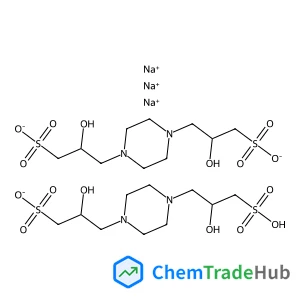
3,3'-(Piperazine-1,4-diyl)bis(2-hydroxypropane-1-sulfonic acid) Sodium Salt
CAS番号:
108321-08-0
分子式:
C20H41N4Na3O16S4
![O-Benzyl-N-[(9H-fluoren-9-ylmethoxy)carbonyl]-N-methyl-L-threonine structure](https://static.chemtradehub.com/structs/198/198561-81-8-a56e.webp "O-Benzyl-N-[(9H-fluoren-9-ylmethoxy)carbonyl]-N-methyl-L-threonine structure")
おすすめサプライヤー





免責事項
このページに表示される学術雑誌情報は、参考および研究目的のみを目的としています。当社は雑誌出版社とは提携しておらず、投稿の取り扱いも行っておりません。出版に関するお問い合わせは、各雑誌出版社に直接ご連絡ください。
表示されている情報に誤りがある場合は、support@chemtradehub.com までご連絡ください。迅速に確認し、対応いたします。