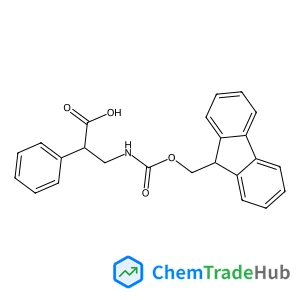
(S)-3-((((9H-Fluoren-9-yl)methoxy)carbonyl)amino)-2-phenylpropanoic acid
CAS番号:
1217663-60-9
分子式:
C24H21NO4
Margarita Albertí, Anna Amat, Antonio Aguilar, Fernando Pirani
The present paper focuses on the characterization of the properties of methanol and water molecules in gas and liquid environments. A force field for methanol–methanol and methanol–water interactions, useful to be applied in Molecular Dynamics (MD) simulations, is proposed. The electrostatic interaction contributions, arising from permanent charge and/or from anisotropic charge distributions originating from permanent electric multipoles (Vel), different in gas and in liquid phases, are combined with the non electrostatic ones (Vnel), defined by means of Improved Lennard-Jones (ILJ) functions [F. Pirani et al., Phys. Chem. Chem. Phys., 2008, 10, 5489–5503]. Interestingly, the relevant parameters of the ILJ functions are not fitted to reproduce the selected properties of the systems but calculated from the molecular polarizability, which is considered the key property to define size (or Pauli) repulsion and dispersion and induction attractions. The constructed force field predicts binding energies and geometries of the methanol–methanol and methanol–water dimers, in good agreement with available data. On the other hand, several bulk and structural properties of liquid methanol, such as densities, vaporization enthalpies, diffusion coefficients, coefficients of cubic thermal expansion, heat capacities at constant pressure and some relevant radial distribution functions, calculated considering 2744 molecules and different conditions of pressure and temperature, have also been found to be in good agreement with experimental data. The study has been completed by calculating the density values at 298 K and 1 bar of some methanol–water mixtures, which have also been found to be in good agreement with experimental data.

Biocatalysis and Biotransformation

Journal of Chemical Sciences

Polycyclic Aromatic Compounds

NDT & E International

Heteroatom Chemistry

Acta Metallurgica Sinica-English Letters

Bioorganic & Medicinal Chemistry Letters

Topics in Catalysis

Critical Reviews in Solid State and Materials Sciences

Herald of the Russian Academy of Sciences
Katlin Ivon Barrios Eguiluz, Giancarlo Richard Salazar-Banda, Maribel Elizabeth Funes-Huacca, Juliana Vieira Alberice, Emanuel Carrilho, Sergio Antonio Spinola Machado, Luis Alberto Avaca
DOI: 10.1039/B809080G
Qing Wang, Xiaohai Yang, Kemin Wang, Weihong Tan, Jun Gou
DOI: 10.1039/B803239D
Kadir Aslan, Chris D. Geddes
DOI: 10.1039/B808292H
Hao Xu, Jun Peng, Hong-Wu Tang, Ying Li, Qiong-Shui Wu, Zhi-Ling Zhang, Gang Zhou, Chuang Chen, Yan Li
DOI: 10.1039/B807251E
D. Ruhlig, H. Gugel, A. Schulte, W. Theisen, W. Schuhmann
DOI: 10.1039/B804718A
Takashi Suzuki, Hirohito Ueno, Junichi Nemoto, Yuki Fujii, Mikio Hoshino, Masao Kaneko
DOI: 10.1039/B822512E
Arunas Ramanavicius, Almira Ramanaviciene
DOI: 10.1039/B801501E
Monique Sigaud, Olivier Vittori, Naim Ouaini
DOI: 10.1039/B811629F
Florence Draux, Pierre Jeannesson, Abdelilah Beljebbar, Ali Tfayli, Nicolas Fourre, Michel Manfait, Josep Sulé-Suso, Ganesh D. Sockalingum
DOI: 10.1039/B812610K
6- bromo-1-cyclopropyl-1H-benzimidazoleは、抗炎症、抗ウイルス作用を持つことが報告されており、新薬開発の研究対象として注目...
取り扱う際には、防護眼鏡と手袋を使用し、ドラフトチャンバー内で操作することを推奨します。漏洩時には適切な手順で処理し、安全データシートを常に参照してください。
2,2’-ジメチル-3,3’-ビピリジンは、ピリジンと2-メチルアクリルアミドを有機合成反応で合成します。この反応では、ピリジンと2-メチルアクリルアミドを含有...
6-甲基ピリジン-2-ボリック酸は、合成化学、医薬品合成、以及研究用途などに広く使用され、特に組換えDNA技術や分子生物学の研究において重要な役割を果たします。
(R)-3-(1-甲基-2-氧環己基)プロpano酸メチルは一定の安全性がありますが、直接的な皮膚接触や吸入は避けるべきです。使用する際は適切な個々の安全データ...
ketorolacは、密封して遮光容器に保管し、直射日光や高温を避けて保存してください。温度は常温で保存し、湿度をなるべく低く保つことが推奨されます。
L-2,3-二氨基丙酸二盐酸盐は腐食性が強く、皮膚や粘膜に刺激を与える可能性があります。取り扱う際は、防塵マスク、ゴーグル、手袋を使用し、適切な排気設備を使用し...
2-(4-溴ピリジン-2-基)乙腈のCAS番号は312325-73-8です。主に結晶形態で存在し、分子量は159.01 g/molです。この化合物は水に溶けやす...
この化合物は毒性は低いですが、直接的な接触や吸入に注意が必要です。PPE(個人防護具)を着用し、ドラフトチャンバーを使用して操作することを推奨します。また、漏洩...
3-(1-氧代-1,3-二氢-2H-2-异吲哚)丙酸は、薬理学研究や医薬品製造において広く用いられる化合物です。また、工業的な用途でも一部の化学反応の触媒や助剤...

Physical Chemistry Chemical Physics (PCCP) is an international journal co-owned by 19 physical chemistry and physics societies from around the world. This journal publishes original, cutting-edge research in physical chemistry, chemical physics and biophysical chemistry. To be suitable for publication in PCCP, articles must include significant innovation and/or insight into physical chemistry; this is the most important criterion that reviewers and Editors will judge against when evaluating submissions. The journal has a broad scope and welcomes contributions spanning experiment, theory, computation and data science. Topical coverage includes spectroscopy, dynamics, kinetics, statistical mechanics, thermodynamics, electrochemistry, catalysis, surface science, quantum mechanics, quantum computing and machine learning. Interdisciplinary research areas such as polymers and soft matter, materials, nanoscience, energy, surfaces/interfaces, and biophysical chemistry are welcomed if they demonstrate significant innovation and/or insight into physical chemistry. Joined experimental/theoretical studies are particularly appreciated when complementary and based on up-to-date approaches.