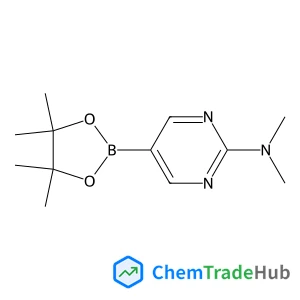
N,N-Dimethyl-5-(4,4,5,5-tetramethyl-1,3,2-dioxaborolan-2-yl)-2-pyrimidinamine
CAS番号:
1032759-30-0
分子式:
C12H20BN3O2
High pressure and nanoscopic confinement are two different strategies commonly employed to modify the physicochemical properties of various materials. Both strategies act mostly by changing the molecular packing. In this work, we performed a comparative study on the effect of compression and confined geometry on crystallization of a molecular liquid. Dielectric spectroscopy was employed to investigate the crystallization of the van der Waals liquid, dimethyl phthalate, in nanoporous alumina of different pore sizes as well as on increased pressure (up to 200 MPa). The analysis of the crystallization kinetics under varying thermodynamic conditions revealed that both strategies affect the crystallization behavior of the sample in very distinct ways. Compression shifts the maximum crystallization rate towards a higher temperature and broadens it. As a result, it is more challenging to avoid crystallization upon cooling the liquid at high pressure. In contrast, when the same material is incorporated into nanopores, crystallization significantly slows down and the maximum rate shifts towards a lower temperature with decreasing pore size. Finally, we show that crystallization in nanoporous alumina is accompanied by pre-crystallization effects upon which a shift of the α-relaxation peak is observed. An equilibration process prior to the initiation of crystallization was detected for the confined material both above and below the glass transition temperature of the interfacial layer, while not in the bulk.

Israel Journal of Chemistry

Science

Science Progress

European Journal of Wood and Wood Products

Journal of Heterocyclic Chemistry

Russian Chemical Reviews

Planta Medica

Organic Preparations and Procedures International

Proceedings of the National Academy of Sciences of the United States of America

Journal of Medicinal Chemistry
Bo-Sheng Zhang, Hui-Liang Hua, Lu-Yao Gao, Ce Liu, Yi-Feng Qiu, Ping-Xin Zhou, Zhao-Zhao Zhou, Jia-Hui Zhao, Yong-Min Liang
DOI: 10.1039/C7QO00164A
Ke Meng, Jingzhao Xia, Yanzhao Wang, Xinghua Zhang, Guoqiang Yang
DOI: 10.1039/C7QO00248C
Xinqiang Cheng, Xinzheng Yang, Yun-Lai Ren, Kaisheng Yao, Huiyong Wang, Jianji Wang
DOI: 10.1039/C9QO00004F
Qiang Zhang, Jianxin Ji, Wei Wei
DOI: 10.1039/C7QO00202E
Irazema J. Islas, Dillan Stengel, Cesar A. Garcia, J. Bennett Addison, George N. Samaan, Gregory P. Holland
DOI: 10.1039/C9QO00232D
Sangepu Bhavanarushi, Yin Xu, Imran Khan, Zhibin Luo, Bin Liu, Jimin Xie
DOI: 10.1039/C9QO00322C
Meng Yan, Xu-Bo Liu, Zhong-Zheng Gao, Yi-Peng Wu, Jun-Li Hou, Hui Wang, Dan-Wei Zhang, Yi Liu, Zhan-Ting Li
DOI: 10.1039/C9QO00382G
Qing Zhou, Bo Chen, Xiao-Bing Huang, Ya-Li Zeng, Wen-Dao Chu, Quan-Zhong Liu
DOI: 10.1039/C9QO00325H
Wan Gao, Jian-Shuang Jiang, Zhong Chen, Ya-Nan Yang, Zi-Ming Feng, Xu Zhang, Xiang Yuan, Pei-Cheng Zhang
DOI: 10.1039/C9QO00279K
6- bromo-1-cyclopropyl-1H-benzimidazoleは、抗炎症、抗ウイルス作用を持つことが報告されており、新薬開発の研究対象として注目...
取り扱う際には、防護眼鏡と手袋を使用し、ドラフトチャンバー内で操作することを推奨します。漏洩時には適切な手順で処理し、安全データシートを常に参照してください。
2,2’-ジメチル-3,3’-ビピリジンは、ピリジンと2-メチルアクリルアミドを有機合成反応で合成します。この反応では、ピリジンと2-メチルアクリルアミドを含有...
6-甲基ピリジン-2-ボリック酸は、合成化学、医薬品合成、以及研究用途などに広く使用され、特に組換えDNA技術や分子生物学の研究において重要な役割を果たします。
(R)-3-(1-甲基-2-氧環己基)プロpano酸メチルは一定の安全性がありますが、直接的な皮膚接触や吸入は避けるべきです。使用する際は適切な個々の安全データ...
ketorolacは、密封して遮光容器に保管し、直射日光や高温を避けて保存してください。温度は常温で保存し、湿度をなるべく低く保つことが推奨されます。
L-2,3-二氨基丙酸二盐酸盐は腐食性が強く、皮膚や粘膜に刺激を与える可能性があります。取り扱う際は、防塵マスク、ゴーグル、手袋を使用し、適切な排気設備を使用し...
2-(4-溴ピリジン-2-基)乙腈のCAS番号は312325-73-8です。主に結晶形態で存在し、分子量は159.01 g/molです。この化合物は水に溶けやす...
この化合物は毒性は低いですが、直接的な接触や吸入に注意が必要です。PPE(個人防護具)を着用し、ドラフトチャンバーを使用して操作することを推奨します。また、漏洩...
3-(1-氧代-1,3-二氢-2H-2-异吲哚)丙酸は、薬理学研究や医薬品製造において広く用いられる化合物です。また、工業的な用途でも一部の化学反応の触媒や助剤...

Physical Chemistry Chemical Physics (PCCP) is an international journal co-owned by 19 physical chemistry and physics societies from around the world. This journal publishes original, cutting-edge research in physical chemistry, chemical physics and biophysical chemistry. To be suitable for publication in PCCP, articles must include significant innovation and/or insight into physical chemistry; this is the most important criterion that reviewers and Editors will judge against when evaluating submissions. The journal has a broad scope and welcomes contributions spanning experiment, theory, computation and data science. Topical coverage includes spectroscopy, dynamics, kinetics, statistical mechanics, thermodynamics, electrochemistry, catalysis, surface science, quantum mechanics, quantum computing and machine learning. Interdisciplinary research areas such as polymers and soft matter, materials, nanoscience, energy, surfaces/interfaces, and biophysical chemistry are welcomed if they demonstrate significant innovation and/or insight into physical chemistry. Joined experimental/theoretical studies are particularly appreciated when complementary and based on up-to-date approaches.
![(2S)-2-{[(9H-Fluoren-9-ylmethoxy)carbonyl]amino}-4-(methylselanyl)butanoic acid structure](https://static.chemtradehub.com/structs/121/1217852-49-7-f252.webp "(2S)-2-{[(9H-Fluoren-9-ylmethoxy)carbonyl]amino}-4-(methylselanyl)butanoic acid structure")