












Determinants of the host–guest interactions between α-, β- and γ-cyclodextrins and group IA, IIA and IIIA metal cations: a DFT/PCM study
文献情報
出版日
2017-05-16
DOI
10.1039/C7CP01253E
インパクトファクター
3.676
著者
S. E. Angelova, V. K. Nikolova, T. M. Dudev
原文を見る
要旨
The most widely used native cyclodextrins are α-, β- and γ-cyclodextrins containing six, seven or eight α-D-glucopyranoside units in the ring, respectively. Although the ligation properties of these host molecules have been extensively studied, a number of questions regarding their metal binding and selectivity remain unaddressed: to what extent do the size and flexibility of the host α-, β- and γ-cyclodextrins influence their metal affinity/selectivity? Which metal is the most preferred binding partner of α-, β- and γ-cyclodextrins? How do the charge, size and preferred coordination number of the metal cation shape its interactions with the host cyclodextrin? Can the guest metal cation inflict structural alterations in the host molecule and, if so, how do these changes correlate with the metal's properties? In the present study, by employing density functional theory (DFT) calculations combined with polarizable continuum model (PCM) computations, we try to answer these questions by evaluating the thermodynamic parameters of the IA, IIA and IIIA group metal binding to α, β- and γ-cyclodextrins. We assess how the interaction between the two binding partners depends on (1) the size, valence state and preferred coordination number of the guest metal cations, (2) the size and flexibility of the host molecule, and (3) the dielectric properties of the environment. The series of group IA (Na+ and Rb+), IIA (Mg2+ and Sr2+) and IIIA (Al3+ and In3+) metal cations have been chosen for the task as they allow us to study the effect of various metal parameters (variable charge, ionic radius and coordination number) on the strength and form of the interactions with the host cyclodextrins.
おすすめジャーナル
関連文献
Dihexadecyldimethylammonium hydroxide admicelles on silica for the preconcentration of selected phenols
Guan-Liang Chen, Shing-Yi Suen, Sarah Vied, Kali Pickering, Christopher Perrin, Eric D. Conte
2008-11-06
Paper
DOI: 10.1039/B814224F
Optical nanosensors—smart tools in bioanalytics
Sergey M. Borisov, Ingo Klimant
2008-07-30
Highlight
DOI: 10.1039/B805432K
Hydroxylamine-amplified gold nanoparticles for the naked eye and chemiluminescent detection of sequence-specific DNA with notable potential for single-nucleotide polymorphism discrimination
Aiping Fan, Choiwan Lau, Jianzhong Lu
2008-12-17
Paper
DOI: 10.1039/B817047A
A planar waveguide optical sensor employing simple light coupling
Torsten Mayr, Tobias Abel, Barbara Enko, Sergey Borisov, Christian Konrad, Stefan Köstler, Bernhard Lamprecht, Stefan Sax, Emil J. W. List, Ingo Klimant
2009-05-13
Communication
DOI: 10.1039/B904536H
Gold nanoparticle-based immunoassay by using non-stripping chemiluminescence detection
Chun-Feng Duan, Yu-Qi Yu, Hua Cui
2008-07-28
Paper
DOI: 10.1039/B807163B
Multi-analyte sensing: a chemometrics approach to understanding the merits of electrode arrays versus single electrodes
Diako Ebrahimi, Edith Chow, Justin J. Gooding, David B. Hibbert
2008-06-19
Paper
DOI: 10.1039/B804811H
Carbon nanotubes as sorbents for the gas phase preconcentration of semivolatile organics in a microtrap
Chaudhery Mustansar Hussain, Chutarat Saridara, Somenath Mitra
2008-05-28
Paper
DOI: 10.1039/B801415A
Immunoassay for P38 MAPK using surface enhanced resonance Raman spectroscopy (SERRS)
Phil Douglas, Robert J. Stokes, Duncan Graham, W. Ewen Smith
2008-04-04
Paper
DOI: 10.1039/B715824F
Self-encapsulation of oxidases as a basic approach to tune the upper detection limit of amperometric biosensors
Arunas Ramanavicius, Almira Ramanaviciene
2008-06-12
Paper
DOI: 10.1039/B801501E
The investigation of photo-induced chemiluminescence on Co2+-doped TiO2nanoparticles and its analytical application
Guixin Li, Hongyan Nan, Xingwang Zheng
2009-03-25
Paper
DOI: 10.1039/B816226C
こちらもおすすめ
化合物よくある質問
6- bromo-1-cyclopropyl-1H-benzimidazoleの市場動向や研究トレンドはどうですか?
6- bromo-1-cyclopropyl-1H-benzimidazoleは、抗炎症、抗ウイルス作用を持つことが報告されており、新薬開発の研究対象として注目...
1416713-53-56-Bromo-1-cyclopropy...
化合物よくある質問
環氧プロpanol-d5を取り扱う際の実験室安全事項は何ですか?
取り扱う際には、防護眼鏡と手袋を使用し、ドラフトチャンバー内で操作することを推奨します。漏洩時には適切な手順で処理し、安全データシートを常に参照してください。
1246819-20-4Glycidol-d5
化合物よくある質問
2,2’-ジメチル-3,3’-ビピリジンはどのように合成されますか?
2,2’-ジメチル-3,3’-ビピリジンは、ピリジンと2-メチルアクリルアミドを有機合成反応で合成します。この反応では、ピリジンと2-メチルアクリルアミドを含有...
86156-55-02,2’-Dimethyl-3,3’-b...
化合物よくある質問
6-甲基ピリジン-2-ボリック酸の主な用途は何ですか?
6-甲基ピリジン-2-ボリック酸は、合成化学、医薬品合成、以及研究用途などに広く使用され、特に組換えDNA技術や分子生物学の研究において重要な役割を果たします。
372963-50-3(6-Methyl-2-pyridiny...
化合物よくある質問
(R)-3-(1-甲基-2-氧環己基)プロpano酸メチルは安全ですか?
(R)-3-(1-甲基-2-氧環己基)プロpano酸メチルは一定の安全性がありますが、直接的な皮膚接触や吸入は避けるべきです。使用する際は適切な個々の安全データ...
94089-47-1methyl 3-[(1R)-1-met...
化合物よくある質問
ketorolacはどのように保存すればよいですか?
ketorolacは、密封して遮光容器に保管し、直射日光や高温を避けて保存してください。温度は常温で保存し、湿度をなるべく低く保つことが推奨されます。
74103-06-3rac Ketorolac
化合物よくある質問
L-2,3-二氨基丙酸二盐酸盐を取り扱う際の実験室安全事項は何ですか?
L-2,3-二氨基丙酸二盐酸盐は腐食性が強く、皮膚や粘膜に刺激を与える可能性があります。取り扱う際は、防塵マスク、ゴーグル、手袋を使用し、適切な排気設備を使用し...
19777-68-5(S)-2,3-Diaminopropa...
化合物よくある質問
2-(4-溴ピリジン-2-基)乙腈の物理化学的性質は何ですか?
2-(4-溴ピリジン-2-基)乙腈のCAS番号は312325-73-8です。主に結晶形態で存在し、分子量は159.01 g/molです。この化合物は水に溶けやす...
312325-73-8(4-Bromo-2-pyridinyl...
化合物よくある質問
3-フローロ-[1,1-ベンジレン]-3,4-ジカルボン酸を取り扱う際の実験室安全事項は何ですか?
この化合物は毒性は低いですが、直接的な接触や吸入に注意が必要です。PPE(個人防護具)を着用し、ドラフトチャンバーを使用して操作することを推奨します。また、漏洩...
1261915-32-53'-Fluoro-[1,1'-biph...
化合物よくある質問
3-(1-氧代-1,3-二氢-2H-2-异吲哚)丙酸の主な用途は何ですか?
3-(1-氧代-1,3-二氢-2H-2-异吲哚)丙酸は、薬理学研究や医薬品製造において広く用いられる化合物です。また、工業的な用途でも一部の化学反応の触媒や助剤...
83747-30-23-(1-Oxo-1,3-dihydro...
掲載誌
Physical Chemistry Chemical Physics

CiteScore:
5.5
自己引用率:
10.3%
年間論文数:
3036
Physical Chemistry Chemical Physics (PCCP) is an international journal co-owned by 19 physical chemistry and physics societies from around the world. This journal publishes original, cutting-edge research in physical chemistry, chemical physics and biophysical chemistry. To be suitable for publication in PCCP, articles must include significant innovation and/or insight into physical chemistry; this is the most important criterion that reviewers and Editors will judge against when evaluating submissions. The journal has a broad scope and welcomes contributions spanning experiment, theory, computation and data science. Topical coverage includes spectroscopy, dynamics, kinetics, statistical mechanics, thermodynamics, electrochemistry, catalysis, surface science, quantum mechanics, quantum computing and machine learning. Interdisciplinary research areas such as polymers and soft matter, materials, nanoscience, energy, surfaces/interfaces, and biophysical chemistry are welcomed if they demonstrate significant innovation and/or insight into physical chemistry. Joined experimental/theoretical studies are particularly appreciated when complementary and based on up-to-date approaches.
おすすめ化合物
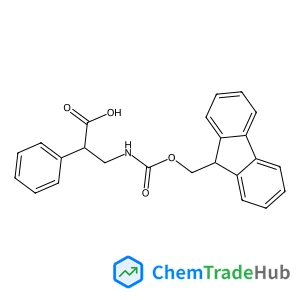
(S)-3-((((9H-Fluoren-9-yl)methoxy)carbonyl)amino)-2-phenylpropanoic acid
CAS番号:
1217663-60-9
分子式:
C24H21NO4
おすすめサプライヤー




免責事項
このページに表示される学術雑誌情報は、参考および研究目的のみを目的としています。当社は雑誌出版社とは提携しておらず、投稿の取り扱いも行っておりません。出版に関するお問い合わせは、各雑誌出版社に直接ご連絡ください。
表示されている情報に誤りがある場合は、support@chemtradehub.com までご連絡ください。迅速に確認し、対応いたします。