












Determination of paramagnetic concentrations inside a diamagnetic matrix using solid-state NMR
文献情報
出版日
2017-04-11
DOI
10.1039/C7CP00451F
インパクトファクター
3.676
著者
Sébastien Maron, Nadège Ollier, Thierry Gacoin, Géraldine Dantelle
原文を見る
要旨
The determination of very low doping levels in solid materials is an important issue for many applications. When considering paramagnetic dopants, the NMR relaxation technique appears to be much more accurate than classical techniques such as Vegard's law resulting from X-ray diffraction (XRD) measurements or chemical analysis that cannot provide information on appropriate dopant spatial distributions. In a recent report, the linear variation of 1/T1, i.e. the nuclear relaxation rate, as a function of Nd3+ content has been used to determine doping levels with a good dispersion homogeneity in the monazite LaPO4 matrix down to 0.1 mol%. We here extend this study to more complex compounds doped with Nd3+, such as YPO4, the solid solution Y0.8Sc0.2PO4, Ba5(PO4)3Cl and a phosphate glass. For all considered compounds except Ba5(PO4)3Cl:Nd, 1/T1 is found to be linearly proportional to the nominal Nd concentration, confirming the ability of the method to investigate the dopant concentration and spatial homogeneity. The results obtained for different compounds open up the discussion on the parameters, such as the orbital overlap and the average P–P distances, influencing the nuclear relaxation rate.
関連文献
A low-cost bio-inspired integrated carbon counter electrode for high conversion efficiency dye-sensitized solar cells
Chunlei Wang, Fanning Meng, Mingxing Wu, Xiao Lin, Tonghua Wang, Jieshan Qiu, Tingli Ma
2013-06-27
Communication
DOI: 10.1039/C3CP52525B
Extending the distance range accessed with continuous wave EPR with Gd3+spin probes at high magnetic fields
Devin T. Edwards, Zhidong Ma, Daniella Goldfarb
2013-05-15
Paper
DOI: 10.1039/C3CP43787F
Double-hybrid density functionals: merging wavefunction and density approaches to get the best of both worlds
2013-06-18
Perspective
DOI: 10.1039/C3CP50907A
Compact large area and high-quality Au film with a hierarchical structure and its application in SERS
Youyi Xia, Tenjiao Li, Jun Chen
2013-05-15
Paper
DOI: 10.1039/C3CP51080H
Transport properties of binuclear metal complexes of the VIII group using a simplified NEGF-DFT approach
Vincenzo Barone, Ivo Cacelli, Alessandro Ferretti
2013-05-10
Paper
DOI: 10.1039/C3CP50974E
Highly soluble energy relay dyes for dye-sensitized solar cells
George Y. Margulis, Bogyu Lim, Brian E. Hardin, Eva L. Unger, Jun-Ho Yum, Johann M. Feckl, Dina Fattakhova-Rohlfing, Thomas Bein, Michael Grätzel, Alan Sellinger, Michael D. McGehee
2013-05-28
Paper
DOI: 10.1039/C3CP51018B
Stability of Si epoxide defects in Si nanowires: a mixed reactive force field/DFT study
Erik C. Neyts, Umedjon Khalilov, Bart Partoens
2013-07-16
Paper
DOI: 10.1039/C3CP51621K
Studies of bimolecular reaction dynamics using pulsed high-intensity vacuum-ultraviolet lasers for photoionization detection
Daniel R. Albert, H. Floyd Davis
2013-07-12
Perspective
DOI: 10.1039/C3CP51930A
1-Propanol probing methodology: two-dimensional characterization of the effect of solute on H2O
2013-06-04
Perspective
DOI: 10.1039/C3CP51650D
こちらもおすすめ
化合物よくある質問
2-メトキシ-4-(メチルスルフィニル)アミンの主な用途は何ですか?
2-メトキシ-4-(メチルスルフィニル)アミンは、主に医薬品および農薬の製造に使用されます。また、合成化学の一部として研究用材料としても利用されます。
41608-73-52-Methoxy-4-(methyls...
118684-13-24-(Bromomethyl)-3-me...
化合物よくある質問
4,6-二氯-N-甲基ピラミジンアミンの代替品はありますか?
代替品としては、4,6-二クロロピラミジンアミンや他のピラミジン系化合物が考えられます。ただし、目的と用途によって最適な代替品は異なります。
10397-15-64,6-Dichloro-N-methy...
化合物よくある質問
6-氯-4-甲基-1H-吲哚を含む廃棄物はどのように処理すべきですか?
6-氯-4-甲基-1H-吲哚の廃棄物は、適切な容器に収集し、密閉して保管します。温度は常温、湿度は低く、直射日光を避けて保管することを推奨します。廃棄処理は専門...
885520-84-36-chloro-4-methyl-1H...
化合物よくある質問
2-フローユロ-4-(トリフルオロメチル)ベンゾイドについて「に適用される法規ガイドラインは何ですか」
2-フローユロ-4-(トリフルオロメチル)ベンゾイドのCAS番号は207974-08-1です。この化合物はGHS分類で毒性物質と有害な反応物質として分類されます...
207974-08-1[2-Fluoro-4-(trifluo...
化合物よくある質問
4-ニトロフェニルN-[(ベンゼルオキシルカーボンイル]グリシングリシングリシン酸はどのように保存すればよいですか?
4-ニトロフェニルN-[(ベンゼルオキシルカーボンイル]グリシングリシングリシン酸は、室温で暗所に保管し、乾燥した環境で保存することを推奨します。容器は密閉性の...
19811-64-44-Nitrophenyl N-[(be...
化合物よくある質問
イソデスロラタドリンの代替品はありますか?
イソデスロラタドリンの代替品としては、デスロラタドリンや他の抗ヒスタミン薬が挙げられます。具体的には、デスロラタドリン、ラセカミド、フェルタドリンなどが、症状や...
183198-49-4Iso Desloratadine
化合物よくある質問
5-甲氧基-1,2,3,4-四氢异喹啉盐酸盐はどのように合成されますか?
5-甲氧基-1,2,3,4-四氢异喹啉盐酸盐の一般的な合成方法は、メタノール中で5-メトキシ-1,2,3,4-四ヒュドロイソキシンを塩酸で塩化します。この反応で...
103030-69-95-Methoxy-1,2,3,4-te...
化合物よくある質問
4-アミノ-5-メトキシ-2-トルエンサルホニック酸についての法規ガイドラインは何ですか?
CAS番号6471-78-9の4-アミノ-5-メトキシ-2-トルエンサルホニック酸は、GHS分類では corrosive(腐食性)と識別されます。EUのREAC...
6471-78-94-Amino-5-Methoxy-2-...
化合物よくある質問
甲基孕酮を取り扱う際の実験室安全事項は何ですか?
甲基孕酮の取り扱いは、PPE(個人保護具)の使用が必要な重要な安全事項を伴います。防塵マスク、ゴーグル、手袋を着用することが推奨されます。ドラフトチャンバーを使...
204063-33-22-[(Diphenylmethyl)a...
掲載誌
Physical Chemistry Chemical Physics

CiteScore:
5.5
自己引用率:
10.3%
年間論文数:
3036
Physical Chemistry Chemical Physics (PCCP) is an international journal co-owned by 19 physical chemistry and physics societies from around the world. This journal publishes original, cutting-edge research in physical chemistry, chemical physics and biophysical chemistry. To be suitable for publication in PCCP, articles must include significant innovation and/or insight into physical chemistry; this is the most important criterion that reviewers and Editors will judge against when evaluating submissions. The journal has a broad scope and welcomes contributions spanning experiment, theory, computation and data science. Topical coverage includes spectroscopy, dynamics, kinetics, statistical mechanics, thermodynamics, electrochemistry, catalysis, surface science, quantum mechanics, quantum computing and machine learning. Interdisciplinary research areas such as polymers and soft matter, materials, nanoscience, energy, surfaces/interfaces, and biophysical chemistry are welcomed if they demonstrate significant innovation and/or insight into physical chemistry. Joined experimental/theoretical studies are particularly appreciated when complementary and based on up-to-date approaches.
おすすめ化合物
![[4-Amino-2-(methylsulfanyl)-5-pyrimidinyl]methanol structure](https://static.chemtradehub.com/structs/588/588-36-3-fc73.webp "[4-Amino-2-(methylsulfanyl)-5-pyrimidinyl]methanol structure")
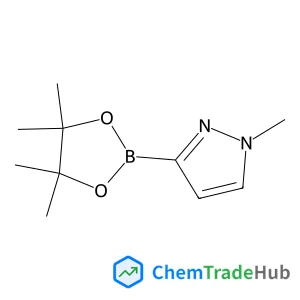
1-Methyl-3-(4,4,5,5-tetramethyl-1,3,2-dioxaborolan-2-yl)-1H-pyrazole
CAS番号:
1020174-04-2
分子式:
C10H17BN2O2
おすすめサプライヤー





免責事項
このページに表示される学術雑誌情報は、参考および研究目的のみを目的としています。当社は雑誌出版社とは提携しておらず、投稿の取り扱いも行っておりません。出版に関するお問い合わせは、各雑誌出版社に直接ご連絡ください。
表示されている情報に誤りがある場合は、support@chemtradehub.com までご連絡ください。迅速に確認し、対応いたします。