












A facile electrochemical intercalation and microwave assisted exfoliation methodology applied to screen-printed electrochemical-based sensing platforms to impart improved electroanalytical outputs
文献情報
出版日
2018-05-18
DOI
10.1039/C7AN01982C
インパクトファクター
4.616
著者
Christopher W. Foster, Samuel. J. Rowley-Neale, Héctor Fernández, Craig E. Banks
原文を見る
要旨
Screen-printed electrodes (SPEs) are ubiquitous with the field of electrochemistry allowing researchers to translate sensors from the laboratory to the field. In this paper, we report an electrochemically driven intercalation process where an electrochemical reaction uses an electrolyte as a conductive medium as well as the intercalation source, which is followed by exfoliation and heating/drying via microwave irradiation, and applied to the working electrode of screen-printed electrodes/sensors (termed EDI-SPEs) for the first time. This novel methodology results in an increase of up to 85% of the sensor area (electrochemically active surface area, as evaluated using an outer-sphere redox probe). Upon further investigation, it is found that an increase in the electroactive area of the EDI-screen-printed based electrochemical sensing platforms is critically dependent upon the analyte and its associated electrochemical mechanism (i.e. adsorption vs. diffusion). Proof-of-concept for the electrochemical sensing of capsaicin, a measure of the hotness of chillies and chilli sauce, within both model aqueous solutions and a real sample (Tabasco sauce) is demonstrated in which the electroanalytical sensitivity (a plot of signal vs. concentration) is doubled when utilising EDI-SPEs over that of SPEs.
関連文献
Theoretical design of conjugated diradicaloids as singlet fission sensitizers: quinones and methylene derivatives
Diego López-Carballeira, Fernando Ruipérez
2017-10-31
Paper
DOI: 10.1039/C7CP05120D
Phonon-mediated superconductivity in Mg intercalated bilayer borophenes
Ji-Hai Liao, Yin-Chang Zhao, Hu Xu
2017-10-25
Paper
DOI: 10.1039/C7CP06180C
Catalytic reduction of SO2 by CO over Au4Pt2(CO)n and Au6Pt(CO)n clusters: a first-principles study
Wei-Feng Xie, Hao-Ran Zhu, Shi-Hao Wei, Da-Yin Hua
2017-10-09
Paper
DOI: 10.1039/C7CP04740A
Ultrafast excited-state dynamics of 2,4-dimethylpyrrole
Zhichao Chen, Zhigang He, Kaijun Yuan
2017-10-23
Paper
DOI: 10.1039/C7CP06292C
Coincident velocity map image reconstruction illustrated by the single-photon valence photoionisation of CF3SF5
Andras Bodi, Patrick Hemberger, Richard P. Tuckett
2017-10-30
Paper
DOI: 10.1039/C7CP05576E
Hidden complexities in the reaction of H2O2 and HNO revealed by ab initio quantum chemical investigations
Daniel Beckett, Marc Edelmann, Jonathan D. Raff, Krishnan Raghavachari
2017-10-16
Paper
DOI: 10.1039/C7CP05883G
Axial–equatorial isomerism and semiexperimental equilibrium structures of fluorocyclohexane
Marcos Juanes, Jean Demaison, Iker León, Alberto Lesarri, Heinz Dieter Rudolph
2017-10-31
Paper
DOI: 10.1039/C7CP06135H
Adsorption and dissociation of O2 on MoO2(11) surfaces: a DFT study
Quan Zhang, Minhua Zhang
2017-10-17
Paper
DOI: 10.1039/C7CP06456J
Accumulation of counterions and coions evaluated by cryogenic XPS as a new tool for describing the structure of electric double layer at the silica/water interface
Jiří Škvarla, Mária Kaňuchová, Andrey Shchukarev, Ivan Brezáni, Juraj Škvarla
2017-10-18
Communication
DOI: 10.1039/C7CP06439J
こちらもおすすめ
化合物よくある質問
環戊烷-1,3-二甲酸甲酯はどのように合成されますか?
環戊烷-1,3-二甲酸甲酯は、環戊烷と塩酸によるヒンデンブルク反応を経由して合成されます。この反応では、環戊烷が塩酸と作用し、1,3-ジカルボキシ基が導入されま...
2435-36-1Dimethyl 1,3-cyclope...
化合物よくある質問
4-メトキシ-1,2,3-スチアゼ-3,5-ジオンとは何ですか?
4-メトキシ-1,2,3-スチアゼ-3,5-ジオンは、CAS番号107843-77-6の化合物で、(E)-ベンジル3-(3,4-ジヒドロキシフェニル) acry...
107843-77-6(E)-Benzyl 3-(3,4-di...
化合物よくある質問
プロスタグランジンA2について「に適用される法規ガイドラインは何ですか?'
プロスタグランジンA2 (CAS番号: 41691-92-3) は、化学物質の安全管理に関する規制として、GHS (危険物質の国際的ハザード分類・ラベル付けシス...
41691-92-316,16-DIMETHYL PROST...
化合物よくある質問
4-アミノ-1-ナフタレン sulfonic 酸についての物理化学的性質は何ですか?
4-アミノ-1-ナフタレン sulfonic 酸のCAS番号は84-86-6です。この化合物は結晶性で、分子量は212.15 g/molです。アルコールや水など...
84-86-64-Amino-1-naphthalen...
化合物よくある質問
N-GlcNAc-生物素を取り扱う際の実験室安全事項は何ですか?
N-GlcNAc-生物素は吸収性があり、皮膚や目への接触を避けることが重要です。PPE(個体保護具)は使用し、ドラフトチャンバーは必要に応じて使用します。漏洩時...
1272755-69-72-Acetamido-2-deoxy-...
化合物よくある質問
3-アミノメチルフローラノピペリジン-1-カルボニル酸テルブチルエステルとは何ですか?
CAS番号1209781-11-2の3-アミノメチルフローラノピペリジン-1-カルボニル酸テルブチルエステルは、有機化合物の一種で、化学式はC10H17FNO3...
1209781-11-22-Methyl-2-propanyl ...
化合物よくある質問
6-溴-1-甲基-1H-ベンゾ[d][1,2,3]三氮唑はどのように合成されますか?
6- bromo-1-methyl-1H-benzotriazoleは、ブロモフリオリンと1-メチル-1H-ベンゾ[d][1,2,3]三氮唑の反応により合成され...
944718-32-56-Bromo-1-methyl-1H-...
化合物よくある質問
4-硫代尿苷はどのように合成されますか?
4-硫代尿苷は、尿素とD-リボシルヒドロキシアルデヒドを用いてスルホン化反応を経て合成されます。通常は塩酸ヒドロキシチオニルスルホン酸などの触媒を使用し、選択性...
6741-73-71-(4-thio-beta-D-rib...
化合物よくある質問
ブレインナトリユリックペプチド32ラットとは何ですか?
ブレインナトリユリックペプチド32ラット(CAS番号: 133448-20-1)は、心臓で作られるホルモンの一つで、心不全の診断や予後評価に使用されます。
133448-20-1Brain Natriuretic Pe...
化合物よくある質問
1-(3-氮杂啶)-4-羟基哌啶双盐酸盐の物理化学的性質は何ですか?
CAS番号810680-60-5の1-(3-氮杂啶)-4-羟基哌啶双盐酸盐は、白色の結晶性粉末である。分子量は360.84 g/molで、水に溶けやすい。反応活...
810680-60-51-(3-Azetidinyl)-4-p...
掲載誌
Analyst

CiteScore:
7.8
自己引用率:
5.6%
年間論文数:
653
Analyst publishes analytical and bioanalytical research that reports premier fundamental discoveries and inventions, and the applications of those discoveries, unconfined by traditional discipline barriers.
おすすめ化合物
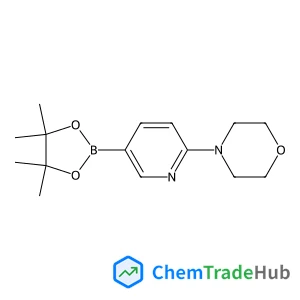
4-(5-(4,4,5,5-tetramethyl-1,3,2-dioxaborolan-2-yl)pyridin-2-yl)morpholine
CAS番号:
485799-04-0
分子式:
C15H23BN2O3
おすすめサプライヤー



免責事項
このページに表示される学術雑誌情報は、参考および研究目的のみを目的としています。当社は雑誌出版社とは提携しておらず、投稿の取り扱いも行っておりません。出版に関するお問い合わせは、各雑誌出版社に直接ご連絡ください。
表示されている情報に誤りがある場合は、support@chemtradehub.com までご連絡ください。迅速に確認し、対応いたします。