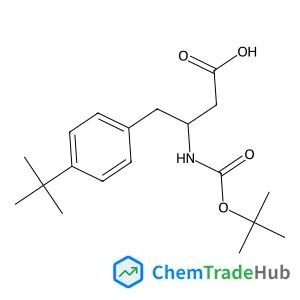
(S)-3-((tert-Butoxycarbonyl)amino)-4-(4-(tert-butyl)phenyl)butanoic acid
CAS番号:
403661-85-8
分子式:
C19H29NO4
Maria A. Morozova, Mekhman S. Yusubov, Václav Eigner, Alexander A. Bondarev, Akio Saito, Marina E. Trusova, Pavel S. Postnikov
A new method of azide–alkyne cycloaddition (AAC) in the presence of Zn(OAc)2 as an inexpensive and environmentally friendly catalyst in neat water has been developed. The proposed methodology has been applied for the synthesis of 1,4-disubstituted-1,2,3-triazoles from terminal alkynes and 1,4,5-trisubstituted-1,2,3-triazoles from internal alkynes. It has been found that Zn-catalyzed AAC is extremely sensitive to steric hindrance in acetylenes and a method of regioselective triazole ring formation has been proposed. Particularly important is the isolation and characterization of a relatively stable Zn-containing intermediate, which has been characterized by NMR and HRMS.

European Journal of Organic Chemistry

Molecular Diversity

Photochemical & Photobiological Sciences

Environmental Toxicology and Pharmacology

Journal of Medical Biochemistry

Lab on a Chip

Advanced Engineering Materials

Angewandte Chemie International Edition

Mini-Reviews in Medicinal Chemistry

Foundations of Chemistry
Dilek Yalcin, Calum J. Drummond, Tamar L. Greaves
DOI: 10.1039/C9CP05711K
Lihui Ou, Junxiang Chen
DOI: 10.1039/C9CP05043D
DOI: 10.1039/C9CP03074C
Stella Schmode, Payal Chatterjee, Alexander D. MacKerell, Jr., Christian Schröder
DOI: 10.1039/C9CP03000J
André D. Bandrauk
DOI: 10.1039/C9CP05213E
Binhong Yu, Yi Wang, Lingrui Wang, Xiao Tan, Yu-Mo Zhang, Minjie Li, Bo Zou, Sean Xiao-An Zhang
DOI: 10.1039/C9CP02445J
Dennis Palagin
DOI: 10.1039/C9CP04973H
Guangtao Liu, Linyan Wang, Xue Yong, Guoying Gao, Hanyu Liu
DOI: 10.1039/C9CP02409C
Tomas Serevičius, Rokas Skaisgiris, Jelena Dodonova, Karolis Kazlauskas, Saulius Juršėnas, Sigitas Tumkevičius
DOI: 10.1039/C9CP05907E
4-アミノフェノール酸ナトリウム水和物は、CAS番号206557-08-6の化合物で、4-アミノフェノールとナトリウムが結合した塩と水和物です。この化合物は、白...
この化合物は特定の合成プロセスに使用される可能性がありますが、代替品として、他の类似的な化合物、例えばMethyl 3-methyl-N-{[(2-methyl...
4-Boc-2-哌嗪甲酸は、薬品開発や合成化学分野で広く使用されており、その需要は継続的に推移しています。特に、新薬開発における合成化学分野での需要が高まってい...
4,4'-二羟甲基联苯のCAS番号は1667-12-5です。この化合物は白色の結晶粉末で、分子量は154.20です。水にわずかに溶けますが、アルコールや有機溶媒...
5-甲硫基戊腈は医薬品産業で使用される可能性があります。また、ポリマー合成の触媒として、センサー製造の一部として、半導体製造のプロセス改善に使用される可能性があ...
この化合物は、1-abieta-8,11,13-trien-19-イルと6'-メトキシシンコナナン-9-基を含有する窒素含有化合物から合成されます。一般的な合成...
6-ブロモベンジジミダゾール-2-カルビルデオキシドは、避光・乾燥した容器(密閉容器)で-20℃~4℃の低温で保存してください。高温や直射日光、湿気は避けてくだ...
621-65-8のCAS番号を持つBoc-N-甲基氨甲环酸は、化学式C7H13NO5を有する化合物です。この化合物は白色の結晶性粉末で、吸湿性があります。
乙基三氟硼酸钾は、トリフLUオール酸カリウムとエチルブロミドを反応させて合成されます。この反応は高い選択性と収率を持ち、触媒を用いることで効率的に進行します。
2-フロウロ-5-クロロ-4-アミノフェノールは、直射日光を避けて冷却された暗所で保存し、密閉容器に保管してください。温度は常温か低温が適しています。

Organic Chemistry Frontiers publishes high-quality research from across organic chemistry. Emphases are placed on studies that make significant contributions to the field of organic chemistry by reporting either new or significantly improved protocols or methodologies. Topics include, but are not limited to the following: Organic synthesis Development of synthetic methodologies Catalysis Natural products Functional organic materials Supramolecular and macromolecular chemistry Physical and computational organic chemistry
![6,7-Dihydro-5H-pyrrolo[1,2-a]imidazole-6-carboxylic acid structure](https://static.chemtradehub.com/structs/136/1369160-12-2-6524.webp "6,7-Dihydro-5H-pyrrolo[1,2-a]imidazole-6-carboxylic acid structure")
![Methyl 3-({2'-[(E)-(hydroxyhydrazono)methyl]-4-biphenylyl}methyl)-2-oxo-2,3-dihydro-1H-benzimidazole-4-carboxylate structure](https://static.chemtradehub.com/structs/149/1499167-72-4-034a.webp "Methyl 3-({2'-[(E)-(hydroxyhydrazono)methyl]-4-biphenylyl}methyl)-2-oxo-2,3-dihydro-1H-benzimidazole-4-carboxylate structure")
![6-Bromo-3-ethyl-3H-imidazo[4,5-b]pyridine structure](https://static.chemtradehub.com/structs/103/1033202-59-3-2a8f.webp "6-Bromo-3-ethyl-3H-imidazo[4,5-b]pyridine structure")