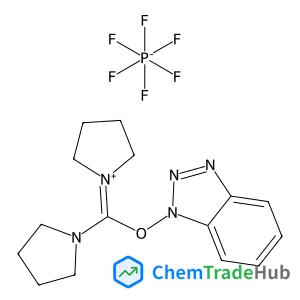
(1H-Benzotriazol-1-yloxy)(di-1-pyrrolidinyl)methylium hexafluorophosphate
CAS番号:
105379-24-6
分子式:
C15H21F6N5OP
Shuai Li, Yuanyuan Cai, Jun Cao, Mengtan Cai, Yuanwei Chen
Micelles with phosphatidylcholine surfaces have numerous advantages, such as good biocompatibility and high enrichment of drug in tumor tissue. In this study, we developed hyaluronic acid-coated phosphatidylcholine micelles, prepared via electrostatic attraction, for targeting the delivery of doxorubicin (DOX) to tumors. An amphiphilic copolymer poly(caprolactone)-poly(N,N-diethylaminoethyl methacrylate)-r-poly(2-(methacryloyloxy) ethyl phosphoryl choline) (PCL-PDEAMPC) was designed and synthesized successfully. PCL-PDEAMPC micelles and their DOX-loaded micelles were prepared by the dialysis method and were coated with hyaluronic acid (HA). The results showed that the micelle diameters increased a little and the zeta potential changed from positive to negative after coating with HA. The in vitro DOX release from phosphatidylcholine micelles could be triggered by pH, and the release from HA-coated PCL-PDEAMPC micelles was slower than that from PCL-PDEAMPC micelles. The in vitro cytotoxicity of the micelles was investigated using the MTT method in 4T1 cells. The results showed that the half maximal inhibitory concentration (IC50) of PCL-PDEAMPC-HA/DOX micelles was lower than that of PCL-PDEAMPC/DOX micelles. The CLSM images of cellular uptake indicated the ability of these micelles to enter into 4T1 cells. The experiments of in vivo antitumor effect and safety evaluation of DOX-loaded micelles demonstrated that the HA-coated DOX micelles had a better treatment effect and lower toxicity to 4T1-bearing Kunming mice. HA-decorated PCL-PDEAMPC micelles are therefore potential carriers for 4T1 tumor treatment.
DOI: 10.1039/C6CP07271B
Guohai Deng, Xuelin Dong, Qifan Liu, Dingqing Li, Hongmin Li, Qiao Sun, Xiaoqing Zeng
DOI: 10.1039/C6CP08125H
Hao Jin, Jianwei Li, Ying Dai, Yadong Wei
DOI: 10.1039/C6CP08158D
Z. J. Li, H. Y. Yu, G. Y. Song, J. Zhao, H. Zhang, M. Zhang, A. L. Meng, Q. D. Li
DOI: 10.1039/C6CP07457J
Seung-Ik Jo, Young-In An, Kang-Yeong Kim, Seo-Yeong Choi, Jin-Su Kwak, Kyung-Ryul Oh, Young-Uk Kwon
DOI: 10.1039/C6CP07787K
Paulo R. Bueno, David A. Miranda
DOI: 10.1039/C6CP02504H
G. W. Driver, Y. Huang, A. Laaksonen, T. Sparrman, Y.-L. Wang, P.-O. Westlund
DOI: 10.1039/C6CP05801A
H. W. Wang, C. L. Li, S. L. Yuan, J. F. Wang, C. L. Lu, J.-M. Liu
DOI: 10.1039/C6CP06369A
Yuri Mikhlin, Vladimir Nasluzov, Alexander Romanchenko, Yevgeny Tomashevich, Alexey Shor, Roberto Félix
DOI: 10.1039/C6CP07598C
2-溴-9,9-二苯基芴は、医薬品、工業材料、有機合成の研究分野で応用されます。特に、レーザー材料や機能性ポリマーの合成に使用されることがあります。また、蛍光色...
四氯化铱の市場は研究開発分野で注目されており、特にナノ技術や金属有機框架(MOFs)の分野での需要が増加傾向にあります。価格は安定しており、中国や韓国での生産が...
1-(4-溴-3-氟苯基)-2-氯乙酮 (CAS番号: 1260857-14-4) の廃棄物は専門的な廃棄処理が必要です。まず、廃棄物は密閉された容器に収集し、...
苦参酚Kは、CAS番号101236-49-1を持つ化合物で、主に天然由来の生薬から抽出されます。この化合物は、抗炎症作用や抗癌作用を持つことが報告されています。
POTASSIUM (1-(TERTBUTOXYCARBONYL)AZETIDIN-3-YL)TRIFLUOROBORATE を含む廃棄物は、まず安全なエント...
4-庚基-4’-聯苯羧酸は、特殊化学品や合成化学の分野で用いられる化学物質ですが、市場動向としては、研究開発の進展とともに需要が増加しています。また、環境配慮型...
6-ブロモ-3-メトキシ-1-フェニル-1H-インドゾールを含む廃棄物は、適切な化学廃棄処理が必要です。通常、廃棄物は密閉容器に収集され、専門の廃棄処理業者に引...
4,4-二甲基-2-吡咯烷酮は医薬、ポリマー、センサー、半導体などの業界で広く使用されています。特に溶媒としての性能が高く評価されています。

Polymer Chemistry welcomes submissions in all areas of polymer science that have a strong focus on macromolecular chemistry. Manuscripts may cover a broad range of fields, yet no direct application focus is required.