












Synthesis and electrochemical polymerization of diketopyrrolopyrrole based donor–acceptor–donor monomers containing 3,6- and 2,7-linked carbazoles
文献情報
出版日
2016-09-13
DOI
10.1039/C6PY01489E
インパクトファクター
5.582
著者
Merve Akbayrak, Ahmet M. Önal
原文を見る
要旨
Three new donor–acceptor–donor (D–A–D) type monomers bearing 2,7- or 3,6-linked carbazoles as the donor unit and 2,5-dihydro-3,6-di-2-thienyl-pyrrolo[3,4-c]pyrrole-1,4-dione (DPP) as the electron poor acceptor unit were synthesized via a Suzuki cross coupling reaction. The monomers were electrochemically polymerized both by repetitive cycling and by constant potential electrolysis in acetonitrile–tetrabutylammonium hexafluorophosphate electrolytic medium containing boron trifluoride diethyl etherate (BFEE). Optical and electrochemical properties of the monomers and their corresponding polymers were investigated and it was found that optical properties show slight variations depending on both the substituent on the nitrogen atom and the linkage site. Monomers, besides reversible oxidations and reversible reduction peaks similar to those present in the differential pulse voltammogram of the acceptor unit, exhibit one irreversible oxidation peak responsible for initiating the electrochemical polymerization of the monomers. Both electrochemical and optical data were used to elucidate the band gap (Eg) values of the polymers and it was found that polymer films obtained from 3,6-linked carbazole derivatives have slightly lower Eg values compared to 2,7-linked derivatives. Furthermore, based on the observed electrochemical behavior of the monomers, a possible mechanism for the electrochemical oxidation was proposed.
関連文献
Phonon vortices at heavy impurities in two-dimensional materials
De-Liang Bao, Mingquan Xu, Ao-Wen Li, Wu Zhou
2023-12-07
Communication
DOI: 10.1039/D3NH00433C
Boosting the in-plane thermal conductivity of nanofibrillated cellulose films: alignment engineering of cross-linked AlN whiskers
Mengyang Niu, Zheng Zhao, Baokai Wang, Chang Yu, Mengyi Li, Jiajun Hu, Lifeng Zhu, Xu Hao, Shiqin Wan, Ming Yue, Weiwei Xuan, Qipeng Lu, Wenbin Cao, Kexin Chen, Qi Wang
2023-10-04
Paper
DOI: 10.1039/D3TA04770A
Topology driven and soft phonon mode enabled Na-ion diffusion in quaternary chalcogenides, Na3ZnGaX4 (X = S, and Se)
Santhoshkumar Sundaramoorthy, Amitava Choudhury, Naresh C. Osti, Alexander I. Kolesnikov, Matthew B. Stone, Yongqiang Cheng
2023-10-04
Paper
DOI: 10.1039/D3TA04479C
Recent progress of MXene as an energy storage material
Yuqiang Wu, Mengtao Sun
2024-01-05
Minireview
DOI: 10.1039/D3NH00402C
A solely biobased strain sensor with an ultra-precision response via a surface graphitization strategy
Zhihao Yang, Ying Yuan, Bin Wang, Xiaojun Shen, Xiluan Wang, Tong-Qi Yuan
2023-11-02
Paper
DOI: 10.1039/D3TA04872A
Construction of supramolecular dimer photosensitizers based on triphenylamine derivatives and cucurbit[8]uril for photocatalysis
Xin-Long Li, Dong-Liang Cheng, Kai-Kai Niu, Hui Liu, Sheng-Sheng Yu, Yue-Bo Wang, Ling-Bao Xing
2023-11-09
Paper
DOI: 10.1039/D3TA05523J
Linker engineering to regulate the fluorescence of hydrazone-linked covalent organic frameworks for the real-time visual detection of norfloxacin and multiple information encryption
Haifei Wan, Mengyao Li, Li Wang, Yonghai Song
2023-10-02
Paper
DOI: 10.1039/D3TA04781D
A low-self-discharge high-loading polysulfide cathode design for lithium–sulfur cells
Cheng-Che Wu, Yun-Chung Ho
2023-11-01
Paper
DOI: 10.1039/D3TA05632E
こちらもおすすめ
化合物よくある質問
2,3-スチオエポキシマドルを取り扱う際の実験室安全事項は何ですか?
取り扱いにはPPE(プロテクティブ・パーソナル・エイド)が必要で、防ぐ手袋と保護眼鏡を着用してください。ドラフトチャンバーの使用を推奨します。漏洩した場合は、適...
4267-80-52,3-Thioepoxy Madol
53981-25-22-Amino-6-fluorophen...
化合物よくある質問
BOC-S-3-アミニ-4-(4-メチオキシベンチル)-ブタン酸の代替品はありますか?
この化合物の代替品としては、BOC保護基を有さないアミノ酸やその他の保護基化合物が考えられます。また、メチオキシ基を有しない他の芳香族アミノ酸も代替品として挙げ...
126800-59-7(3S)-4-(4-Methoxyphe...
化合物よくある質問
Methyl 2-(chloromethyl)-3-nitrobenzoate(1218910-61-2)の代替品はありますか?
Methyl 2-(chloromethyl)-3-nitrobenzoate(1218910-61-2)の代替品としては、化学組成を変えることで効果を達成する...
1218910-61-2Methyl 2-(chlorometh...
化合物よくある質問
(2R)-2-アミノ-N-ベンジル-3-ヒドロキシプロパナミドを含む廃棄物はどのように処理すべきですか?
(2R)-2-アミノ-N-ベンジル-3-ヒドロキシプロパナミドを含む廃棄物は、適切な廃棄物管理ガイドラインに基づき処理する必要があります。まず、廃棄物を適切に収...
175481-39-7(2R)-2-amino-N-benzy...
化合物よくある質問
6,7-二氢-咪唑並[1,2-a]ピリドイン-8(5h)-酮はどのように合成されますか?
6,7-二氢-咪唑並[1,2-a]ピリドイン-8(5h)-酮は、2-ブロモフェニルアセトインとリン酸ハロゲン化物を反応させることで合成できます。この反応は高温で...
457949-09-66,7-Dihydroimidazo[1...
化合物よくある質問
エチル(3R)-3-ピロリジニル酢酸水和塩とは何ですか?
エチル(3R)-3-ピロリジニル酢酸水和塩は、CAS番号1332459-32-1の化合物で、(R)-乙基2-(ピロリジン-3-基)酢酸塩水和塩と呼ばれます。この...
1332459-32-1Ethyl (3R)-3-pyrroli...
化合物よくある質問
(2S)-{[(2-メチルエチルオキシ]カルボニル}アミノ)[2-(トリアフルオロメチルフェニル]エチカシック酸の物理化学的性質は何ですか?
(2S)-{[(2-メチルエチルオキシ]カルボニル}アミノ)[2-(トリアフルオロメチルフェニル]エチカシック酸のCAS番号は1203454-45-8です。この...
1203454-45-8(2S)-({[(2-Methyl-2-...
化合物よくある質問
2-ブロモ-1-(2-メチル-2-プロパニル)-4-ニトロベンゼンはどのように保存すればよいですか?
2-ブロモ-1-(2-メチル-2-プロパニル)-4-ニトロベンゼンは、直射日光を避けて暗所で、室温(約15℃〜25℃)、乾燥した場所に保存する必要があります。ま...
6310-17-42-Bromo-1-(2-methyl-...
化合物よくある質問
1-[(4-硝基フェニル)スルホニル]-1H-1,2,4-三唑の市場動向や研究トレンドはどうですか?
市場動向としては、1-[(4-硝基フェニル)スルホニル]-1H-1,2,4-三唑は主に農業用除草剤や合成化学製品の原料として利用されています。研究トレンドとして...
57777-84-11-[(4-Nitrophenyl)su...
掲載誌
Polymer Chemistry

CiteScore:
8.6
自己引用率:
7.3%
年間論文数:
457
Polymer Chemistry welcomes submissions in all areas of polymer science that have a strong focus on macromolecular chemistry. Manuscripts may cover a broad range of fields, yet no direct application focus is required.
おすすめ化合物
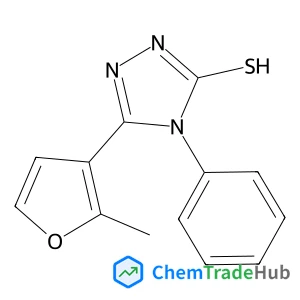
5-(2-Methyl-3-furyl)-4-phenyl-2,4-dihydro-3H-1,2,4-triazole-3-thione
CAS番号:
346464-59-3
分子式:
C13H11N3OS

![6,6-Dimethylbicyclo[3.1.1]hept-2-ene-2-carbaldehyde structure](https://static.chemtradehub.com/structs/564/564-94-3-e746.webp "6,6-Dimethylbicyclo[3.1.1]hept-2-ene-2-carbaldehyde structure")

おすすめサプライヤー





免責事項
このページに表示される学術雑誌情報は、参考および研究目的のみを目的としています。当社は雑誌出版社とは提携しておらず、投稿の取り扱いも行っておりません。出版に関するお問い合わせは、各雑誌出版社に直接ご連絡ください。
表示されている情報に誤りがある場合は、support@chemtradehub.com までご連絡ください。迅速に確認し、対応いたします。