












Poly(triphenyl ethene) and poly(tetraphenyl ethene): synthesis, aggregation-induced emission property and application as paper sensors for effective nitro-compounds detection
文献情報
出版日
2016-09-09
DOI
10.1039/C6PY01358A
インパクトファクター
5.582
著者
Hui Zhou, Xiaobai Wang, Ting Ting Lin, Jing Song, Ben Zhong Tang
原文を見る
要旨
Two unique aggregation-induced emission (AIE) active polymers poly(triphenyl ethene) (PTriPE) and poly(tetraphenyl ethene) (PTPE), comprising sole repeating units, triphenyl and tetraphenyl, respectively, were synthesized through the Suzuki coupling of (2,2-dibromoethene-1,1-diyl)dibenzene and related di-boronic acid or ester compounds. The polymers PTriPE and PTPE had number-molecular weights (10 100–17 400) with polydispersity indices of 1.5–1.7, and they were soluble in common organic solvents. The polymers in THF/H2O mixtures were able to form remarkably stable nanoparticles and no agglomeration was observed even when stored at 4 °C for several months. The polymer PTriPE and PTPE exhibited much more significant AIE activities when compared to their corresponding small AIE molecule 1,1,2,2-tetraphenylethene (TPE) and 4,4′-(2,2-diphenylethene-1,1-diyl)dibiphenyl (DPDB) in THF–H2O mixtures. The fluorescence of polymer nanoparticles in THF/H2O mixture could be quenched by various nitro-compounds, and PTriPE nanoparticles demonstrated a better fluorescence quenching response than PTPE. The film formed by PTriPE nanoparticles showed a reasonable fluorescence quenching response to nitro-compounds, for example, ∼5 ppb in the case of 2,4,6-trinitrotoluene vapor, despite its thickness approaching the micrometer level. Furthermore, PTriPE-based paper sensors were fabricated from its polymer nanoparticles’ solution, and is still effective with a polymer surface concentration as low as 1.0 μg cm−2 in detecting various nitro-compounds at a scale less than 1 ng, making it a useful tool for a quick, inexpensive and most importantly, highly sensitive detection of nitro-compounds based explosives.
関連文献
An aggregation-induced emission luminogen combined with a cyanoacrylate fuming method for latent fingerprint analysis
Xiaodong Jin, Hao Wang, Ran Xin, Yining Ma, Guoping Wu, Tongxiang Xu, Xiaowei Xia, Shifan Wang, Rongliang Ma
2020-01-07
Paper
DOI: 10.1039/C9AN02158B
Current developments in LC-MS for pharmaceutical analysis
Marco Beccaria, Deirdre Cabooter
2020-01-16
Critical Review
DOI: 10.1039/C9AN02145K
Double remote electrochemical addressing and optical readout of electrochemiluminescence at the tip of an optical fiber
Haidong Li, Patrick Garrigue, Laurent Bouffier, Stéphane Arbault, Alexander Kuhn, Neso Sojic
2016-04-28
Paper
DOI: 10.1039/C6AN00652C
Effective isolation of exosomes with polyethylene glycol from cell culture supernatant for in-depth proteome profiling
Zhigang Sui, Yichu Shan, Lihua Zhang, Yukui Zhang
2016-05-04
Paper
DOI: 10.1039/C6AN00892E
Investigating CC positions and hydroxylation sites in lipids using Paternò–Büchi functionalization mass spectrometry
Patrick Esch, Sven Heiles
2020-01-23
Paper
DOI: 10.1039/C9AN02260K
Structure dependence of lasing action in organic polymer films on DFB gratings for dinitrotoluene vapor detection
Qiufeng Liu, Keqiang Qiu, Shengnan He, Honglin Liu, Zhengkun Liu, Yilin Hong, Shaojun Fu
2016-05-31
Communication
DOI: 10.1039/C6AN00653A
A dual-channel detection of mercuric ions using a label free G-quadruplex-based DNAzyme molecule
2016-05-20
Communication
DOI: 10.1039/C6AN00795C
An FcεRI-IgE-based genetically encoded microfluidic cell sensor for fast Gram-negative bacterial screening in food samples
Jun Yang, Donglei Jiang, Xiulan Sun
2020-01-18
Paper
DOI: 10.1039/C9AN02289A
Gadolinium-based MRI contrast agent for the detection of tyrosinase
Hyewon Seo
2019-12-17
Communication
DOI: 10.1039/C9AN02213A
こちらもおすすめ
化合物よくある質問
2,3-スチオエポキシマドルを取り扱う際の実験室安全事項は何ですか?
取り扱いにはPPE(プロテクティブ・パーソナル・エイド)が必要で、防ぐ手袋と保護眼鏡を着用してください。ドラフトチャンバーの使用を推奨します。漏洩した場合は、適...
4267-80-52,3-Thioepoxy Madol
53981-25-22-Amino-6-fluorophen...
化合物よくある質問
BOC-S-3-アミニ-4-(4-メチオキシベンチル)-ブタン酸の代替品はありますか?
この化合物の代替品としては、BOC保護基を有さないアミノ酸やその他の保護基化合物が考えられます。また、メチオキシ基を有しない他の芳香族アミノ酸も代替品として挙げ...
126800-59-7(3S)-4-(4-Methoxyphe...
化合物よくある質問
Methyl 2-(chloromethyl)-3-nitrobenzoate(1218910-61-2)の代替品はありますか?
Methyl 2-(chloromethyl)-3-nitrobenzoate(1218910-61-2)の代替品としては、化学組成を変えることで効果を達成する...
1218910-61-2Methyl 2-(chlorometh...
化合物よくある質問
(2R)-2-アミノ-N-ベンジル-3-ヒドロキシプロパナミドを含む廃棄物はどのように処理すべきですか?
(2R)-2-アミノ-N-ベンジル-3-ヒドロキシプロパナミドを含む廃棄物は、適切な廃棄物管理ガイドラインに基づき処理する必要があります。まず、廃棄物を適切に収...
175481-39-7(2R)-2-amino-N-benzy...
化合物よくある質問
6,7-二氢-咪唑並[1,2-a]ピリドイン-8(5h)-酮はどのように合成されますか?
6,7-二氢-咪唑並[1,2-a]ピリドイン-8(5h)-酮は、2-ブロモフェニルアセトインとリン酸ハロゲン化物を反応させることで合成できます。この反応は高温で...
457949-09-66,7-Dihydroimidazo[1...
化合物よくある質問
エチル(3R)-3-ピロリジニル酢酸水和塩とは何ですか?
エチル(3R)-3-ピロリジニル酢酸水和塩は、CAS番号1332459-32-1の化合物で、(R)-乙基2-(ピロリジン-3-基)酢酸塩水和塩と呼ばれます。この...
1332459-32-1Ethyl (3R)-3-pyrroli...
化合物よくある質問
(2S)-{[(2-メチルエチルオキシ]カルボニル}アミノ)[2-(トリアフルオロメチルフェニル]エチカシック酸の物理化学的性質は何ですか?
(2S)-{[(2-メチルエチルオキシ]カルボニル}アミノ)[2-(トリアフルオロメチルフェニル]エチカシック酸のCAS番号は1203454-45-8です。この...
1203454-45-8(2S)-({[(2-Methyl-2-...
化合物よくある質問
2-ブロモ-1-(2-メチル-2-プロパニル)-4-ニトロベンゼンはどのように保存すればよいですか?
2-ブロモ-1-(2-メチル-2-プロパニル)-4-ニトロベンゼンは、直射日光を避けて暗所で、室温(約15℃〜25℃)、乾燥した場所に保存する必要があります。ま...
6310-17-42-Bromo-1-(2-methyl-...
化合物よくある質問
1-[(4-硝基フェニル)スルホニル]-1H-1,2,4-三唑の市場動向や研究トレンドはどうですか?
市場動向としては、1-[(4-硝基フェニル)スルホニル]-1H-1,2,4-三唑は主に農業用除草剤や合成化学製品の原料として利用されています。研究トレンドとして...
57777-84-11-[(4-Nitrophenyl)su...
掲載誌
Polymer Chemistry

CiteScore:
8.6
自己引用率:
7.3%
年間論文数:
457
Polymer Chemistry welcomes submissions in all areas of polymer science that have a strong focus on macromolecular chemistry. Manuscripts may cover a broad range of fields, yet no direct application focus is required.
おすすめ化合物

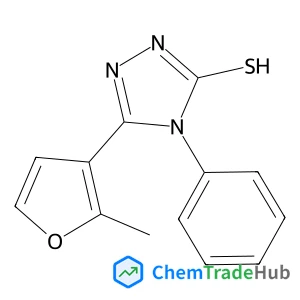
5-(2-Methyl-3-furyl)-4-phenyl-2,4-dihydro-3H-1,2,4-triazole-3-thione
CAS番号:
346464-59-3
分子式:
C13H11N3OS
![tert-butyl 8-benzyl-2,8-diazaspiro[4.5]decane-2-carboxylate structure](https://static.chemtradehub.com/structs/336/336191-16-3-bb55.webp "tert-butyl 8-benzyl-2,8-diazaspiro[4.5]decane-2-carboxylate structure")
![8-Bromo-6-fluoro[1,2,4]triazolo[1,5-a]pyridin-2-amine structure](https://static.chemtradehub.com/structs/125/1257705-51-3-9f4a.webp "8-Bromo-6-fluoro[1,2,4]triazolo[1,5-a]pyridin-2-amine structure")
おすすめサプライヤー






免責事項
このページに表示される学術雑誌情報は、参考および研究目的のみを目的としています。当社は雑誌出版社とは提携しておらず、投稿の取り扱いも行っておりません。出版に関するお問い合わせは、各雑誌出版社に直接ご連絡ください。
表示されている情報に誤りがある場合は、support@chemtradehub.com までご連絡ください。迅速に確認し、対応いたします。