












Temperature and pH dual-responsive poly(vinyl lactam) copolymers functionalized with amine side groups via RAFT polymerization
文献情報
出版日
2016-07-13
DOI
10.1039/C6PY00885B
インパクトファクター
5.582
著者
原文を見る
要旨
A series of well-defined statistical copolymers based on cyclic N-vinyl lactams (N-vinylcaprolactam, N-vinylpiperidine and N-vinylpyrrolidone) and N-vinylformamide (VFA) were successfully synthesized via RAFT polymerization. The less-polar solvents (anisole and 1,4-dioxane) were more favorable over the highly-polar solvents (DMSO and DMF) while 2-(ethoxycarbonothioylthio)propanoate was more suitable than dithiobenzoate derivatives as the chain transfer agent (CTA) for copolymerization. The optimal polymerization conditions were explored with methyl 2-(ethoxycarbonothioylthio)propanoate as the CTA and anisole as the solvent. The narrow dispersity (Đ) of the copolymers, linear relationship between conversion and molecular weight, and symmetrical unimodal GPC traces confirmed the controlled character of the polymerization process. The polymerization process was progressively disfavored by the enhanced steric hindrance from the enlarged lactam ring while the VFA composition could be well controlled up to as high as 50% by continuously feeding VFA with a syringe pump. The lower critical solution temperatures (LCSTs) of the thermo-responsive copolymers poly(N-vinylcaprolactam-co-N-vinylformamide) and poly(N-vinylpiperidine-co-N-vinylformamide) in aqueous solutions reflected by the appearance of the cloud points can be tunable by the molecular weights and compositions of the copolymers. Primary amine functionalized temperature/pH dual responsive reactive copolymers were obtained by the controlled hydrolysis of the VFA components under alkaline conditions. The influence of the lactam ring on the hydrolysis rates was investigated. The LCSTs of the hydrolyzed copolymers can be elegantly adjusted by the hydrolysis degree. Amine-enriched nanogels were prepared in W/O emulsions utilizing the coupling between the reactive amine side-groups of polymer chains and diacrylate functionalities of a poly(ethylene glycol) cross-linker via Michael addition reaction, which displayed temperature and pH double responsiveness. The nanogels were labelled with fluorescein isothiocyanate (FITC) through conjugation with the residual primary amine groups on the surface. This facile chemistry has opened up routes to synthesize water-soluble reactive stimuli-responsive copolymers with well-defined architectures for design of functional macromolecular materials.
関連文献
An inner filter effect based sensing system for the determination of caffeine in beverage samples
Natalia González, Sara P. Lantmann Corral, Graciela Zanini, Carolina C. Acebal
2020-01-03
Paper
DOI: 10.1039/C9AN02483B
Monitoring drug–lipid membrane interactions via a molecular rotor probe
Qinqin Xu, Tao Zhao, Zhihua Sun
2016-05-23
Paper
DOI: 10.1039/C6AN00721J
Anodic stripping voltammetry with graphite felt electrodes for the trace analysis of silver
2016-05-31
Paper
DOI: 10.1039/C6AN00590J
Investigating CC positions and hydroxylation sites in lipids using Paternò–Büchi functionalization mass spectrometry
Patrick Esch, Sven Heiles
2020-01-23
Paper
DOI: 10.1039/C9AN02260K
Recent progress of heterostructure-based photoelectrodes in photoelectrochemical biosensing: a mini review
Bing Wang, Jun-Tao Cao, Yan-Ming Liu
2020-01-07
Minireview
DOI: 10.1039/C9AN02448D
A high-resolution method to assess cell multinucleation with cytoplasm-localized fluorescent probes
Qinghua Cui, Hui Meng, Fangfang Lai, Shufang Wang, Xiang Zhang, Xiaoguang Chen, Dali Yin
2016-05-19
Communication
DOI: 10.1039/C6AN00613B
A miniaturized electrochemical device integrating a biconical microchannel and carbon fiber disk ultramicroelectrode
Fengxia Chang, Xia Xie, Meixian Li, Zhiwei Zhu
2016-07-05
Communication
DOI: 10.1039/C6AN01205A
Label-free offline versus online activity methods for nucleoside diphosphate kinase b using high performance liquid chromatography
Juliana Maria Lima, Plínio Salmazo Vieira, Arthur Henrique Cavalcante de Oliveira, Carmen Lúcia Cardoso
2016-05-27
Paper
DOI: 10.1039/C6AN00655H
Surface-enhanced spatially-offset Raman spectroscopy (SESORS) for detection of neurochemicals through the skull at physiologically relevant concentrations
Amber S. Moody, Taylor D. Payne, Brian A. Barth, Bhavya Sharma
2020-01-16
Paper
DOI: 10.1039/C9AN01708A
Effective isolation of exosomes with polyethylene glycol from cell culture supernatant for in-depth proteome profiling
Zhigang Sui, Yichu Shan, Lihua Zhang, Yukui Zhang
2016-05-04
Paper
DOI: 10.1039/C6AN00892E
こちらもおすすめ
化合物よくある質問
2,3-スチオエポキシマドルを取り扱う際の実験室安全事項は何ですか?
取り扱いにはPPE(プロテクティブ・パーソナル・エイド)が必要で、防ぐ手袋と保護眼鏡を着用してください。ドラフトチャンバーの使用を推奨します。漏洩した場合は、適...
4267-80-52,3-Thioepoxy Madol
53981-25-22-Amino-6-fluorophen...
化合物よくある質問
BOC-S-3-アミニ-4-(4-メチオキシベンチル)-ブタン酸の代替品はありますか?
この化合物の代替品としては、BOC保護基を有さないアミノ酸やその他の保護基化合物が考えられます。また、メチオキシ基を有しない他の芳香族アミノ酸も代替品として挙げ...
126800-59-7(3S)-4-(4-Methoxyphe...
化合物よくある質問
Methyl 2-(chloromethyl)-3-nitrobenzoate(1218910-61-2)の代替品はありますか?
Methyl 2-(chloromethyl)-3-nitrobenzoate(1218910-61-2)の代替品としては、化学組成を変えることで効果を達成する...
1218910-61-2Methyl 2-(chlorometh...
化合物よくある質問
(2R)-2-アミノ-N-ベンジル-3-ヒドロキシプロパナミドを含む廃棄物はどのように処理すべきですか?
(2R)-2-アミノ-N-ベンジル-3-ヒドロキシプロパナミドを含む廃棄物は、適切な廃棄物管理ガイドラインに基づき処理する必要があります。まず、廃棄物を適切に収...
175481-39-7(2R)-2-amino-N-benzy...
化合物よくある質問
6,7-二氢-咪唑並[1,2-a]ピリドイン-8(5h)-酮はどのように合成されますか?
6,7-二氢-咪唑並[1,2-a]ピリドイン-8(5h)-酮は、2-ブロモフェニルアセトインとリン酸ハロゲン化物を反応させることで合成できます。この反応は高温で...
457949-09-66,7-Dihydroimidazo[1...
化合物よくある質問
エチル(3R)-3-ピロリジニル酢酸水和塩とは何ですか?
エチル(3R)-3-ピロリジニル酢酸水和塩は、CAS番号1332459-32-1の化合物で、(R)-乙基2-(ピロリジン-3-基)酢酸塩水和塩と呼ばれます。この...
1332459-32-1Ethyl (3R)-3-pyrroli...
化合物よくある質問
(2S)-{[(2-メチルエチルオキシ]カルボニル}アミノ)[2-(トリアフルオロメチルフェニル]エチカシック酸の物理化学的性質は何ですか?
(2S)-{[(2-メチルエチルオキシ]カルボニル}アミノ)[2-(トリアフルオロメチルフェニル]エチカシック酸のCAS番号は1203454-45-8です。この...
1203454-45-8(2S)-({[(2-Methyl-2-...
化合物よくある質問
2-ブロモ-1-(2-メチル-2-プロパニル)-4-ニトロベンゼンはどのように保存すればよいですか?
2-ブロモ-1-(2-メチル-2-プロパニル)-4-ニトロベンゼンは、直射日光を避けて暗所で、室温(約15℃〜25℃)、乾燥した場所に保存する必要があります。ま...
6310-17-42-Bromo-1-(2-methyl-...
化合物よくある質問
1-[(4-硝基フェニル)スルホニル]-1H-1,2,4-三唑の市場動向や研究トレンドはどうですか?
市場動向としては、1-[(4-硝基フェニル)スルホニル]-1H-1,2,4-三唑は主に農業用除草剤や合成化学製品の原料として利用されています。研究トレンドとして...
57777-84-11-[(4-Nitrophenyl)su...
掲載誌
Polymer Chemistry

CiteScore:
8.6
自己引用率:
7.3%
年間論文数:
457
Polymer Chemistry welcomes submissions in all areas of polymer science that have a strong focus on macromolecular chemistry. Manuscripts may cover a broad range of fields, yet no direct application focus is required.
おすすめ化合物
![6,6-Dimethylbicyclo[3.1.1]hept-2-ene-2-carbaldehyde structure](https://static.chemtradehub.com/structs/564/564-94-3-e746.webp "6,6-Dimethylbicyclo[3.1.1]hept-2-ene-2-carbaldehyde structure")
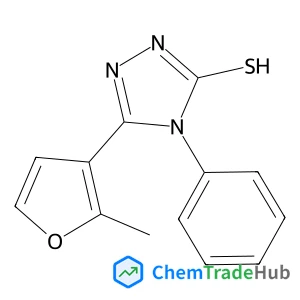
5-(2-Methyl-3-furyl)-4-phenyl-2,4-dihydro-3H-1,2,4-triazole-3-thione
CAS番号:
346464-59-3
分子式:
C13H11N3OS
おすすめサプライヤー





免責事項
このページに表示される学術雑誌情報は、参考および研究目的のみを目的としています。当社は雑誌出版社とは提携しておらず、投稿の取り扱いも行っておりません。出版に関するお問い合わせは、各雑誌出版社に直接ご連絡ください。
表示されている情報に誤りがある場合は、support@chemtradehub.com までご連絡ください。迅速に確認し、対応いたします。