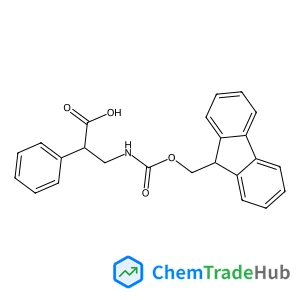
(S)-3-((((9H-Fluoren-9-yl)methoxy)carbonyl)amino)-2-phenylpropanoic acid
CAS番号:
1217663-60-9
分子式:
C24H21NO4
P. Chávez, P. Lévêque, N. Leclerc
Three π-conjugated alternating copolymers, based on dibenzosilole as an electron-rich unit and fluorinated or non-fluorinated quinoxaline as an electron-withdrawing unit, connected through thiazole or thiophene moieties, have been synthesized, fully characterized and applied as donors in polymer solar cells (PSCs). The three copolymers, namely PDBS-TQx, PDBS-TQxF and PDBS-TzQx, belong to the wide band-gap semiconductor materials family, and they show an absorption edge in the visible region close to 650 nm. In order to tune the position of the polymer energy levels, and in particular to decrease their HOMO energy level, we compare the use of a thiazole spacer sandwiching the electron-deficient moiety as an alternative way to the popular backbone fluorination. PSCs based on a blend of PDBS-TQx and [6,6]-phenyl-C71-butyric acid methylester (PC71BM) as an active layer have shown the best device performances with a maximum power conversion efficiency (PCE) of 5.14% for the active area of 0.28 cm2 (under standard illumination of AM 1.5G, 1000 W m−2). Interestingly this polymer outperforms P3HT:(PC61BM) solar cells used as a reference material in this work. In addition to the thorough characterization data, including among other spectroscopy techniques, XRD, OFET, AFM and nc-AFM, we discuss in detail the relationship between the chemical structures of the three polymers, their optoelectronic properties, the phase separation in blends with PC71BM and their photovoltaic performances.
DOI: 10.1039/C3CP51743H
Yang Song
DOI: 10.1039/C3CP52154K
Devin T. Edwards, Zhidong Ma, Daniella Goldfarb
DOI: 10.1039/C3CP43787F
Vincenzo Barone, Ivo Cacelli, Alessandro Ferretti
DOI: 10.1039/C3CP50974E
Sarah Jaber, Pamela Nasr, Yan Xin, Fatima Sleem, Lara I. Halaoui
DOI: 10.1039/C3CP51061A
G. Ramos-Sanchez, P. B. Balbuena
DOI: 10.1039/C3CP51791H
Li-Lin Tan, Hong-Yan Chen, Li-Feng Hao, Yong Shen, Li-Min Xiao, Jun-Min Liu, Dai-Bin Kuang, Cheng-Yong Su
DOI: 10.1039/C3CP51633D
Yilei Wu, Agnieszka Olzyńska, Martin Hof, Gokhan Yahioglu, Duncan R. Casey, Oscar Ces, Jana Humpolíčková, Marina K. Kuimova
DOI: 10.1039/C3CP51953H
Joshua J. Melko, Shaun G. Ard, Joseph A. Fournier, Jun Li, Nicholas S. Shuman, Hua Guo, Albert A. Viggiano
DOI: 10.1039/C3CP50335F
6- bromo-1-cyclopropyl-1H-benzimidazoleは、抗炎症、抗ウイルス作用を持つことが報告されており、新薬開発の研究対象として注目...
取り扱う際には、防護眼鏡と手袋を使用し、ドラフトチャンバー内で操作することを推奨します。漏洩時には適切な手順で処理し、安全データシートを常に参照してください。
2,2’-ジメチル-3,3’-ビピリジンは、ピリジンと2-メチルアクリルアミドを有機合成反応で合成します。この反応では、ピリジンと2-メチルアクリルアミドを含有...
6-甲基ピリジン-2-ボリック酸は、合成化学、医薬品合成、以及研究用途などに広く使用され、特に組換えDNA技術や分子生物学の研究において重要な役割を果たします。
(R)-3-(1-甲基-2-氧環己基)プロpano酸メチルは一定の安全性がありますが、直接的な皮膚接触や吸入は避けるべきです。使用する際は適切な個々の安全データ...
ketorolacは、密封して遮光容器に保管し、直射日光や高温を避けて保存してください。温度は常温で保存し、湿度をなるべく低く保つことが推奨されます。
L-2,3-二氨基丙酸二盐酸盐は腐食性が強く、皮膚や粘膜に刺激を与える可能性があります。取り扱う際は、防塵マスク、ゴーグル、手袋を使用し、適切な排気設備を使用し...
2-(4-溴ピリジン-2-基)乙腈のCAS番号は312325-73-8です。主に結晶形態で存在し、分子量は159.01 g/molです。この化合物は水に溶けやす...
この化合物は毒性は低いですが、直接的な接触や吸入に注意が必要です。PPE(個人防護具)を着用し、ドラフトチャンバーを使用して操作することを推奨します。また、漏洩...
3-(1-氧代-1,3-二氢-2H-2-异吲哚)丙酸は、薬理学研究や医薬品製造において広く用いられる化合物です。また、工業的な用途でも一部の化学反応の触媒や助剤...

Polymer Chemistry welcomes submissions in all areas of polymer science that have a strong focus on macromolecular chemistry. Manuscripts may cover a broad range of fields, yet no direct application focus is required.