












Preparation and characterization of long chain branched polycarbonates with significantly enhanced environmental stress cracking behavior through gamma radiation with addition of difunctional monomer
文献情報
出版日
2016-05-03
DOI
10.1039/C6PY00289G
インパクトファクター
5.582
著者
Xiaohang Han, Yangguang Hu, Miao Tang, Huagao Fang, Qianghua Wu, Zhigang Wang
原文を見る
要旨
In this study a series of long chain branched polycarbonates (LCB-PCs) was prepared from linear PC precursors through gamma radiation with addition of a difunctional monomer, divinyl benzene (DVB) of varying amounts. The topological structures of the linear PCs and LCB-PCs were measured by size-exclusion chromatography coupled with a multiangle light scattering detector (SEC-MALLS) and rheology. SEC-MALLS measurements showed that the topological structures of the PCs were changed with the introduction of LCB structures. Rheological measurements showed that the LCB structures of the LCB-PCs contributed to enhancements of storage modulus, complex viscosity, shear-thinning behavior, and the deviation of phase angle, δ, from the “standard” curve of linear PCs in the δ − |G*| plots (van Gurp–Palmen plot). Modulated differential scanning calorimetry (MDSC) measurements showed that the glass transition temperature, Tg, of LCB-PCs decreases with increasing LCB degree, which is attributed to the combined effects of both increased branching density and free chain ends. LCB structures introduced into PCs did not apparently weaken the tensile properties of the PC materials, whereas the notched Izod impact strength could be obviously improved by the LCB structures. More importantly, the influence of LCB structures on the environmental stress cracking (ESC) behavior of LCB-PCs was explored and the results indicated that the ESC properties of LCB-PCs could be significantly enhanced with the introduction of LCB structures, which makes the application of LCB-PCs as the window view materials for helmets worn by astronauts while in outer space a possibility.
おすすめジャーナル
関連文献
An ENDOR and DFT analysis of hindered methyl group rotations in frozen solutions of bis(acetylacetonato)-copper(ii)
Katherine M. Sharples, Emma Carter, Colan E. Hughes, Kenneth D. M. Harris, James A. Platts, Damien M. Murphy
2013-08-05
Paper
DOI: 10.1039/C3CP52464G
Solution-processable hole-transporting material containing fluorenyl core and triple-carbazolyl terminals: synthesis and application to enhancement of electroluminescence
Chia-Shing Wu, Szu-Wen Fang, Yun Chen
2013-07-17
Paper
DOI: 10.1039/C3CP52087K
The mechanistic exploration of porous activated graphene sheets-anchored SnO2nanocrystals for application in high-performance Li-ion battery anodes
Yingchang Yang, Xiaobo Ji, Fang Lu, Qiyuan Chen, Craig E. Banks
2013-08-07
Paper
DOI: 10.1039/C3CP52808A
Chromism based on supramolecular H-bonds
Chuanlang Zhan, Xunlei Ding, Shanlin Zhang, Xin Zhang, Huiying Liu, Lili Chen, Yishi Wu, Hongbing Fu, Shenggui He, Yan Huang, Jiannian Yao
2013-05-20
Paper
DOI: 10.1039/C3CP51268A
Propagation of nanopores during anodic etching of n-InP in KOH
Robert P. Lynch, Nathan Quill, Shohei Nakahara, D. Noel Buckley
2013-07-31
Paper
DOI: 10.1039/C3CP52253A
QM/MM surface-hopping dynamics of a bridged azobenzene derivative
2013-07-08
Paper
DOI: 10.1039/C3CP50606A
Charge transport characteristics of a high-mobility diketopyrrolopyrrole-based polymer
Dae Sung Chung, Il Kang, Yun-Hi Kim, Soon-Ki Kwon
2013-07-08
Paper
DOI: 10.1039/C3CP52422A
Surface plasmon resonance-based fiber optic hydrogen sulphide gas sensor utilizing Cu–ZnO thin films
Rana Tabassum, Satyendra K. Mishra, Banshi D. Gupta
2013-05-30
Paper
DOI: 10.1039/C3CP51525G
Water and water-like liquids: relationships between structure, entropy and mobility
Divya Nayar, Charusita Chakravarty
2013-07-29
Perspective
DOI: 10.1039/C3CP51114F
Time-resolved photoelectron spectroscopy of adenine and adenosine in aqueous solution
Franziska Buchner, Hans-Hermann Ritze, Jan Lahl, Andrea Lübcke
2013-05-07
Paper
DOI: 10.1039/C3CP51057C
こちらもおすすめ
化合物よくある質問
6- bromo-1-cyclopropyl-1H-benzimidazoleの市場動向や研究トレンドはどうですか?
6- bromo-1-cyclopropyl-1H-benzimidazoleは、抗炎症、抗ウイルス作用を持つことが報告されており、新薬開発の研究対象として注目...
1416713-53-56-Bromo-1-cyclopropy...
化合物よくある質問
環氧プロpanol-d5を取り扱う際の実験室安全事項は何ですか?
取り扱う際には、防護眼鏡と手袋を使用し、ドラフトチャンバー内で操作することを推奨します。漏洩時には適切な手順で処理し、安全データシートを常に参照してください。
1246819-20-4Glycidol-d5
化合物よくある質問
2,2’-ジメチル-3,3’-ビピリジンはどのように合成されますか?
2,2’-ジメチル-3,3’-ビピリジンは、ピリジンと2-メチルアクリルアミドを有機合成反応で合成します。この反応では、ピリジンと2-メチルアクリルアミドを含有...
86156-55-02,2’-Dimethyl-3,3’-b...
化合物よくある質問
6-甲基ピリジン-2-ボリック酸の主な用途は何ですか?
6-甲基ピリジン-2-ボリック酸は、合成化学、医薬品合成、以及研究用途などに広く使用され、特に組換えDNA技術や分子生物学の研究において重要な役割を果たします。
372963-50-3(6-Methyl-2-pyridiny...
化合物よくある質問
(R)-3-(1-甲基-2-氧環己基)プロpano酸メチルは安全ですか?
(R)-3-(1-甲基-2-氧環己基)プロpano酸メチルは一定の安全性がありますが、直接的な皮膚接触や吸入は避けるべきです。使用する際は適切な個々の安全データ...
94089-47-1methyl 3-[(1R)-1-met...
化合物よくある質問
ketorolacはどのように保存すればよいですか?
ketorolacは、密封して遮光容器に保管し、直射日光や高温を避けて保存してください。温度は常温で保存し、湿度をなるべく低く保つことが推奨されます。
74103-06-3rac Ketorolac
化合物よくある質問
L-2,3-二氨基丙酸二盐酸盐を取り扱う際の実験室安全事項は何ですか?
L-2,3-二氨基丙酸二盐酸盐は腐食性が強く、皮膚や粘膜に刺激を与える可能性があります。取り扱う際は、防塵マスク、ゴーグル、手袋を使用し、適切な排気設備を使用し...
19777-68-5(S)-2,3-Diaminopropa...
化合物よくある質問
2-(4-溴ピリジン-2-基)乙腈の物理化学的性質は何ですか?
2-(4-溴ピリジン-2-基)乙腈のCAS番号は312325-73-8です。主に結晶形態で存在し、分子量は159.01 g/molです。この化合物は水に溶けやす...
312325-73-8(4-Bromo-2-pyridinyl...
化合物よくある質問
3-フローロ-[1,1-ベンジレン]-3,4-ジカルボン酸を取り扱う際の実験室安全事項は何ですか?
この化合物は毒性は低いですが、直接的な接触や吸入に注意が必要です。PPE(個人防護具)を着用し、ドラフトチャンバーを使用して操作することを推奨します。また、漏洩...
1261915-32-53'-Fluoro-[1,1'-biph...
化合物よくある質問
3-(1-氧代-1,3-二氢-2H-2-异吲哚)丙酸の主な用途は何ですか?
3-(1-氧代-1,3-二氢-2H-2-异吲哚)丙酸は、薬理学研究や医薬品製造において広く用いられる化合物です。また、工業的な用途でも一部の化学反応の触媒や助剤...
83747-30-23-(1-Oxo-1,3-dihydro...
掲載誌
Polymer Chemistry

CiteScore:
8.6
自己引用率:
7.3%
年間論文数:
457
Polymer Chemistry welcomes submissions in all areas of polymer science that have a strong focus on macromolecular chemistry. Manuscripts may cover a broad range of fields, yet no direct application focus is required.
おすすめ化合物
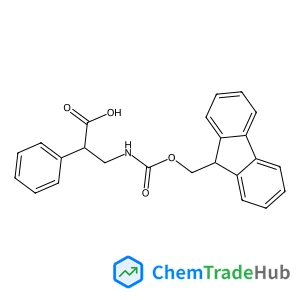
(S)-3-((((9H-Fluoren-9-yl)methoxy)carbonyl)amino)-2-phenylpropanoic acid
CAS番号:
1217663-60-9
分子式:
C24H21NO4
![(2S)-2-{[(9H-Fluoren-9-ylmethoxy)carbonyl]amino}-4-(methylselanyl)butanoic acid structure](https://static.chemtradehub.com/structs/121/1217852-49-7-f252.webp "(2S)-2-{[(9H-Fluoren-9-ylmethoxy)carbonyl]amino}-4-(methylselanyl)butanoic acid structure")
(2S)-2-{[(9H-Fluoren-9-ylmethoxy)carbonyl]amino}-4-(methylselanyl)butanoic acid
CAS番号:
1217852-49-7
分子式:
C20H21NO4Se
おすすめサプライヤー






免責事項
このページに表示される学術雑誌情報は、参考および研究目的のみを目的としています。当社は雑誌出版社とは提携しておらず、投稿の取り扱いも行っておりません。出版に関するお問い合わせは、各雑誌出版社に直接ご連絡ください。
表示されている情報に誤りがある場合は、support@chemtradehub.com までご連絡ください。迅速に確認し、対応いたします。