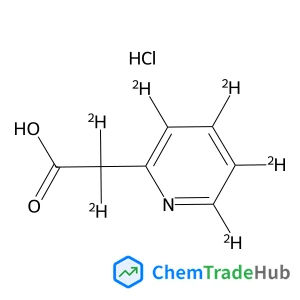
2,2-dideuterio-2-(3,4,5,6-tetradeuterio-2-pyridyl)acetic acid;hydrochloride
CAS番号:
1329799-67-8
分子式:
C7H2ClD6NO2
Marta Corno, Massimo Delle Piane, Patrick Choquet, Piero Ugliengo
A density functional theory (PBE functional) investigation is carried out, in which a model of an amorphous silica surface is functionalized by ortho-benzoquinone. Surface functionalization with catechol and quinone-based compounds is relevant in biomedical fields, from prosthetic implants to dentistry, to develop multifunctional coatings with antimicrobial properties. The present study provides atomistic information on the specific interactions between the functionalizing agent and the silanol groups at the silica surface. The distinct configurations of the functional groups, the hydrogen bond pattern, the role of dispersion forces and the simulated IR spectra provide detailed insight into the features of this model surface coating. Ab initio molecular dynamics gives further insights into the mobility of the functionalizing groups. As a final step, we studied the condensation reaction with allylamine, via Schiff base formation, to ground subsequent simulations on condensation with model peptides of antimicrobial activity.
Xiujuan Shi, Yuecheng Cui, Weikang Yang, Lin Yuan, Hong Chen
DOI: 10.1039/C6PY00882H
So Young Lee, Sukjae Hong, Jong Hyun Jang, Dirk Henkensmeier, Sung Jong Yoo, Hyoung-Juhn Kim, Sung-Hyun Kim
DOI: 10.1039/C4PY01218F
Francesca Lorandi, Abdirisak A. Isse, Armando Gennaro
DOI: 10.1039/C6PY01032F
Kun Wei, Lei Wang, Lei Li, Sixun Zheng
DOI: 10.1039/C4PY00786G
Irina V. Vasilenko, Ivan A. Berezianko, Dmitriy I. Shiman, Sergei V. Kostjuk
DOI: 10.1039/C6PY01325B
Barbara E. Rolfe, Pamela J. Russell, Brian W.-C. Tse
DOI: 10.1039/C4PY00999A
Yi Han, Bo Zhu, Ying Chen, Zhishan Bo, Yulan Chen
DOI: 10.1039/C7PY01052D
Ihor Kulai, Jens Ulbrich, Ramiro Guerrero-Santos, Mathias Destarac, Simon Harrisson
DOI: 10.1039/C7PY00495H
Yuping Zhao, Guiqiang He, Weihong Guo, Lili Bao, Meijun Yi, Yongkuan Gong, Shiping Zhang
DOI: 10.1039/C6PY00845C
CAS番号163217-74-1の「邻羟基阿托伐他汀内酯标准品」は、GHS分類では危険物に分類されず、主にREACH規則とFDA/EPAの管理対象となります。R...
メチル(3R)-3-アミノ-2,3-ジヒドロ-1-ベンゾファンラニン-5-カルボイル酸塩塩酸塩は、医薬品や合成化学の研究に広く用いられます。また、特定の薬物の前...
トランス-4-メチルピロリジン-3-オール塩酸塩は、4-メチルピロリジンの塩酸塩化によって合成されます。一般的な合成方法では、4-メチルピロリジンを塩酸に加えて...
硫雜環丁烷-1,1-二氧化物は安全ではありません。毒性は報告されていませんが、高温下で分解し、可燃性があるため、高圧ガスは注意が必要です。密閉した容器で保管し、...
9-ヒドロキシエリプチシネ塩酸塩は、エリプチシネから塩酸を添加することで合成されます。選択性は高いですが、収率は約70%です。
5-塩素-2-(メチルアミノ)フェニル-(2-塩素フェニル)メタン酮のCAS番号は5621-86-3です。この化合物は白色の結晶性粉末で、分子量は415.03で...
1-[2-(4-甲氧基-苯氧基)-乙基]-哌嗪は、直射日光を避けて暗所に、室温(15-25℃)で保管し、密閉容器に入れることで安定性を保つことができます。
2-[3-(4-甲氧基フェニル)プロピル]-4,4,5,5-四メチル-1,3,2-ドイボロロールアンは、医薬品の合成、有機合成化学、および新材料の研究で使用され...

Physical Chemistry Chemical Physics (PCCP) is an international journal co-owned by 19 physical chemistry and physics societies from around the world. This journal publishes original, cutting-edge research in physical chemistry, chemical physics and biophysical chemistry. To be suitable for publication in PCCP, articles must include significant innovation and/or insight into physical chemistry; this is the most important criterion that reviewers and Editors will judge against when evaluating submissions. The journal has a broad scope and welcomes contributions spanning experiment, theory, computation and data science. Topical coverage includes spectroscopy, dynamics, kinetics, statistical mechanics, thermodynamics, electrochemistry, catalysis, surface science, quantum mechanics, quantum computing and machine learning. Interdisciplinary research areas such as polymers and soft matter, materials, nanoscience, energy, surfaces/interfaces, and biophysical chemistry are welcomed if they demonstrate significant innovation and/or insight into physical chemistry. Joined experimental/theoretical studies are particularly appreciated when complementary and based on up-to-date approaches.