












Computational study of the interplay between intermolecular interactions and CO2 orientations in type I hydrates
文献情報
出版日
2016-12-12
DOI
10.1039/C6CP07097C
インパクトファクター
3.676
著者
M. Pérez-Rodríguez, A. Vidal-Vidal, J. M. Míguez, F. J. Blas, J.-P. Torré, M. M. Piñeiro
原文を見る
要旨
Carbon dioxide (CO2) molecules show a rich orientation landscape when they are enclathrated in type I hydrates. Previous studies have described experimentally their preferential orientations, and some theoretical works have explained, but only partially, these experimental results. In the present paper, we use classical molecular dynamics and electronic density functional theory to advance in the theoretical description of CO2 orientations within type I hydrates. Our results are fully compatible with those previously reported, both theoretical and experimental, the geometric shape of the cavities in hydrate being, and therefore, the steric constraints, responsible for some (but not all) preferential angles. In addition, our calculations also show that guest–guest interactions in neighbouring cages are a key factor to explain the remaining experimental angles. Besides the implication concerning equation of state hydrate modeling approximations, the conclusion is that these guest–guest interactions should not be neglected, contrary to the usual practice.
関連文献
Interfacial charge separation and photovoltaic efficiency in Fe(ii)–carbene sensitized solar cells
Mariachiara Pastore, Thibaut Duchanois, Li Liu, Antonio Monari, Xavier Assfeld, Stefan Haacke, Philippe C. Gros
2016-09-16
Paper
DOI: 10.1039/C6CP05535D
Dynamic disorder, phonon lifetimes, and the assignment of modes to the vibrational spectra of methylammonium lead halide perovskites
Aurélien M. A. Leguy, Jarvist M. Frost, Jonathan Skelton, Federico Brivio, Xabier Rodríguez-Martínez, Oliver J. Weber, Anuradha Pallipurath, M. Isabel Alonso, Mariano Campoy-Quiles, Mark T. Weller, Aron Walsh, Piers R. F. Barnes
2016-06-17
Communication
DOI: 10.1039/C6CP03474H
New insights into the photoswitching mechanisms of normal dithienylethenes
G. Buntinx, O. Devos, N. Jaïdane, S. Delbaere, A. K. Tiwari, J. Dubois, M. Takeshita, Y. Wada, S. Aloïse
2016-09-13
Paper
DOI: 10.1039/C6CP03471C
Exploration of the phase diagram of liquid water in the low-temperature metastable region using synthetic fluid inclusions
C. Qiu, Y. Krüger, M. Wilke, J. Rička, M. Frenz
2016-09-01
Paper
DOI: 10.1039/C6CP04250C
Efficient light harvesting over a CdS/In2O3 photonic crystal photocatalyst for hydrogenation of 4-nitroaniline to p-phenylenediamine
Xiaofang Li, Changqian Wang, Bo Li, Yu Shao, Danzhen Li
2016-09-09
Paper
DOI: 10.1039/C6CP04929J
Half-metallic YN2 monolayer: dual spin filtering, dual spin diode and spin Seebeck effects
Jie Li, Guoying Gao, Yi Min, Kailun Yao
2016-09-16
Paper
DOI: 10.1039/C6CP05626A
Control of calcium accessibility over hydroxyapatite by post-precipitation steps: influence on the catalytic reactivity toward alcohols
Manel Ben Osman, Sarah Diallo Garcia, Jean-Marc Krafft, Christophe Methivier, Juliette Blanchard, Tetsuya Yoshioka, Jun Kubo, Guylène Costentin
2016-09-13
Paper
DOI: 10.1039/C6CP05294K
The first example of ab initio calculations of f–f transitions for the case of [Eu(DOTP)]5− complex—experiment versus theory
Rafał Janicki, Andrzej Kędziorski, Anna Mondry
2016-09-12
Paper
DOI: 10.1039/C6CP05284C
Helium droplet infrared spectroscopy of glycine and glycine–water aggregates
Matin Kaufmann, Daniel Leicht, Raffael Schwan, Devendra Mani, Gerhard Schwaab, Martina Havenith
2016-09-21
Paper
DOI: 10.1039/C6CP05042E
A comparative study of small 3d-metal oxide (FeO)n, (CoO)n, and (NiO)n clusters
G. L. Gutsev, K. G. Belay, L. G. Gutsev, B. R. Ramachandran
2016-09-12
Paper
DOI: 10.1039/C6CP03241A
こちらもおすすめ
化合物よくある質問
4'-ブロモビフェニル-3-メトークシーディ.ActionBarはどのように保存すればよいですか?
4'-ブロモビフェニル-3-メトークシーディ.ActionBarは、冷暗所で、直射日光を避け、密栓の容器に保存し、遠隔場所に保管してください。温度は常温(0〜2...
149506-25-24'-Bromo-biphenyl-3-...
2947-60-6(3-Methylphenyl)acet...
化合物よくある質問
2-異丙基フェニルヒドラジン塩酸塩とは何ですか?
2-異丙基フェニルヒドラジン塩酸塩は、CAS番号58928-82-8を有する化合物で、構造式はC11H14N2HClです。これは塩基性化合物であり、水に溶けやす...
58928-82-8(2-Isopropylphenyl)h...
化合物よくある質問
5-(4-クロロフェニル)-4H-1,2,4-三氮唑-3-アミンを取り扱う際の実験室安全事項は何ですか?
5-(4-クロロフェニル)-4H-1,2,4-三氮唑-3-アミンは取り扱いに注意が必要です。PPEとして防塵マスク、ゴーグル、手袋を使用し、ドラフトチャンバーを...
98554-00-85-(4-Chlorophenyl)-1...
化合物よくある質問
去甲基雷贝拉唑硫醚はどのように合成されますか?
去甲基雷贝拉唑硫醚は、ベンジミダゾール硫化物と3-メチル-4-ピリジノールの反応によって合成されます。具体的には、2-チオキシドベンジミダゾールと3-メチル-4...
117976-91-73-({2-[(1H-Benzimida...
化合物よくある質問
2-ブロモ-5-フロロ-N-(2-フェノールメチル)ベンゼンウレアは安全ですか?
2-ブロモ-5-フロロ-N-(2-フェノールメチル)ベンゼンウレアは、毒性や刺激性の実験データに基づき、適切な取扱いと防護措置を講じることで安全に使用できます。...
923722-86-52-Bromo-5-fluoro-N-(...
化合物よくある質問
対甲苯磺酸酯-四聚乙二醇-四氢吡喃醚の物理化学的性質は何ですか?
対甲苯磺酸酯-四聚乙二醇-四氢吡喃醚のCAS番号は86259-89-4です。この化合物は無色の液体で、分子量は約724.8です。高濃度では溶血性が報告されており...
86259-89-42-(2-{2-[2-(Tetrahyd...
化合物よくある質問
2-(3-(二氟甲基)-4-氟苯基)-4,4,5,5-四甲基-1,3,2-二噁硼戊環はどのように保存すればよいですか?
2-(3-(二氟甲基)-4-氟苯基)-4,4,5,5-四甲基-1,3,2-二噁硼戊環は、室温で暗い場所に保管し、直射日光から遠ざけ、容器は密閉状態で保存してくだ...
445303-65-12-[3-(difluoromethyl...
化合物よくある質問
6-アミノ-5-クロロ-2-シクロプロピルピリミジンカルボン酸の代替品はありますか?
この化合物の代替品には、ピロリミジン酸やその類似物、またピロリミジンカルボン酸の他の異性体があります。これらの代替品は、特定の化学反応や目的に応じて選択すること...
858956-08-86-Amino-5-chloro-2-c...
化合物よくある質問
5-クロロベンゾ[1,3]二オキセイン-4-アミンに適用される法規ガイドラインは何ですか?
5-クロロベンゾ[1,3]二オキセイン-4-アミンはCAS番号379228-45-2に該当します。この化合物はGHS分類でH314(接触により急性毒性がある)と...
379228-45-25-Chloro-1,3-benzodi...
掲載誌
Physical Chemistry Chemical Physics

CiteScore:
5.5
自己引用率:
10.3%
年間論文数:
3036
Physical Chemistry Chemical Physics (PCCP) is an international journal co-owned by 19 physical chemistry and physics societies from around the world. This journal publishes original, cutting-edge research in physical chemistry, chemical physics and biophysical chemistry. To be suitable for publication in PCCP, articles must include significant innovation and/or insight into physical chemistry; this is the most important criterion that reviewers and Editors will judge against when evaluating submissions. The journal has a broad scope and welcomes contributions spanning experiment, theory, computation and data science. Topical coverage includes spectroscopy, dynamics, kinetics, statistical mechanics, thermodynamics, electrochemistry, catalysis, surface science, quantum mechanics, quantum computing and machine learning. Interdisciplinary research areas such as polymers and soft matter, materials, nanoscience, energy, surfaces/interfaces, and biophysical chemistry are welcomed if they demonstrate significant innovation and/or insight into physical chemistry. Joined experimental/theoretical studies are particularly appreciated when complementary and based on up-to-date approaches.
おすすめ化合物
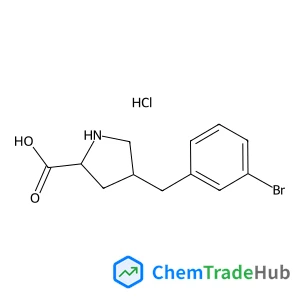
(2S,4R)-4-(3-Bromobenzyl)pyrrolidine-2-carboxylic acid hydrochloride
CAS番号:
1049734-10-2
分子式:
C12H15BrClNO2
おすすめサプライヤー






免責事項
このページに表示される学術雑誌情報は、参考および研究目的のみを目的としています。当社は雑誌出版社とは提携しておらず、投稿の取り扱いも行っておりません。出版に関するお問い合わせは、各雑誌出版社に直接ご連絡ください。
表示されている情報に誤りがある場合は、support@chemtradehub.com までご連絡ください。迅速に確認し、対応いたします。