












![(3S,4aS,8aS)-2-[(2R,3S)-3-Amino-2-hydroxy-4-phenylbutyl]-N-(2-methyl-2-propanyl)decahydro-3-isoquinolinecarboxamide structure](https://static.chemtradehub.com/structs/136/136522-17-3-4d77.webp "(3S,4aS,8aS)-2-[(2R,3S)-3-Amino-2-hydroxy-4-phenylbutyl]-N-(2-methyl-2-propanyl)decahydro-3-isoquinolinecarboxamide structure")
Molecular hydrogen production from amorphous solid water during low energy electron irradiation
文献情報
出版日
2017-01-09
DOI
10.1039/C6CP06928B
インパクトファクター
3.676
著者
Martin R. S. McCoustra
原文を見る
要旨
This work investigates the production of molecular hydrogen isotopologues (H2, HD, and D2) during low energy electron irradiation of layered and isotopically labelled thin films of amorphous solid water (ASW) in ultrahigh vacuum. Experimentally, the production of these molecules with both irradiation time and incident electron energy in the range 400 to 500 eV is reported as a function of the depth of a buried D2O layer in an H2O film. H2 is produced consistently in all measurements, reflecting the H2O component of the film, though it does exhibit a modest reduction in intensity at the time corresponding to product escape from the buried D2O layer. In contrast, HD and D2 production exhibit peaks at times corresponding to product escape from the buried D2O layer in the composite film. These features broaden the deeper the HD or D2 is formed due to diffusion. A simple random-walk model is presented that can qualitatively explain the appearance profile of these peaks as a function of the incident electron penetration.
関連文献
Incorporating QM and solvation into docking for applications to GPCR targets
Minsup Kim, Art E. Cho
2016-09-16
Paper
DOI: 10.1039/C6CP04742D
A heterojunction photocatalyst composed of zinc rhodium oxide, single crystal-derived bismuth vanadium oxide, and silver for overall pure-water splitting under visible light up to 740 nm
Ryoya Kobayashi, Toshihiro Takashima, Satoshi Tanigawa, Shugo Takeuchi, Bunsho Ohtani
2016-06-30
Paper
DOI: 10.1039/C6CP02903E
Prediction of flatness-driven quantum spin Hall effect in functionalized germanene and stanene
Run-wu Zhang, Wei-xiao Ji, Chang-wen Zhang, Ping Li, Pei-ji Wang
2016-09-21
Paper
DOI: 10.1039/C6CP06216D
Resonant multiphoton ionisation probe of the photodissociation dynamics of ammonia
Adam D. Smith, Hannah M. Watts, Edward Jager, Daniel A. Horke, Emma Springate, Oliver Alexander, Cephise Cacho, Richard T. Chapman, Russell S. Minns
2016-09-16
Paper
DOI: 10.1039/C6CP05279G
Dynamic disorder, phonon lifetimes, and the assignment of modes to the vibrational spectra of methylammonium lead halide perovskites
Aurélien M. A. Leguy, Jarvist M. Frost, Jonathan Skelton, Federico Brivio, Xabier Rodríguez-Martínez, Oliver J. Weber, Anuradha Pallipurath, M. Isabel Alonso, Mariano Campoy-Quiles, Mark T. Weller, Aron Walsh, Piers R. F. Barnes
2016-06-17
Communication
DOI: 10.1039/C6CP03474H
Electronic and optical properties of MAPbX3 perovskites (X = I, Br, Cl): a unified DFT and GW theoretical analysis
Paolo Umari
2016-09-08
Paper
DOI: 10.1039/C6CP03969C
Interfacial charge separation and photovoltaic efficiency in Fe(ii)–carbene sensitized solar cells
Mariachiara Pastore, Thibaut Duchanois, Li Liu, Antonio Monari, Xavier Assfeld, Stefan Haacke, Philippe C. Gros
2016-09-16
Paper
DOI: 10.1039/C6CP05535D
Adsorption dynamics and rate assessment of volatile organic compounds in active carbon
J. Zhu, H. L. Zhan, X. Y. Miao, Y. Song, K. Zhao
2016-09-08
Communication
DOI: 10.1039/C6CP05593A
Resonant excitation energy transfer from carbon dots to different sized silver nanoparticles
Roopali Prajapati, Arpan Bhattacharya, Tushar Kanti Mukherjee
2016-09-23
Paper
DOI: 10.1039/C6CP05451J
こちらもおすすめ
化合物よくある質問
4'-ブロモビフェニル-3-メトークシーディ.ActionBarはどのように保存すればよいですか?
4'-ブロモビフェニル-3-メトークシーディ.ActionBarは、冷暗所で、直射日光を避け、密栓の容器に保存し、遠隔場所に保管してください。温度は常温(0〜2...
149506-25-24'-Bromo-biphenyl-3-...
2947-60-6(3-Methylphenyl)acet...
化合物よくある質問
2-異丙基フェニルヒドラジン塩酸塩とは何ですか?
2-異丙基フェニルヒドラジン塩酸塩は、CAS番号58928-82-8を有する化合物で、構造式はC11H14N2HClです。これは塩基性化合物であり、水に溶けやす...
58928-82-8(2-Isopropylphenyl)h...
化合物よくある質問
5-(4-クロロフェニル)-4H-1,2,4-三氮唑-3-アミンを取り扱う際の実験室安全事項は何ですか?
5-(4-クロロフェニル)-4H-1,2,4-三氮唑-3-アミンは取り扱いに注意が必要です。PPEとして防塵マスク、ゴーグル、手袋を使用し、ドラフトチャンバーを...
98554-00-85-(4-Chlorophenyl)-1...
化合物よくある質問
去甲基雷贝拉唑硫醚はどのように合成されますか?
去甲基雷贝拉唑硫醚は、ベンジミダゾール硫化物と3-メチル-4-ピリジノールの反応によって合成されます。具体的には、2-チオキシドベンジミダゾールと3-メチル-4...
117976-91-73-({2-[(1H-Benzimida...
化合物よくある質問
2-ブロモ-5-フロロ-N-(2-フェノールメチル)ベンゼンウレアは安全ですか?
2-ブロモ-5-フロロ-N-(2-フェノールメチル)ベンゼンウレアは、毒性や刺激性の実験データに基づき、適切な取扱いと防護措置を講じることで安全に使用できます。...
923722-86-52-Bromo-5-fluoro-N-(...
化合物よくある質問
対甲苯磺酸酯-四聚乙二醇-四氢吡喃醚の物理化学的性質は何ですか?
対甲苯磺酸酯-四聚乙二醇-四氢吡喃醚のCAS番号は86259-89-4です。この化合物は無色の液体で、分子量は約724.8です。高濃度では溶血性が報告されており...
86259-89-42-(2-{2-[2-(Tetrahyd...
化合物よくある質問
2-(3-(二氟甲基)-4-氟苯基)-4,4,5,5-四甲基-1,3,2-二噁硼戊環はどのように保存すればよいですか?
2-(3-(二氟甲基)-4-氟苯基)-4,4,5,5-四甲基-1,3,2-二噁硼戊環は、室温で暗い場所に保管し、直射日光から遠ざけ、容器は密閉状態で保存してくだ...
445303-65-12-[3-(difluoromethyl...
化合物よくある質問
6-アミノ-5-クロロ-2-シクロプロピルピリミジンカルボン酸の代替品はありますか?
この化合物の代替品には、ピロリミジン酸やその類似物、またピロリミジンカルボン酸の他の異性体があります。これらの代替品は、特定の化学反応や目的に応じて選択すること...
858956-08-86-Amino-5-chloro-2-c...
化合物よくある質問
5-クロロベンゾ[1,3]二オキセイン-4-アミンに適用される法規ガイドラインは何ですか?
5-クロロベンゾ[1,3]二オキセイン-4-アミンはCAS番号379228-45-2に該当します。この化合物はGHS分類でH314(接触により急性毒性がある)と...
379228-45-25-Chloro-1,3-benzodi...
掲載誌
Physical Chemistry Chemical Physics

CiteScore:
5.5
自己引用率:
10.3%
年間論文数:
3036
Physical Chemistry Chemical Physics (PCCP) is an international journal co-owned by 19 physical chemistry and physics societies from around the world. This journal publishes original, cutting-edge research in physical chemistry, chemical physics and biophysical chemistry. To be suitable for publication in PCCP, articles must include significant innovation and/or insight into physical chemistry; this is the most important criterion that reviewers and Editors will judge against when evaluating submissions. The journal has a broad scope and welcomes contributions spanning experiment, theory, computation and data science. Topical coverage includes spectroscopy, dynamics, kinetics, statistical mechanics, thermodynamics, electrochemistry, catalysis, surface science, quantum mechanics, quantum computing and machine learning. Interdisciplinary research areas such as polymers and soft matter, materials, nanoscience, energy, surfaces/interfaces, and biophysical chemistry are welcomed if they demonstrate significant innovation and/or insight into physical chemistry. Joined experimental/theoretical studies are particularly appreciated when complementary and based on up-to-date approaches.
おすすめ化合物
![19-[Chloro(dideuterio)methyl]-19-deuterio-20,20-dideuteriooxyoctatriacontane-18,21-dione structure](https://static.chemtradehub.com/structs/124/1246818-85-8-6244.webp "19-[Chloro(dideuterio)methyl]-19-deuterio-20,20-dideuteriooxyoctatriacontane-18,21-dione structure")
![Ethyl thieno[3,2-f]quinoline-2-carboxylate structure](https://static.chemtradehub.com/structs/299/29948-26-3-f62b.webp "Ethyl thieno[3,2-f]quinoline-2-carboxylate structure")
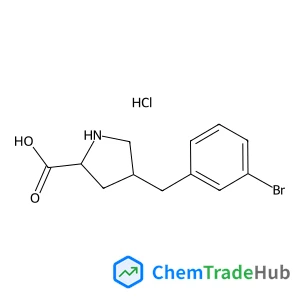
(2S,4R)-4-(3-Bromobenzyl)pyrrolidine-2-carboxylic acid hydrochloride
CAS番号:
1049734-10-2
分子式:
C12H15BrClNO2
おすすめサプライヤー




免責事項
このページに表示される学術雑誌情報は、参考および研究目的のみを目的としています。当社は雑誌出版社とは提携しておらず、投稿の取り扱いも行っておりません。出版に関するお問い合わせは、各雑誌出版社に直接ご連絡ください。
表示されている情報に誤りがある場合は、support@chemtradehub.com までご連絡ください。迅速に確認し、対応いたします。