


Photoluminescence quenching of inorganic cesium lead halides perovskite quantum dots (CsPbX3) by electron/hole acceptor
文献情報
出版日
2016-11-16
DOI
10.1039/C6CP04083G
インパクトファクター
3.676
著者
Yan-Xia Zhang, Hai-Yu Wang, Zhen-Yu Zhang, Yu Zhang, Chun Sun, Yuan-Yuan Yue, Lei Wang, Qi-Dai Chen, Hong-Bo Sun
原文を見る
要旨
Recently, all-inorganic cesium lead halide perovskites (CsPbX3) quantum dots (QDs) have attracted great attention due to their halogen composition and size tunable band gap engineering, the same physical mechanism that is responsible for excellent performance in light-emitting devices. However, little is known about the time-resolved fluorescence quenching dynamics process of these CsPbX3 QDs. In this article, we present comprehensive contrastive spectral studies on the electron and hole extraction dynamics of CsPbX3 colloidal QDs with and without quencher by time-resolved femtosecond transient absorption (TA) and time-correlated single-photon counting (TCSPC) spectroscopy methods. We have identified that the partial electrons of the conduction band and holes of the valence band of CsPbX3 QDs can be directly extracted by tetracyanoethylene (TCNE) and phenothiazine (PTZ), respectively. Moreover, compared with the CsPbBr3 QDs, the CsPbI3 QDs showed relatively slower charge extraction rates. We also found that the CsPbBr3 QDs with smaller size showed faster carrier recombination rates and photoluminescence (PL) decay lifetime due to the relatively stronger quantum confinement effects. We believe that this study may be useful for realising optimal applications in photovoltaic and light emission devices.
おすすめジャーナル

New Journal of Chemistry

Journal of Peptide Science

Nature Medicine

Russian Journal of Coordination Chemistry

Chemistry Education Research and Practice

Journal of Saudi Chemical Society

Crystallography Reports

Russian Journal of General Chemistry

Russian Chemical Bulletin

Current Opinion in Solid State & Materials Science
関連文献
Animal fats as a suitable feedstock for co-processing with atmospheric gas oil
Héctor de Paz Carmona, Aleš Vráblík, José Miguel Hidalgo Herrador, Romana Velvarská, Radek Černý
2021-09-02
Paper
DOI: 10.1039/D1SE00917F
Thermodynamic analysis of the electrochemical synthesis of ammonia in solid-state proton-conducting electrochemical reactors considering interfacial potential steps
Wenchao Lian, Yingyu Mo, Libin Lei, Jihao Zhang, Yongzhen Ou, Ruiming Qiu, Zhipeng Tian, Jianping Liu, Jiang Liu
2021-12-27
Paper
DOI: 10.1039/D1SE01735G
Enhancing the thermoelectric efficiency in p-type Mg3Sb2via Mg site co-doping
Manjusha Battabyal, P. K. Jain, Avnee Chauhan, Dillip K. Satapathy, Raghavan Gopalan
2021-07-01
Paper
DOI: 10.1039/D1SE00656H
A photocatalyst foam for superior visible-light photocatalytic hydrogen evolution
2021-08-23
Paper
DOI: 10.1039/D1SE00934F
Tuning the synergistic effects of MoS2 and spinel NiFe2O4 nanostructures for high performance energy storage and conversion applications
Pratik V. Shinde, Shyam Babu, Shrawan Kr Mishra, Dattatray Late, Chandra Sekhar Rout, Manoj Kumar Singh
2021-06-15
Paper
DOI: 10.1039/D1SE00378J
Layered BiOCl/H+TiNbO5− heterojunctions for boosting visible-light-driven photocatalytic RhB degradation
Chao Liu, Xin Gao, Caijun Zhangai, Ting Cheng, Yan Wang, Beibei Zhang, Pengyu Dong, Xiaowei Chen, Xinguo Xi, Zhigang Zou
2021-08-02
Paper
DOI: 10.1039/D1SE01115D
One-step hydrogenolysis of 5-hydroxymethylfurfural to 1,2,6-hexanetriol using a Pt@MIL-53-derived Pt@Al2O3 catalyst and NaBH4 in aqueous media
Babasaheb M. Matsagar, Hsiang-L. Sung, Jyun-Yi Yeh, Ching-Tien Chen
2021-07-03
Paper
DOI: 10.1039/D1SE00802A
Fluidization and reaction behavior in chemical looping gasification of lignite
Jie Yang, Shengyu Liu, Zhiying Guo, Ran Ao, Quxiu Dai, Yuxin Sun, Zhiyong Deng, Xiandong Tan, Yijin Yang, Liping Ma
2021-06-03
Paper
DOI: 10.1039/D1SE00627D
Few-layered ultra-small MoS2 nanosheet cathode for high-performance rechargeable aluminum-ion battery
Qiang Zhang, Qianfeng Liu, Erdong Wang
2021-08-03
Communication
DOI: 10.1039/D1SE00959A
こちらもおすすめ
化合物よくある質問
カルボニル基が付いた5-氰基-1-{[(2-メチル-2-プロpanyl)オキシ]カーボンイル}1H-吲哚-2-イリド-2-ボリン酸はどのように保存すればよいですか?
カルボニル基が付いた5-氰基-1-{[(2-メチル-2-プロpanyl)オキシ]カーボンイル}1H-吲哚-2-イリド-2-ボリン酸は、直射日光を避けて室温(15...
475102-15-9(5-Cyano-1-{[(2-meth...
化合物よくある質問
tert-ブチル2-クロロメチルピリジン-3-基炭酸エステルの市場動向や研究トレンドはどうですか?
この化合物は合成化学分野において、特にピリジン化合物の合成や改良に用いられます。最近の研究では、ピリジン化合物の新規合成法や特性の改良が注目されています。市場動...
1203498-98-9tert-Butyl 2-chloro-...
化合物よくある質問
聚二季戊四醇六丙烯酸酯はどの業界で使用されていますか?
聚二季戊四醇六丙烯酸酯は、医薬品、ポリマー、センサー、半導体などの業界で広く使用されています。特にポリマー業界では硬化剤として、医薬分野では医療機器の製造に使用...
29570-58-93-(Acryloyloxy)-2-({...
化合物よくある質問
1-氯-5-硝基异喹啉の市場動向や研究トレンドはどうですか?
1-氯-5-硝基异喹啉は、薬理学や合成化学の研究分野で注目されています。市場動向としては、その生物学的な活性や合成可能性を評価する研究が増えています。また、代替...
58142-97-51-Chloro-5-nitroisoq...
化合物よくある質問
2-チロール-5-メチルスルフェニル-3-trifルオルメチルベンゼンはどのように合成されますか?
2-チロール-5-メチルスルフェニル-3-trifルオルメチルベンゼンは、トリフルオロメチル化反応と硫化反応を経て合成されます。通常、トリフルオロメチル化剤と硫...
957066-04-51-Chloro-4-(methylsu...
化合物よくある質問
p-トールイルマグネシウムブロミドの物理化学的性質は何ですか?
p-トールイルマグネシウムブロミドのCAS番号は4294-57-9です。この化合物は白色の結晶性粉末で、分子量は204.32です。溶剤中で良好に溶解しますが、水...
4294-57-9p-Tolylmagnesium bro...
化合物よくある質問
1-(5-甲基-2-硫化素基)プロパン-1-酮の市場動向や研究トレンドはどうですか?
1-(5-甲基-2-硫化素基)プロパン-1-酮の市場動向は、化学産業全体の需要に影響を受けますが、最近では pharmaceutical 分野での応用が注目され...
59303-13-81-(5-Methyl-2-thieny...
化合物よくある質問
十一碳烯酰甘氨酸を取り扱う際の実験室安全事項は何ですか?
十一碳烯酰甘氨酸は吸入や皮膚から吸収されることがあり、取り扱う際には防塵マスクと手袋を使用してください。ドラフトチャンバーを用いて漏洩を処理し、適切なSDS(S...
54301-26-7N-10-Undecenoylglyci...
化合物よくある質問
1H,1H-全氟-3,6-二氧杂葵-1-醇を取り扱う際の実験室安全事項は何ですか?
この化合物は吸入や皮膚吸収による毒性があるため、防塵マスク、ゴーグル、防護手袋を使用する必要があります。ドラフトチャンバーでの操作が必要です。漏洩時には即座に換...
152914-73-32,2-Difluoro-2-[1,1,...
化合物よくある質問
3-(4-(フルオロメチルオキシ)フェニル)-1,2,4-オキサジアゾール-5-カルボハイドライドは安全ですか?
安全性は化合物の使用方法によります。直接的な毒性は報告されていませんが、吸入や皮膚接触には注意が必要です。適切な防護服を着用し、換気を図ることを推奨します。
883028-82-83-(4-(Trifluorometho...
掲載誌
Physical Chemistry Chemical Physics

CiteScore:
5.5
自己引用率:
10.3%
年間論文数:
3036
Physical Chemistry Chemical Physics (PCCP) is an international journal co-owned by 19 physical chemistry and physics societies from around the world. This journal publishes original, cutting-edge research in physical chemistry, chemical physics and biophysical chemistry. To be suitable for publication in PCCP, articles must include significant innovation and/or insight into physical chemistry; this is the most important criterion that reviewers and Editors will judge against when evaluating submissions. The journal has a broad scope and welcomes contributions spanning experiment, theory, computation and data science. Topical coverage includes spectroscopy, dynamics, kinetics, statistical mechanics, thermodynamics, electrochemistry, catalysis, surface science, quantum mechanics, quantum computing and machine learning. Interdisciplinary research areas such as polymers and soft matter, materials, nanoscience, energy, surfaces/interfaces, and biophysical chemistry are welcomed if they demonstrate significant innovation and/or insight into physical chemistry. Joined experimental/theoretical studies are particularly appreciated when complementary and based on up-to-date approaches.
おすすめ化合物
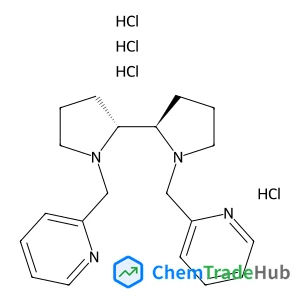
(2R,2'R)-1,1'-Bis(2-pyridinylmethyl)-2,2'-bipyrrolidine tetrahydrochloride
CAS番号:
1228077-88-0
分子式:
C20H30Cl4N4
おすすめサプライヤー




免責事項
このページに表示される学術雑誌情報は、参考および研究目的のみを目的としています。当社は雑誌出版社とは提携しておらず、投稿の取り扱いも行っておりません。出版に関するお問い合わせは、各雑誌出版社に直接ご連絡ください。
表示されている情報に誤りがある場合は、support@chemtradehub.com までご連絡ください。迅速に確認し、対応いたします。