


![19-[Chloro(dideuterio)methyl]-19-deuterio-20,20-dideuteriooxyoctatriacontane-18,21-dione structure](https://static.chemtradehub.com/structs/124/1246818-85-8-6244.webp "19-[Chloro(dideuterio)methyl]-19-deuterio-20,20-dideuteriooxyoctatriacontane-18,21-dione structure")
Coacervation of α-elastin studied by ultrafast nonlinear infrared spectroscopy
文献情報
出版日
2016-09-21
DOI
10.1039/C6CP04049G
インパクトファクター
3.676
著者
Francesca Palombo, Ellen Green, C. Peter Winlove
原文を見る
要旨
Elastin is the main protein to confer elasticity to biological tissues, through the formation of a hierarchical network of fibres. α-Elastin, a soluble form of the protein, is widely used in studies of the biosynthesis of human elastic tissue and exhibits coacervation in solution. This process involves the association of α-elastin molecules through a liquid–liquid phase transition, which is reversible unless the temperature is driven sufficiently high to induce the formation of insoluble aggregates. The thermodynamics of this process have attracted interest over many years and in the present work we used ultrafast nonlinear infrared spectroscopy of the amide I protein backbone vibration to resolve the secondary structural changes occurring during coacervation and probe the protein dynamics on a picosecond time scale. Four classes of carbonyl oscillators with distinct absorption peaks were revealed and, through narrowband excitation, vibrational and anisotropy decays could be distinguished. Analysis of the vibrational lifetimes and anisotropy decay times of these bands characterized the conformational changes and revealed the structural bases of the coacervation process.
おすすめジャーナル

Chemical Communications

Russian Chemical Bulletin

Acta Materialia

Current Opinion in Colloid & Interface Science

Journal of Saudi Chemical Society

Chemistry Education Research and Practice

Organic Process Research & Development

Russian Journal of General Chemistry

Russian Journal of Coordination Chemistry

Current Opinion in Solid State & Materials Science
関連文献
Left or right cholesterics? A matter of helix handedness and curliness
Elisa Frezza, Alberta Ferrarini, Hima Bindu Kolli, Achille Giacometti, Giorgio Cinacchi
2014-06-16
Paper
DOI: 10.1039/C4CP01816H
Elasticity of grossular–andradite solid solution: an ab initio investigation
Alessandro Erba, Roberto Dovesi
2014-06-09
Paper
DOI: 10.1039/C4CP01597E
Small-angle neutron scattering study of micropore collapse in amorphous solid water
Christian Mitterdorfer, Marion Bauer, Tristan G. A. Youngs, Daniel T. Bowron, Catherine R. Hill, Helen J. Fraser, John L. Finney, Thomas Loerting
2014-06-17
Paper
DOI: 10.1039/C4CP00593G
Morphology engineering of high performance binary oxide electrodes
Kunfeng Chen, Congting Sun, Dongfeng Xue
2014-11-10
Perspective
DOI: 10.1039/C4CP03888F
Determination of protein binding affinities within hydrogel-based molecularly imprinted polymers (HydroMIPs)
Hazim F. EL-Sharif, Daniel M. Hawkins, Derek Stevenson, Subrayal M. Reddy
2014-06-16
Paper
DOI: 10.1039/C4CP01798F
Plasmonic gold–poly(N-isopropylacrylamide) core–shell colloids with homogeneous density profiles: a small angle scattering study
Martin Dulle, Sarah Jaber, Sabine Rosenfeldt, Aurel Radulescu, Stephan Förster, Paul Mulvaney, Matthias Karg
2014-11-19
Paper
DOI: 10.1039/C4CP04816D
Tilt boundary induced heteroepitaxy in chemically grown dendritic silver nanostructures on germanium and their optical properties
Tanmay Ghosh, Pabitra Das, Tapas Kumar Chini, Tapas Ghosh, Biswarup Satpati
2014-06-02
Paper
DOI: 10.1039/C4CP01711K
Protonation induced shifting of electron-accepting centers in intramolecular charge transfer chromophores: a theoretical study
Tao Tang, Hong Chi, Tingting Lin
2014-08-05
Paper
DOI: 10.1039/C4CP02410A
Michaelis–Menten kinetics under non-isothermal conditions
Anders Lervik, Hong Qian
2014-11-18
Paper
DOI: 10.1039/C4CP04334K
こちらもおすすめ
化合物よくある質問
4'-ブロモビフェニル-3-メトークシーディ.ActionBarはどのように保存すればよいですか?
4'-ブロモビフェニル-3-メトークシーディ.ActionBarは、冷暗所で、直射日光を避け、密栓の容器に保存し、遠隔場所に保管してください。温度は常温(0〜2...
149506-25-24'-Bromo-biphenyl-3-...
2947-60-6(3-Methylphenyl)acet...
化合物よくある質問
2-異丙基フェニルヒドラジン塩酸塩とは何ですか?
2-異丙基フェニルヒドラジン塩酸塩は、CAS番号58928-82-8を有する化合物で、構造式はC11H14N2HClです。これは塩基性化合物であり、水に溶けやす...
58928-82-8(2-Isopropylphenyl)h...
化合物よくある質問
5-(4-クロロフェニル)-4H-1,2,4-三氮唑-3-アミンを取り扱う際の実験室安全事項は何ですか?
5-(4-クロロフェニル)-4H-1,2,4-三氮唑-3-アミンは取り扱いに注意が必要です。PPEとして防塵マスク、ゴーグル、手袋を使用し、ドラフトチャンバーを...
98554-00-85-(4-Chlorophenyl)-1...
化合物よくある質問
去甲基雷贝拉唑硫醚はどのように合成されますか?
去甲基雷贝拉唑硫醚は、ベンジミダゾール硫化物と3-メチル-4-ピリジノールの反応によって合成されます。具体的には、2-チオキシドベンジミダゾールと3-メチル-4...
117976-91-73-({2-[(1H-Benzimida...
化合物よくある質問
2-ブロモ-5-フロロ-N-(2-フェノールメチル)ベンゼンウレアは安全ですか?
2-ブロモ-5-フロロ-N-(2-フェノールメチル)ベンゼンウレアは、毒性や刺激性の実験データに基づき、適切な取扱いと防護措置を講じることで安全に使用できます。...
923722-86-52-Bromo-5-fluoro-N-(...
化合物よくある質問
対甲苯磺酸酯-四聚乙二醇-四氢吡喃醚の物理化学的性質は何ですか?
対甲苯磺酸酯-四聚乙二醇-四氢吡喃醚のCAS番号は86259-89-4です。この化合物は無色の液体で、分子量は約724.8です。高濃度では溶血性が報告されており...
86259-89-42-(2-{2-[2-(Tetrahyd...
化合物よくある質問
2-(3-(二氟甲基)-4-氟苯基)-4,4,5,5-四甲基-1,3,2-二噁硼戊環はどのように保存すればよいですか?
2-(3-(二氟甲基)-4-氟苯基)-4,4,5,5-四甲基-1,3,2-二噁硼戊環は、室温で暗い場所に保管し、直射日光から遠ざけ、容器は密閉状態で保存してくだ...
445303-65-12-[3-(difluoromethyl...
化合物よくある質問
6-アミノ-5-クロロ-2-シクロプロピルピリミジンカルボン酸の代替品はありますか?
この化合物の代替品には、ピロリミジン酸やその類似物、またピロリミジンカルボン酸の他の異性体があります。これらの代替品は、特定の化学反応や目的に応じて選択すること...
858956-08-86-Amino-5-chloro-2-c...
化合物よくある質問
5-クロロベンゾ[1,3]二オキセイン-4-アミンに適用される法規ガイドラインは何ですか?
5-クロロベンゾ[1,3]二オキセイン-4-アミンはCAS番号379228-45-2に該当します。この化合物はGHS分類でH314(接触により急性毒性がある)と...
379228-45-25-Chloro-1,3-benzodi...
掲載誌
Physical Chemistry Chemical Physics

CiteScore:
5.5
自己引用率:
10.3%
年間論文数:
3036
Physical Chemistry Chemical Physics (PCCP) is an international journal co-owned by 19 physical chemistry and physics societies from around the world. This journal publishes original, cutting-edge research in physical chemistry, chemical physics and biophysical chemistry. To be suitable for publication in PCCP, articles must include significant innovation and/or insight into physical chemistry; this is the most important criterion that reviewers and Editors will judge against when evaluating submissions. The journal has a broad scope and welcomes contributions spanning experiment, theory, computation and data science. Topical coverage includes spectroscopy, dynamics, kinetics, statistical mechanics, thermodynamics, electrochemistry, catalysis, surface science, quantum mechanics, quantum computing and machine learning. Interdisciplinary research areas such as polymers and soft matter, materials, nanoscience, energy, surfaces/interfaces, and biophysical chemistry are welcomed if they demonstrate significant innovation and/or insight into physical chemistry. Joined experimental/theoretical studies are particularly appreciated when complementary and based on up-to-date approaches.
おすすめ化合物
![2-[(E)-(2-Methoxyphenyl)diazenyl]-3-oxo-N-(2-oxo-2,3-dihydro-1H-benzimidazol-5-yl)butanamide structure](https://static.chemtradehub.com/structs/821/82199-12-0-f1d0.webp "2-[(E)-(2-Methoxyphenyl)diazenyl]-3-oxo-N-(2-oxo-2,3-dihydro-1H-benzimidazol-5-yl)butanamide structure")
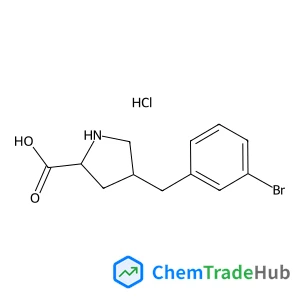
(2S,4R)-4-(3-Bromobenzyl)pyrrolidine-2-carboxylic acid hydrochloride
CAS番号:
1049734-10-2
分子式:
C12H15BrClNO2
おすすめサプライヤー




免責事項
このページに表示される学術雑誌情報は、参考および研究目的のみを目的としています。当社は雑誌出版社とは提携しておらず、投稿の取り扱いも行っておりません。出版に関するお問い合わせは、各雑誌出版社に直接ご連絡ください。
表示されている情報に誤りがある場合は、support@chemtradehub.com までご連絡ください。迅速に確認し、対応いたします。