












Aqueous biphasic systems composed of ionic liquids and polypropylene glycol: insights into their liquid–liquid demixing mechanisms
文献情報
出版日
2016-06-24
DOI
10.1039/C6CP04023C
インパクトファクター
3.676
著者
Catarina M. S. S. Neves, Jesus Lemus, Jorge F. B. Pereira, Mara G. Freire, João A. P. Coutinho
原文を見る
要旨
Novel ternary phase diagrams of aqueous biphasic systems (ABSs) composed of polypropylene glycol with an average molecular weight of 400 g mol−1 (PPG-400) and a vast number of ionic liquids (ILs) were determined. The large array of selected ILs allowed us to evaluate their tuneable structural features, namely the effect of the anion nature, cation core and cation alkyl side chain length on the phase behaviour. Additional evidence on the molecular-level mechanisms which rule the phase splitting was obtained by 1H NMR (Nuclear Magnetic Resonance) spectroscopy and by COSMO-RS (Conductor-like Screening Model for Real Solvents). Some systems, for which the IL–PPG-400 pairs are completely miscible, revealed to be of type “0”. All data collected suggest that the formation of PPG–IL-based ABSs is controlled by the interactions established between the IL and PPG, contrarily to previous reports where a “salting-out” phenomenon exerted by the IL over the polymer in aqueous media was proposed as the dominant effect in ABS formation. The influence of temperature on the liquid–liquid demixing was also evaluated. In general, an increase in temperature favours the formation of an ABS in agreement with the lower critical solution temperature (LCST) phase behaviour usually observed in polymer–IL binary mixtures. Partition results of a dye (chloroanilic acid, in its neutral form) further confirm the possibility of tailoring the phases' polarities of IL–PPG-based ABSs.
関連文献
Mixing ionic liquids – “simple mixtures” or “double salts”?
Gregory Chatel, Jorge F. B. Pereira, Varun Debbeti, Hui Wang, Robin D. Rogers
2014-01-21
Critical Review
DOI: 10.1039/C3GC41389F
Trifluoromethylation of heterocycles in water at room temperature
James C. Fennewald, Bruce H. Lipshutz
2013-12-05
Communication
DOI: 10.1039/C3GC42119H
Efficient synthesis of nebularine and vidarabine via dehydrazination of (hetero)aromatics catalyzed by CuSO4 in water
Ming-Sheng Xie, Hong-Ying Niu
2013-10-17
Communication
DOI: 10.1039/C3GC41658E
Synthesis of soluble core cross-linked polystyrene star polymer by application of acrylate-nitrile oxide ‘click chemistry’ using metal-free reagents
Rakesh Banerjee, Saikat Maiti, Dibakar Dhara
2013-11-04
Paper
DOI: 10.1039/C3GC41722K
Functionalized dicyandiamide–formaldehyde polymers as efficient heterogeneous catalysts for conversion of CO2 into organic carbonates
Jian Sun, Wei-Guo Cheng, Jin-Quan Wang, Hong-Yan He, Suo-Jiang Zhang
2014-02-28
Paper
DOI: 10.1039/C3GC42331J
Vanillin, a promising biobased building-block for monomer synthesis
Maxence Fache, Emilie Darroman, Vincent Besse, Rémi Auvergne, Sylvain Caillol, Bernard Boutevin
2014-02-18
Paper
DOI: 10.1039/C3GC42613K
Asymmetric hydrogenation of unprotected indoles using iridium complexes derived from P–OP ligands and (reusable) Brønsted acids
José Luis Núñez-Rico, Héctor Fernández-Pérez
2013-12-19
Communication
DOI: 10.1039/C3GC42132E
Clean and efficient assembly of functionalized benzofuro[2,3-c]pyridines via metal-free one-pot domino reactions
Yin Rao, Zhexian Li, Guodong Yin
2014-01-10
Paper
DOI: 10.1039/C3GC42234H
Highly efficient SO2 capture by phenyl-containing azole-based ionic liquids through multiple-site interactions
Wenjun Lin, Fang Ding, Xiaoyan Luo, Xi He, Congmin Wang
2013-10-16
Paper
DOI: 10.1039/C3GC41458B
A low temperature and solvent-free direct chemical synthesis of L10 FePt nanoparticles with size tailoring
X. C. Hu, E. Agostinelli, C. Ni, G. C. Hadjipanayis, A. Capobianchi
2014-01-17
Paper
DOI: 10.1039/C3GC42186D
こちらもおすすめ
化合物よくある質問
4-アミノフェノール酸ナトリウム水和物とは何ですか?
4-アミノフェノール酸ナトリウム水和物は、CAS番号206557-08-6の化合物で、4-アミノフェノールとナトリウムが結合した塩と水和物です。この化合物は、白...
206557-08-64-Aminobenzoic acid ...
化合物よくある質問
Methyl 3-methyl-N-{[(2-methyl-2-propanyl)oxy]carbonyl}-L-histidinateの代替品はありますか?
この化合物は特定の合成プロセスに使用される可能性がありますが、代替品として、他の类似的な化合物、例えばMethyl 3-methyl-N-{[(2-methyl...
72212-51-2Methyl 3-methyl-N-{[...
化合物よくある質問
4-Boc-2-哌嗪甲酸の市場動向や研究トレンドはどうですか?
4-Boc-2-哌嗪甲酸は、薬品開発や合成化学分野で広く使用されており、その需要は継続的に推移しています。特に、新薬開発における合成化学分野での需要が高まってい...
192330-11-3(2R)-4-[(tert-butoxy...
化合物よくある質問
4,4'-二羟甲基联苯の物理化学的性質は何ですか?
4,4'-二羟甲基联苯のCAS番号は1667-12-5です。この化合物は白色の結晶粉末で、分子量は154.20です。水にわずかに溶けますが、アルコールや有機溶媒...
1667-12-54,4'-Biphenyldiyldim...
化合物よくある質問
5-甲硫基戊腈はどの業界で使用されていますか?
5-甲硫基戊腈は医薬品産業で使用される可能性があります。また、ポリマー合成の触媒として、センサー製造の一部として、半導体製造のプロセス改善に使用される可能性があ...
59121-25-45-(Methylsulfanyl)pe...
化合物よくある質問
CAS番号1311961-50-8の化合物はどのように合成されますか?
この化合物は、1-abieta-8,11,13-trien-19-イルと6'-メトキシシンコナナン-9-基を含有する窒素含有化合物から合成されます。一般的な合成...
1311961-50-81-Abieta-8,11,13-tri...
化合物よくある質問
6-ブロモベンジジミダゾール-2-カルビルデオキシドはどのように保存すればよいですか?
6-ブロモベンジジミダゾール-2-カルビルデオキシドは、避光・乾燥した容器(密閉容器)で-20℃~4℃の低温で保存してください。高温や直射日光、湿気は避けてくだ...
885280-26-25-Bromo-1H-benzimida...
化合物よくある質問
Boc-N-甲基氨甲环酸とは何ですか?
621-65-8のCAS番号を持つBoc-N-甲基氨甲环酸は、化学式C7H13NO5を有する化合物です。この化合物は白色の結晶性粉末で、吸湿性があります。
621-65-83-Hydroxy-1,2-propan...
化合物よくある質問
乙基三氟硼酸钾はどのように合成されますか?
乙基三氟硼酸钾は、トリフLUオール酸カリウムとエチルブロミドを反応させて合成されます。この反応は高い選択性と収率を持ち、触媒を用いることで効率的に進行します。
882871-21-8Potassium ethyltrifl...
化合物よくある質問
2-フロウロ-5-クロロ-4-アミノフェノールはどのように保存すればよいですか?
2-フロウロ-5-クロロ-4-アミノフェノールは、直射日光を避けて冷却された暗所で保存し、密閉容器に保管してください。温度は常温か低温が適しています。
847872-10-04-Amino-5-chloro-2-f...
掲載誌
Physical Chemistry Chemical Physics

CiteScore:
5.5
自己引用率:
10.3%
年間論文数:
3036
Physical Chemistry Chemical Physics (PCCP) is an international journal co-owned by 19 physical chemistry and physics societies from around the world. This journal publishes original, cutting-edge research in physical chemistry, chemical physics and biophysical chemistry. To be suitable for publication in PCCP, articles must include significant innovation and/or insight into physical chemistry; this is the most important criterion that reviewers and Editors will judge against when evaluating submissions. The journal has a broad scope and welcomes contributions spanning experiment, theory, computation and data science. Topical coverage includes spectroscopy, dynamics, kinetics, statistical mechanics, thermodynamics, electrochemistry, catalysis, surface science, quantum mechanics, quantum computing and machine learning. Interdisciplinary research areas such as polymers and soft matter, materials, nanoscience, energy, surfaces/interfaces, and biophysical chemistry are welcomed if they demonstrate significant innovation and/or insight into physical chemistry. Joined experimental/theoretical studies are particularly appreciated when complementary and based on up-to-date approaches.
おすすめ化合物
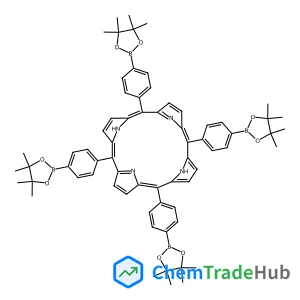
5,10,15,20-tetrakis(4-boronic acid pinacol ester phenyl) porphyrin
CAS番号:
1332748-00-1
分子式:
C68H74B4N4O8
おすすめサプライヤー




免責事項
このページに表示される学術雑誌情報は、参考および研究目的のみを目的としています。当社は雑誌出版社とは提携しておらず、投稿の取り扱いも行っておりません。出版に関するお問い合わせは、各雑誌出版社に直接ご連絡ください。
表示されている情報に誤りがある場合は、support@chemtradehub.com までご連絡ください。迅速に確認し、対応いたします。