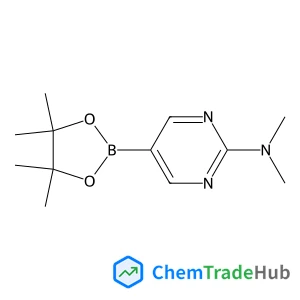
N,N-Dimethyl-5-(4,4,5,5-tetramethyl-1,3,2-dioxaborolan-2-yl)-2-pyrimidinamine
CAS番号:
1032759-30-0
分子式:
C12H20BN3O2
Fu Kit Sheong
Constructing Markov State Models (MSMs) based on short molecular dynamics simulations is a powerful computational technique to complement experiments in predicting long-time kinetics of biomolecular processes at atomic resolution. Even though the MSM approach has been widely applied to study one-body processes such as protein folding and enzyme conformational changes, the majority of biological processes, e.g. protein–ligand recognition, signal transduction, and protein aggregation, essentially involve multiple entities. Here we review the attempts at constructing MSMs for multi-body systems, point out the challenges therein and discuss recent algorithmic progresses that alleviate these challenges. In particular, we describe an automatic kinetics based partitioning method that achieves optimal definition of the conformational states in a multi-body system, and discuss a novel maximum-likelihood approach that efficiently estimates the slow uphill kinetics utilizing pre-computed equilibrium populations of all states. We expect that these new algorithms and their combinations may boost investigations of important multi-body biological processes via the efficient construction of MSMs.
DOI: 10.1039/C9CP01234F
Philipp Honegger, Othmar Steinhauser
DOI: 10.1039/C9CP00053D
Stuart W. Crane, Omair Ghafur, Thomas Y. Cowie, Anita G. Lindsay, James O. F. Thompson, Jason B. Greenwood
DOI: 10.1039/C9CP00620F
Barbora Tarabová, Petr Lukeš, Malte U. Hammer, Helena Jablonowski, Thomas von Woedtke, Stephan Reuter, Zdenko Machala
DOI: 10.1039/C9CP00871C
DOI: 10.1039/C8CP06702C
Paweł Piotr Michałowski, Piotr Knyps, Paweł Ciepielewski, Piotr Caban, Ewa Dumiszewska, Jacek Baranowski
DOI: 10.1039/C9CP00613C
Sebastian Krickl, Thomas Buchecker, Gašper Jošt, Didier Touraud, Pierre Bauduin, Arno Pfitzner, Werner Kunz
DOI: 10.1039/C8CP07544A
Qiang Zhu
DOI: 10.1039/C8CP07202G
Mohammad Aarabi, Reza Omidyan, Satchin Soorkia, Gilles Grégoire, Maria-Elisa Crestoni, Aurélien de la Lande, Benoît Soep, Niloufar Shafizadeh
DOI: 10.1039/C8CP06210B
E. Kathleen Carter, Thomas Dodd, W. David Wilson, Ivaylo Ivanov
DOI: 10.1039/C8CP05537H
6- bromo-1-cyclopropyl-1H-benzimidazoleは、抗炎症、抗ウイルス作用を持つことが報告されており、新薬開発の研究対象として注目...
取り扱う際には、防護眼鏡と手袋を使用し、ドラフトチャンバー内で操作することを推奨します。漏洩時には適切な手順で処理し、安全データシートを常に参照してください。
2,2’-ジメチル-3,3’-ビピリジンは、ピリジンと2-メチルアクリルアミドを有機合成反応で合成します。この反応では、ピリジンと2-メチルアクリルアミドを含有...
6-甲基ピリジン-2-ボリック酸は、合成化学、医薬品合成、以及研究用途などに広く使用され、特に組換えDNA技術や分子生物学の研究において重要な役割を果たします。
(R)-3-(1-甲基-2-氧環己基)プロpano酸メチルは一定の安全性がありますが、直接的な皮膚接触や吸入は避けるべきです。使用する際は適切な個々の安全データ...
ketorolacは、密封して遮光容器に保管し、直射日光や高温を避けて保存してください。温度は常温で保存し、湿度をなるべく低く保つことが推奨されます。
L-2,3-二氨基丙酸二盐酸盐は腐食性が強く、皮膚や粘膜に刺激を与える可能性があります。取り扱う際は、防塵マスク、ゴーグル、手袋を使用し、適切な排気設備を使用し...
2-(4-溴ピリジン-2-基)乙腈のCAS番号は312325-73-8です。主に結晶形態で存在し、分子量は159.01 g/molです。この化合物は水に溶けやす...
この化合物は毒性は低いですが、直接的な接触や吸入に注意が必要です。PPE(個人防護具)を着用し、ドラフトチャンバーを使用して操作することを推奨します。また、漏洩...
3-(1-氧代-1,3-二氢-2H-2-异吲哚)丙酸は、薬理学研究や医薬品製造において広く用いられる化合物です。また、工業的な用途でも一部の化学反応の触媒や助剤...

Physical Chemistry Chemical Physics (PCCP) is an international journal co-owned by 19 physical chemistry and physics societies from around the world. This journal publishes original, cutting-edge research in physical chemistry, chemical physics and biophysical chemistry. To be suitable for publication in PCCP, articles must include significant innovation and/or insight into physical chemistry; this is the most important criterion that reviewers and Editors will judge against when evaluating submissions. The journal has a broad scope and welcomes contributions spanning experiment, theory, computation and data science. Topical coverage includes spectroscopy, dynamics, kinetics, statistical mechanics, thermodynamics, electrochemistry, catalysis, surface science, quantum mechanics, quantum computing and machine learning. Interdisciplinary research areas such as polymers and soft matter, materials, nanoscience, energy, surfaces/interfaces, and biophysical chemistry are welcomed if they demonstrate significant innovation and/or insight into physical chemistry. Joined experimental/theoretical studies are particularly appreciated when complementary and based on up-to-date approaches.
![(2S)-2-{[(9H-Fluoren-9-ylmethoxy)carbonyl]amino}-4-(methylselanyl)butanoic acid structure](https://static.chemtradehub.com/structs/121/1217852-49-7-f252.webp "(2S)-2-{[(9H-Fluoren-9-ylmethoxy)carbonyl]amino}-4-(methylselanyl)butanoic acid structure")