












Energetics of nonpolar and polar compounds in cationic, anionic, and nonionic micelles studied by all-atom molecular dynamics simulation combined with a theory of solutions
文献情報
出版日
2016-04-27
DOI
10.1039/C6CP01834C
インパクトファクター
3.676
著者
Atsushi Date, Ryosuke Ishizuka
原文を見る
要旨
Energetic analysis was conducted for nonpolar and polar solutes bound in a cationic micelle of dodecyl trimethyl ammonium bromide (DTAB), an anionic micelle of sodium dodecyl sulfate (SDS), and a nonionic micelle of tetraethylene glycol monododecyl ether (Brij30). All-atom molecular dynamics simulation was performed, and the free energies of binding the solutes in the hydrophobic-core and headgroup regions of the micelles were computed using the energy-representation method. It was found in all the micelles examined that aromatic naphthalene is preferably located more outward than aliphatic propane and that the polar solutes are localized at the interface of the hydrophobic and hydrophilic regions. The roles of the surfactant and water were then elucidated by decomposing the free energy into the contributions from the respective species. Water was observed to play a decisive role in determining the binding location of the solute, while the surfactant was found to be more important for the overall stabilization of the solute within the micelle. The effects of attractive and repulsive interactions of the solute with the surfactant and water were further examined, and their competition was analyzed in connection with the preferable location of the solute in the micellar system.
関連文献
Effect of Ag and Pd promotion on CH4 selectivity in Fe(100) Fischer–Tröpsch catalysis
Jennifer Wilcox, David W. Ball
2017-01-23
Paper
DOI: 10.1039/C6CP07116C
Graphene-modulated photo-absorption in adsorbed azobenzene monolayers
2017-01-30
Paper
DOI: 10.1039/C6CP06939H
Probing the degradation and homogeneity of embedded perovskite semiconducting layers in photovoltaic devices by Raman spectroscopy
K. E. A. Hooper, H. K. H. Lee, M. J. Newman, S. Meroni, J. Baker, T. M. Watson, W. C. Tsoi
2017-02-02
Paper
DOI: 10.1039/C6CP05123E
Charge transport mechanisms in sol–gel grown La0.7Pb0.3MnO3/LaAlO3 manganite films
Eesh Vaghela, M. J. Keshvani, Keval Gadani, Zalak Joshi, Hetal Boricha, K. Asokan, D. Venkateshwarlu, V. Ganesan, N. A. Shah, P. S. Solanki
2017-01-31
Paper
DOI: 10.1039/C6CP07730G
Crystallization kinetics of cerium oxide nanoparticles formed by spontaneous, room-temperature hydrolysis of cerium(iv) ammonium nitrate in light and heavy water
Natasha W. Pettinger, Robert E. A. Williams, Jinquan Chen
2017-01-10
Paper
DOI: 10.1039/C6CP08227K
Correlated/non-correlated ion dynamics of charge-neutral ion couples: the origin of ionicity in ionic liquids
G. W. Driver, Y. Huang, A. Laaksonen, T. Sparrman, Y.-L. Wang, P.-O. Westlund
2016-12-08
Paper
DOI: 10.1039/C6CP05801A
Cobalt disulfide/graphite foam composite films as self-standing electrocatalytic electrodes for overall water splitting
Yue Tong, Xiaowen Yu, Gaoquan Shi
2017-01-16
Paper
DOI: 10.1039/C6CP08176B
The water association band as a marker of hydrogen bonds in trehalose amorphous matrices
Sergio Giuffrida, Lorenzo Cordone
2017-01-04
Paper
DOI: 10.1039/C6CP06848K
Piezochromism and structural and electronic properties of benz[a]anthracene under pressure
Weizhao Cai, Rong Zhang, Shanti Deemyad
2017-01-31
Paper
DOI: 10.1039/C6CP08171A
こちらもおすすめ
化合物よくある質問
2-ブロモ-9,9-ジフェニル-9H-フルオレンの主な用途は何ですか?
2-溴-9,9-二苯基芴は、医薬品、工業材料、有機合成の研究分野で応用されます。特に、レーザー材料や機能性ポリマーの合成に使用されることがあります。また、蛍光色...
474918-32-62-Bromo-9,9-diphenyl...
化合物よくある質問
四氯化铱の市場動向や研究トレンドはどうですか?
四氯化铱の市場は研究開発分野で注目されており、特にナノ技術や金属有機框架(MOFs)の分野での需要が増加傾向にあります。価格は安定しており、中国や韓国での生産が...
207399-11-9Tetrachloroiridium h...
882-06-44-Nitrocinnamic acid
化合物よくある質問
1-(4-溴-3-氟苯基)-2-氯乙酮を含む廃棄物はどのように処理すべきですか?
1-(4-溴-3-氟苯基)-2-氯乙酮 (CAS番号: 1260857-14-4) の廃棄物は専門的な廃棄処理が必要です。まず、廃棄物は密閉された容器に収集し、...
1260857-14-41-(4-Bromo-3-fluorop...
化合物よくある質問
苦参酚Kとは何ですか?
苦参酚Kは、CAS番号101236-49-1を持つ化合物で、主に天然由来の生薬から抽出されます。この化合物は、抗炎症作用や抗癌作用を持つことが報告されています。
101236-49-1Kushenol K
化合物よくある質問
POTASSIUM (1-(TERTBUTOXYCARBONYL)AZETIDIN-3-YL)TRIFLUOROBORATE を含む廃棄物はどのように処理すべきですか?
POTASSIUM (1-(TERTBUTOXYCARBONYL)AZETIDIN-3-YL)TRIFLUOROBORATE を含む廃棄物は、まず安全なエント...
1430219-73-0Potassium (1-(tert-b...
化合物よくある質問
4-庚基-4’-联苯羧酸の市場動向や研究トレンドはどうですか?
4-庚基-4’-聯苯羧酸は、特殊化学品や合成化学の分野で用いられる化学物質ですが、市場動向としては、研究開発の進展とともに需要が増加しています。また、環境配慮型...
58573-94-74'-Heptyl-4-biphenyl...
化合物よくある質問
6-ブロモ-3-メトキシ-1-フェニル-1H-インドゾールを含む廃棄物はどのように処理すべきですか?
6-ブロモ-3-メトキシ-1-フェニル-1H-インドゾールを含む廃棄物は、適切な化学廃棄処理が必要です。通常、廃棄物は密閉容器に収集され、専門の廃棄処理業者に引...
1332527-03-36-Bromo-3-methoxy-1-...
化合物よくある質問
4,4-二甲基-2-吡咯烷酮はどの業界で使用されていますか?
4,4-二甲基-2-吡咯烷酮は医薬、ポリマー、センサー、半導体などの業界で広く使用されています。特に溶媒としての性能が高く評価されています。
66899-02-34,4-dimethylpyrrolid...
51312-42-6Sodium Phosphotungst...
掲載誌
Physical Chemistry Chemical Physics

CiteScore:
5.5
自己引用率:
10.3%
年間論文数:
3036
Physical Chemistry Chemical Physics (PCCP) is an international journal co-owned by 19 physical chemistry and physics societies from around the world. This journal publishes original, cutting-edge research in physical chemistry, chemical physics and biophysical chemistry. To be suitable for publication in PCCP, articles must include significant innovation and/or insight into physical chemistry; this is the most important criterion that reviewers and Editors will judge against when evaluating submissions. The journal has a broad scope and welcomes contributions spanning experiment, theory, computation and data science. Topical coverage includes spectroscopy, dynamics, kinetics, statistical mechanics, thermodynamics, electrochemistry, catalysis, surface science, quantum mechanics, quantum computing and machine learning. Interdisciplinary research areas such as polymers and soft matter, materials, nanoscience, energy, surfaces/interfaces, and biophysical chemistry are welcomed if they demonstrate significant innovation and/or insight into physical chemistry. Joined experimental/theoretical studies are particularly appreciated when complementary and based on up-to-date approaches.
おすすめ化合物
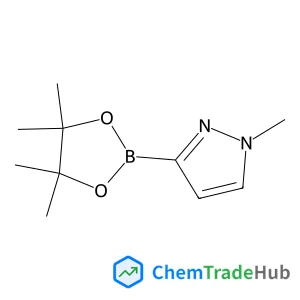
1-Methyl-3-(4,4,5,5-tetramethyl-1,3,2-dioxaborolan-2-yl)-1H-pyrazole
CAS番号:
1020174-04-2
分子式:
C10H17BN2O2
おすすめサプライヤー






免責事項
このページに表示される学術雑誌情報は、参考および研究目的のみを目的としています。当社は雑誌出版社とは提携しておらず、投稿の取り扱いも行っておりません。出版に関するお問い合わせは、各雑誌出版社に直接ご連絡ください。
表示されている情報に誤りがある場合は、support@chemtradehub.com までご連絡ください。迅速に確認し、対応いたします。