


Approaches towards molecular amplification for sensing
文献情報
出版日
2016-04-14
DOI
10.1039/C6AN00348F
インパクトファクター
4.616
著者
Sean Goggins, Christopher G. Frost
原文を見る
要旨
Diagnostic assays that rely on molecular interactions have come a long way; from initial reversible detection systems towards irreversible reaction indicator-based methods. More recently, the emergence of innovative molecular amplification methodologies has revolutionised sensing, allowing diagnostic assays to achieve ultra-low limits of detection. There have been a significant number of molecular amplification approaches developed over recent years to accommodate the wide variety of analytes that require sensitive detection. To celebrate this achievement, this comprehensive critical review has been compiled to give a broad overview of the many different approaches used to attain amplification in sensing with an aim to inspire the next generation of diagnostic assays looking to achieve the ultimate detection limit. This review has been created with the focus on how each conceptually unique molecular amplification methodology achieves amplification, not just its sensitivity, while highlighting any key processes. Excluded are any references that were not found to contain an obvious molecular amplifier or amplification component, or that did not use an appropriate signal readout that could be incorporated into a sensing application. Additionally, methodologies where amplification is achieved through advances in instrumentation are also excluded. Depending upon the type of approach employed, amplification strategies are divided into four categories: target, label, signal or receptor amplification. More recent, more complex protocols combine a number of approaches and are therefore categorised by which amplification component described within was considered as the biggest advancement. The advantages and disadvantages of each methodology are discussed along with any limits of detection, if stated in the original article. Any subsequent use of the methodology within sensing or any other application is also mentioned to draw attention to its practicality. The importance of amplification within sensing is wholly emphasised while perspectives on the future direction of the field are also shared.
おすすめジャーナル

Russian Journal of Organic Chemistry

Current Opinion in Colloid & Interface Science

Current Opinion in Solid State & Materials Science

Nature Medicine

Journal of Saudi Chemical Society

Chemistry Education Research and Practice

Crystallography Reports

New Journal of Chemistry

Russian Chemical Bulletin

Organic Process Research & Development
関連文献
Solution processed single-phase Cu2SnS3 films: structure and photovoltaic performance
Devendra Tiwari, Tristan Koehler, Reiner Klenk, David J. Fermin
2017-03-27
Paper
DOI: 10.1039/C7SE00150A
Polyaniline coated Fe3O4 hollow nanospheres as anode materials for lithium ion batteries
Xiaoliang Wang, Yanguo Liu, Hongyan Han, Yanyan Zhao, Wuming Ma
2017-04-12
Paper
DOI: 10.1039/C7SE00139H
Lithium sulfur and lithium oxygen batteries: new frontiers of sustainable energy storage
Lorenzo Carbone, Steve G. Greenbaum, Jusef Hassoun
2017-02-10
Review Article
DOI: 10.1039/C6SE00124F
Stabilization of GaAs photoanodes by in situ deposition of nickel-borate surface catalysts as hole trapping sites
Savio J. A. Moniz, Daqian Guo, Mingchu Tang, Qi Jiang, Siming Chen, Huiyun Liu, Aiqin Wang, Tao Zhang, Junwang Tang
2019-01-21
Paper
DOI: 10.1039/C8SE00265G
Tin–lead halide perovskites with improved thermal and air stability for efficient all-perovskite tandem solar cells
Kevin A. Bush, James A. Raiford, Eli J. Wolf, Simon A. Swifter, Caleb C. Boyd, Hsin-Ping Wang, Michael F. Toney, Stacey F. Bent
2018-08-07
Paper
DOI: 10.1039/C8SE00314A
An investigation of Cu–Re–ZnO catalysts for the hydrogenolysis of glycerol under continuous flow conditions
Mzamo L. Shozi, Venkata D. B. C. Dasireddy, Sooboo Singh, Pheladi Mohlala, David J. Morgan, Sarwat Iqbal, Holger B. Friedrich
2017-06-28
Paper
DOI: 10.1039/C7SE00199A
Preparation of high performance supercapacitor materials by fast pyrolysis of corn gluten meal waste
Ke Tian, Hong Jiang
2017-04-03
Paper
DOI: 10.1039/C7SE00029D
A vitamin C fuel cell with a non-bonded cathodic interface
Ravikumar Thimmappa, Zahid Manzoor Bhat, Shahid Pottachola Shafi, Harish Makri Nimbegondi Kotresh, Alagar Raja Kottaichamy, Kallam Ramareddy Venugopala Reddy, Musthafa Ottakam Thotiyl
2018-06-19
Paper
DOI: 10.1039/C8SE00221E
こちらもおすすめ
化合物よくある質問
カルボニル基が付いた5-氰基-1-{[(2-メチル-2-プロpanyl)オキシ]カーボンイル}1H-吲哚-2-イリド-2-ボリン酸はどのように保存すればよいですか?
カルボニル基が付いた5-氰基-1-{[(2-メチル-2-プロpanyl)オキシ]カーボンイル}1H-吲哚-2-イリド-2-ボリン酸は、直射日光を避けて室温(15...
475102-15-9(5-Cyano-1-{[(2-meth...
化合物よくある質問
tert-ブチル2-クロロメチルピリジン-3-基炭酸エステルの市場動向や研究トレンドはどうですか?
この化合物は合成化学分野において、特にピリジン化合物の合成や改良に用いられます。最近の研究では、ピリジン化合物の新規合成法や特性の改良が注目されています。市場動...
1203498-98-9tert-Butyl 2-chloro-...
化合物よくある質問
聚二季戊四醇六丙烯酸酯はどの業界で使用されていますか?
聚二季戊四醇六丙烯酸酯は、医薬品、ポリマー、センサー、半導体などの業界で広く使用されています。特にポリマー業界では硬化剤として、医薬分野では医療機器の製造に使用...
29570-58-93-(Acryloyloxy)-2-({...
化合物よくある質問
1-氯-5-硝基异喹啉の市場動向や研究トレンドはどうですか?
1-氯-5-硝基异喹啉は、薬理学や合成化学の研究分野で注目されています。市場動向としては、その生物学的な活性や合成可能性を評価する研究が増えています。また、代替...
58142-97-51-Chloro-5-nitroisoq...
化合物よくある質問
2-チロール-5-メチルスルフェニル-3-trifルオルメチルベンゼンはどのように合成されますか?
2-チロール-5-メチルスルフェニル-3-trifルオルメチルベンゼンは、トリフルオロメチル化反応と硫化反応を経て合成されます。通常、トリフルオロメチル化剤と硫...
957066-04-51-Chloro-4-(methylsu...
化合物よくある質問
p-トールイルマグネシウムブロミドの物理化学的性質は何ですか?
p-トールイルマグネシウムブロミドのCAS番号は4294-57-9です。この化合物は白色の結晶性粉末で、分子量は204.32です。溶剤中で良好に溶解しますが、水...
4294-57-9p-Tolylmagnesium bro...
化合物よくある質問
1-(5-甲基-2-硫化素基)プロパン-1-酮の市場動向や研究トレンドはどうですか?
1-(5-甲基-2-硫化素基)プロパン-1-酮の市場動向は、化学産業全体の需要に影響を受けますが、最近では pharmaceutical 分野での応用が注目され...
59303-13-81-(5-Methyl-2-thieny...
化合物よくある質問
十一碳烯酰甘氨酸を取り扱う際の実験室安全事項は何ですか?
十一碳烯酰甘氨酸は吸入や皮膚から吸収されることがあり、取り扱う際には防塵マスクと手袋を使用してください。ドラフトチャンバーを用いて漏洩を処理し、適切なSDS(S...
54301-26-7N-10-Undecenoylglyci...
化合物よくある質問
1H,1H-全氟-3,6-二氧杂葵-1-醇を取り扱う際の実験室安全事項は何ですか?
この化合物は吸入や皮膚吸収による毒性があるため、防塵マスク、ゴーグル、防護手袋を使用する必要があります。ドラフトチャンバーでの操作が必要です。漏洩時には即座に換...
152914-73-32,2-Difluoro-2-[1,1,...
化合物よくある質問
3-(4-(フルオロメチルオキシ)フェニル)-1,2,4-オキサジアゾール-5-カルボハイドライドは安全ですか?
安全性は化合物の使用方法によります。直接的な毒性は報告されていませんが、吸入や皮膚接触には注意が必要です。適切な防護服を着用し、換気を図ることを推奨します。
883028-82-83-(4-(Trifluorometho...
掲載誌
Analyst

CiteScore:
7.8
自己引用率:
5.6%
年間論文数:
653
Analyst publishes analytical and bioanalytical research that reports premier fundamental discoveries and inventions, and the applications of those discoveries, unconfined by traditional discipline barriers.
おすすめ化合物
![(3-{[4-(Aminomethyl)-6-(trifluoromethyl)-2-pyridinyl]oxy}phenyl)[(3R,4R)-3-fluoro-4-hydroxy-1-pyrrolidinyl]methanone structure](https://static.chemtradehub.com/structs/200/2007885-39-2-affc.webp "(3-{[4-(Aminomethyl)-6-(trifluoromethyl)-2-pyridinyl]oxy}phenyl)[(3R,4R)-3-fluoro-4-hydroxy-1-pyrrolidinyl]methanone structure")
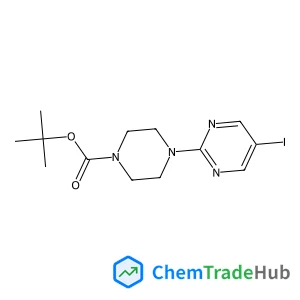
2-Methyl-2-propanyl 4-(5-iodo-2-pyrimidinyl)-1-piperazinecarboxylate
CAS番号:
1027616-32-5
分子式:
C13H19IN4O2
おすすめサプライヤー





免責事項
このページに表示される学術雑誌情報は、参考および研究目的のみを目的としています。当社は雑誌出版社とは提携しておらず、投稿の取り扱いも行っておりません。出版に関するお問い合わせは、各雑誌出版社に直接ご連絡ください。
表示されている情報に誤りがある場合は、support@chemtradehub.com までご連絡ください。迅速に確認し、対応いたします。