



Quantitative analysis of trace palladium contamination in solution using electrochemical X-ray fluorescence (EC-XRF)
文献情報
出版日
2016-04-20
DOI
10.1039/C6AN00340K
インパクトファクター
4.616
著者
Zoë J. Ayres, Mark E. Newton, Julie V. Macpherson
原文を見る
要旨
The application of electrochemical X-ray fluorescence (EC-XRF), for the detection of palladium (Pd) contamination in a range of solutions containing electrochemically active compounds, present in excess and relevant to the pharmaceutical and food industries, is reported. In EC-XRF, EC is used to electrochemically pre-concentrate metal on an electrode under forced convection conditions, whilst XRF is employed to spectroscopically quantify the amount of metal deposited, which quantitatively correlates with the original metal concentration in solution. Boron doped diamond is used as the electrode due to its very wide cathodic window and the fact that B and C are non-interfering elements for XRF analysis. The effect of several parameters on the Pd XRF signal intensity are explored including: deposition potential (Edep), deposition time (tdep) and Pd2+ concentration, [Pd2+]. Under high deposition potentials (Edep = −1.5 V), the Pd XRF peak intensity varies linearly with both tdep and [Pd2+]. Quantification of [Pd2+] is demonstrated in the presence of excess acetaminophen (ACM), L-ascorbic acid, caffeine and riboflavin. We show the same Pd XRF signal intensity (for [Pd2+] = 1.1 μM and tdep = 325 s) is observed, i.e. same amount of Pd is deposited on the electrode surface, irrespective of whether these redox active molecules are present or absent. For tdep = 900 s we report a limit of detection for [Pd2+] of 3.6 ppb (34 nM). Even lower LODs are possible by increasing tdep or by optimising the X-ray source specifically for Pd. The work presented for Pd detection in the presence of ACM, achieves the required detection sensitivity stipulated by international pharmacopeia guidelines.
おすすめジャーナル

Russian Journal of Coordination Chemistry

Russian Journal of Applied Chemistry

Organic Process Research & Development

Current Opinion in Solid State & Materials Science

Russian Journal of Organic Chemistry

Acta Materialia

Russian Journal of Bioorganic Chemistry

Nature Medicine

Saudi Pharmaceutical Journal

New Journal of Chemistry
関連文献
Light-driven generation of chlorine and hydrogen from brine using highly selective Ru/Ti oxide redox catalysts
L. McCafferty, C. O'Rourke, A. Mills, A. Kafizas, I. P. Parkin, J. A. Darr
2017-01-11
Communication
DOI: 10.1039/C6SE00057F
Phosphorus-doped TiO2 nanotube arrays for visible-light-driven photoelectrochemical water oxidation
Dong-Dong Qin, Qiu-Hong Wang, Jing Chen, Cai-Hua He, Yang Li, Cai-He Wang, Jing-Jing Quan, Chun-Lan Tao, Xiao-Quan Lu
2017-01-09
Communication
DOI: 10.1039/C6SE00045B
Short peptide-regulated aggregation of porphyrins for photoelectric conversion
Shengjie Wang, Dongxiu Zhang, Xiao Zhang, Daoyong Yu, Xiaofeng Jiang, Zhenyang Wang, Meiwen Cao, Yongqing Xia, Heyuan Liu
2018-12-27
Paper
DOI: 10.1039/C8SE00523K
Facile synthesis of water soluble reduced graphene oxide with a high concentration and its application in printable micro-supercapacitors
Pengli Zhu, Leicong Zhang, Fengrui Zhou, Xianwen liang, Tingxi Li, Qing Wang, Rong Sun
2017-07-18
Paper
DOI: 10.1039/C7SE00214A
Drastic improvement in the photocatalytic activity of Ga2O3 modified with Mg–Al layered double hydroxide for the conversion of CO2 in water
Shoji Iguchi, Yudai Hasegawa, Shotaro Kidera, Soichi Kikkawa
2017-06-28
Paper
DOI: 10.1039/C7SE00204A
Preparation of high performance supercapacitor materials by fast pyrolysis of corn gluten meal waste
Ke Tian, Hong Jiang
2017-04-03
Paper
DOI: 10.1039/C7SE00029D
こちらもおすすめ
化合物よくある質問
カルボニル基が付いた5-氰基-1-{[(2-メチル-2-プロpanyl)オキシ]カーボンイル}1H-吲哚-2-イリド-2-ボリン酸はどのように保存すればよいですか?
カルボニル基が付いた5-氰基-1-{[(2-メチル-2-プロpanyl)オキシ]カーボンイル}1H-吲哚-2-イリド-2-ボリン酸は、直射日光を避けて室温(15...
475102-15-9(5-Cyano-1-{[(2-meth...
化合物よくある質問
tert-ブチル2-クロロメチルピリジン-3-基炭酸エステルの市場動向や研究トレンドはどうですか?
この化合物は合成化学分野において、特にピリジン化合物の合成や改良に用いられます。最近の研究では、ピリジン化合物の新規合成法や特性の改良が注目されています。市場動...
1203498-98-9tert-Butyl 2-chloro-...
化合物よくある質問
聚二季戊四醇六丙烯酸酯はどの業界で使用されていますか?
聚二季戊四醇六丙烯酸酯は、医薬品、ポリマー、センサー、半導体などの業界で広く使用されています。特にポリマー業界では硬化剤として、医薬分野では医療機器の製造に使用...
29570-58-93-(Acryloyloxy)-2-({...
化合物よくある質問
1-氯-5-硝基异喹啉の市場動向や研究トレンドはどうですか?
1-氯-5-硝基异喹啉は、薬理学や合成化学の研究分野で注目されています。市場動向としては、その生物学的な活性や合成可能性を評価する研究が増えています。また、代替...
58142-97-51-Chloro-5-nitroisoq...
化合物よくある質問
2-チロール-5-メチルスルフェニル-3-trifルオルメチルベンゼンはどのように合成されますか?
2-チロール-5-メチルスルフェニル-3-trifルオルメチルベンゼンは、トリフルオロメチル化反応と硫化反応を経て合成されます。通常、トリフルオロメチル化剤と硫...
957066-04-51-Chloro-4-(methylsu...
化合物よくある質問
p-トールイルマグネシウムブロミドの物理化学的性質は何ですか?
p-トールイルマグネシウムブロミドのCAS番号は4294-57-9です。この化合物は白色の結晶性粉末で、分子量は204.32です。溶剤中で良好に溶解しますが、水...
4294-57-9p-Tolylmagnesium bro...
化合物よくある質問
1-(5-甲基-2-硫化素基)プロパン-1-酮の市場動向や研究トレンドはどうですか?
1-(5-甲基-2-硫化素基)プロパン-1-酮の市場動向は、化学産業全体の需要に影響を受けますが、最近では pharmaceutical 分野での応用が注目され...
59303-13-81-(5-Methyl-2-thieny...
化合物よくある質問
十一碳烯酰甘氨酸を取り扱う際の実験室安全事項は何ですか?
十一碳烯酰甘氨酸は吸入や皮膚から吸収されることがあり、取り扱う際には防塵マスクと手袋を使用してください。ドラフトチャンバーを用いて漏洩を処理し、適切なSDS(S...
54301-26-7N-10-Undecenoylglyci...
化合物よくある質問
1H,1H-全氟-3,6-二氧杂葵-1-醇を取り扱う際の実験室安全事項は何ですか?
この化合物は吸入や皮膚吸収による毒性があるため、防塵マスク、ゴーグル、防護手袋を使用する必要があります。ドラフトチャンバーでの操作が必要です。漏洩時には即座に換...
152914-73-32,2-Difluoro-2-[1,1,...
化合物よくある質問
3-(4-(フルオロメチルオキシ)フェニル)-1,2,4-オキサジアゾール-5-カルボハイドライドは安全ですか?
安全性は化合物の使用方法によります。直接的な毒性は報告されていませんが、吸入や皮膚接触には注意が必要です。適切な防護服を着用し、換気を図ることを推奨します。
883028-82-83-(4-(Trifluorometho...
掲載誌
Analyst

CiteScore:
7.8
自己引用率:
5.6%
年間論文数:
653
Analyst publishes analytical and bioanalytical research that reports premier fundamental discoveries and inventions, and the applications of those discoveries, unconfined by traditional discipline barriers.
おすすめ化合物
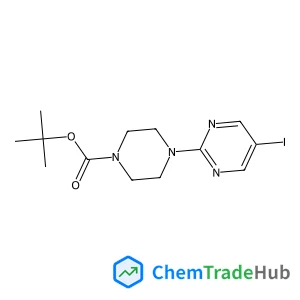
2-Methyl-2-propanyl 4-(5-iodo-2-pyrimidinyl)-1-piperazinecarboxylate
CAS番号:
1027616-32-5
分子式:
C13H19IN4O2
![(3-{[4-(Aminomethyl)-6-(trifluoromethyl)-2-pyridinyl]oxy}phenyl)[(3R,4R)-3-fluoro-4-hydroxy-1-pyrrolidinyl]methanone structure](https://static.chemtradehub.com/structs/200/2007885-39-2-affc.webp "(3-{[4-(Aminomethyl)-6-(trifluoromethyl)-2-pyridinyl]oxy}phenyl)[(3R,4R)-3-fluoro-4-hydroxy-1-pyrrolidinyl]methanone structure")
おすすめサプライヤー






免責事項
このページに表示される学術雑誌情報は、参考および研究目的のみを目的としています。当社は雑誌出版社とは提携しておらず、投稿の取り扱いも行っておりません。出版に関するお問い合わせは、各雑誌出版社に直接ご連絡ください。
表示されている情報に誤りがある場合は、support@chemtradehub.com までご連絡ください。迅速に確認し、対応いたします。