












![Pyrazolo[1,5-a]pyridine-3-carbothioamide structure](https://static.chemtradehub.com/structs/885/885275-44-5-aae0.webp "Pyrazolo[1,5-a]pyridine-3-carbothioamide structure")
Development of a new in situ analysis technique applying luminescence of local coordination sensors: principle and application for monitoring metal-ligand exchange processes
文献情報
出版日
2016-03-15
DOI
10.1039/C6AN00075D
インパクトファクター
4.616
著者
Huayna Terraschke, Laura Ruiz Arana, Patric Lindenberg, Wolfgang Bensch
原文を見る
要旨
Here, we introduce the principle of the novel in situ luminescence analysis of coordination sensor (ILACS) approach for monitoring the formation of solid materials, recording information from the formed solid compounds as well as from the surrounding solutions. This technique utilizes as a main tool the sensitivity of luminescence properties of lanthanide (Ln) ions on the coordination environment, being incorporated as local sensors by the investigated material during synthesis. The luminescence spectra and their environment-dependent developments are monitored in situ from the early stages of the reaction until the final product formation under real conditions with a high time resolution. The ILACS principle is demonstrated here for monitoring the formation of [Eu(phen)2(NO3)3] (phen = 1,10-phenanthroline) and further metal-ligand exchange processes during its conversion to [Sn(phen)Cl4]. These reactions were followed, for instance, analyzing the antenna effect, shift of the 5D0 → 7F4 Eu3+ transition and quenching effects. In addition, these results have been validated by comparison with other in situ techniques. The results demonstrate that ILACS is a new powerful, fast, broadly available in situ characterization method, which is applicable for liquids, amorphous samples, and very small crystallites besides for large crystals.
関連文献
UPS and UV spectroscopies combined to position the energy levels of TiO2 anatase and rutile nanopowders
Clément Maheu, Luis Cardenas, Eric Puzenat, Pavel Afanasiev, Christophe Geantet
2018-09-17
Paper
DOI: 10.1039/C8CP04614J
Raising glass transition temperature of polymer nanofilms as a function of negative interface energy
Xue Yao, Yaru Wang, Xingyou Lang, Yongfu Zhu, Qing Jiang
2019-02-07
Paper
DOI: 10.1039/C8CP07267A
A detailed insight into the catalytic reduction of NO operated by Cr–Cu nanostructures embedded in a CeO2 surface
Mauro Boero, Kazuki Tamai
2018-08-08
Paper
DOI: 10.1039/C8CP04314K
Magnetic-field-tuned phase transition of a molecular material from the isolated-spin to the coupled-spin regime
Ana M. Plutín, Eduardo E. Castellano, Alzir A. Batista, Rafael Calvo, Otaciro R. Nascimento
2019-02-07
Paper
DOI: 10.1039/C8CP06719H
Structural and bonding properties of Cu3O3− and Cu3O4− clusters: anion photoelectron spectroscopy and density functional calculations
Xi-Ling Xu, Bin Yang, Zhi-You Wei, Guo-Jin Cao, Hong-Guang Xu
2018-07-23
Paper
DOI: 10.1039/C8CP03302A
Tannic acid capped gold nanoparticles: capping agent chemistry controls the redox activity
Alex L. Suherman, Giorgia Zampardi, Hatem M. A. Amin, Neil P. Young, Richard G. Compton
2019-02-04
Paper
DOI: 10.1039/C9CP00056A
Effect of an external electric field on capillary filling of water in hydrophilic silica nanochannels
Andres Rojano Crisson, Enrique Wagemann, Harvey A. Zambrano
2018-06-22
Paper
DOI: 10.1039/C8CP03186J
Noble gas hydrides in the triplet state: HNgCCO+ (Ng = He, Ne, Ar, Kr, and Xe)
Arijit Gupta, Rishabh Gupta
2018-07-13
Paper
DOI: 10.1039/C8CP03516D
Thermophysical properties of glyceline–water mixtures investigated by molecular modelling
Jörg Baz, Christoph Held, Jürgen Pleiss, Niels Hansen
2019-02-25
Paper
DOI: 10.1039/C9CP00036D
The impact of chemical order on defect transport in mixed pyrochlores
Blas P. Uberuaga, Romain Perriot, Ghanshyam Pilania
2019-02-19
Paper
DOI: 10.1039/C8CP07597B
こちらもおすすめ
化合物よくある質問
2-ブロモ-9,9-ジフェニル-9H-フルオレンの主な用途は何ですか?
2-溴-9,9-二苯基芴は、医薬品、工業材料、有機合成の研究分野で応用されます。特に、レーザー材料や機能性ポリマーの合成に使用されることがあります。また、蛍光色...
474918-32-62-Bromo-9,9-diphenyl...
化合物よくある質問
四氯化铱の市場動向や研究トレンドはどうですか?
四氯化铱の市場は研究開発分野で注目されており、特にナノ技術や金属有機框架(MOFs)の分野での需要が増加傾向にあります。価格は安定しており、中国や韓国での生産が...
207399-11-9Tetrachloroiridium h...
882-06-44-Nitrocinnamic acid
化合物よくある質問
1-(4-溴-3-氟苯基)-2-氯乙酮を含む廃棄物はどのように処理すべきですか?
1-(4-溴-3-氟苯基)-2-氯乙酮 (CAS番号: 1260857-14-4) の廃棄物は専門的な廃棄処理が必要です。まず、廃棄物は密閉された容器に収集し、...
1260857-14-41-(4-Bromo-3-fluorop...
化合物よくある質問
苦参酚Kとは何ですか?
苦参酚Kは、CAS番号101236-49-1を持つ化合物で、主に天然由来の生薬から抽出されます。この化合物は、抗炎症作用や抗癌作用を持つことが報告されています。
101236-49-1Kushenol K
化合物よくある質問
POTASSIUM (1-(TERTBUTOXYCARBONYL)AZETIDIN-3-YL)TRIFLUOROBORATE を含む廃棄物はどのように処理すべきですか?
POTASSIUM (1-(TERTBUTOXYCARBONYL)AZETIDIN-3-YL)TRIFLUOROBORATE を含む廃棄物は、まず安全なエント...
1430219-73-0Potassium (1-(tert-b...
化合物よくある質問
4-庚基-4’-联苯羧酸の市場動向や研究トレンドはどうですか?
4-庚基-4’-聯苯羧酸は、特殊化学品や合成化学の分野で用いられる化学物質ですが、市場動向としては、研究開発の進展とともに需要が増加しています。また、環境配慮型...
58573-94-74'-Heptyl-4-biphenyl...
化合物よくある質問
6-ブロモ-3-メトキシ-1-フェニル-1H-インドゾールを含む廃棄物はどのように処理すべきですか?
6-ブロモ-3-メトキシ-1-フェニル-1H-インドゾールを含む廃棄物は、適切な化学廃棄処理が必要です。通常、廃棄物は密閉容器に収集され、専門の廃棄処理業者に引...
1332527-03-36-Bromo-3-methoxy-1-...
化合物よくある質問
4,4-二甲基-2-吡咯烷酮はどの業界で使用されていますか?
4,4-二甲基-2-吡咯烷酮は医薬、ポリマー、センサー、半導体などの業界で広く使用されています。特に溶媒としての性能が高く評価されています。
66899-02-34,4-dimethylpyrrolid...
51312-42-6Sodium Phosphotungst...
掲載誌
Analyst

CiteScore:
7.8
自己引用率:
5.6%
年間論文数:
653
Analyst publishes analytical and bioanalytical research that reports premier fundamental discoveries and inventions, and the applications of those discoveries, unconfined by traditional discipline barriers.
おすすめ化合物
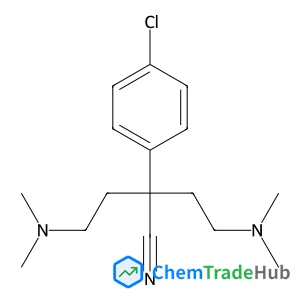
2-(4-Chlorophenyl)-4-(dimethylamino)-2-(2-(dimethylamino)ethyl)butanenitrile
CAS番号:
1246816-57-8
分子式:
C16H24ClN3
![2,6-Bis({(2R)-2-[hydroxy(diphenyl)methyl]-1-pyrrolidinyl}methyl)-4-methylphenol structure](https://static.chemtradehub.com/structs/877/877395-58-9-70bf.webp "2,6-Bis({(2R)-2-[hydroxy(diphenyl)methyl]-1-pyrrolidinyl}methyl)-4-methylphenol structure")
おすすめサプライヤー





免責事項
このページに表示される学術雑誌情報は、参考および研究目的のみを目的としています。当社は雑誌出版社とは提携しておらず、投稿の取り扱いも行っておりません。出版に関するお問い合わせは、各雑誌出版社に直接ご連絡ください。
表示されている情報に誤りがある場合は、support@chemtradehub.com までご連絡ください。迅速に確認し、対応いたします。