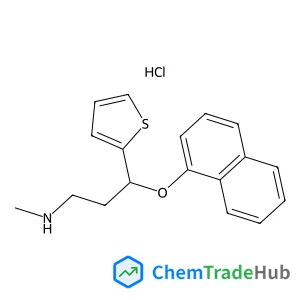
N-Methyl-3-(1-naphthyloxy)-3-(2-thienyl)-1-propanamine hydrochloride (1:1)
CAS番号:
1188266-11-6
分子式:
C18H20ClNOS
Qi Li, Guangshe Li, Chaochao Fu, Dong Luo, Jianming Fan, Dongjiu Xie, Liping Li
Lithium batteries for UPS, portable electronics and electrical vehicles rely on high-energy cathodes. Li-rich manganese-rich oxide (xLi2MnO3·(1 − x)LiMO2, M = transition metals) is one of the few materials that might meet such a requirement, but it suffers from poor energy retention due to serious voltage and/or capacity fade, which challenges its applications. Here we show that this challenge can be addressed by optimizing the interactions between the components Li2MnO3 and LiMO2 in the Li-rich oxide (i.e. stabilizing the layered structure through Li2MnO3 and controlling Li2MnO3 activation through LiMO2). To realize this synergistic effect, a novel Li2MnO3-stabilized Li1.080Mn0.503Ni0.387Co0.030O2 was designed and prepared using a hierarchical carbonate precursor obtained by a solvo/hydro-thermal method. This layered oxide is demonstrated to have a high working voltage of 3.9 V and large specific energy of 805 W h kg−1 at 29 °C as well as impressive energy retention of 92% over 100 cycles. Even when exposed to 55 °C, energy retention is still as high as 85% at 200 mA g−1. The attractive performance is most likely the consequence of the balanced stability and specific energy in the present material, which is promisingly applicable to other Li-rich oxide systems. This work sheds light on harnessing Li2MnO3 activation and furthermore efficient battery design simply through compositional tuning and temperature regulation.
John W. C. Cheing, William P. D. Goldring, Gerald Pattenden
DOI: 10.1039/B310753A
Lin-Ping Zhang, Thomas C. W. Mak
DOI: 10.1039/B307604K
Michel Frigoli, Georg H. Mehl
DOI: 10.1039/B316146C
Hayley J. Whitfield, Roger J. Griffin, Ian R. Hardcastle, Andrew Henderson, Jerome Meneyrol, Veronique Mesguiche, Kerry L. Sayle, Bernard T. Golding
DOI: 10.1039/B308948G
Sònia Abelló, Francisco Medina, Xavier Rodríguez, Yolanda Cesteros, Pilar Salagre, Jesús E. Sueiras, Didier Tichit, Bernard Coq
DOI: 10.1039/B401448K
John Baty, Michael L. Sinnott
DOI: 10.1039/B316417A
Janice Aldrich-Wright, Craig Brodie, Edith C. Glazer, Nathan W. Luedtke, Lev Elson-Schwab, Yitzhak Tor
DOI: 10.1039/B316917K
G. D. Kishore Kumar, Sundarababu Baskaran
DOI: 10.1039/B402371D
Alison Y. Cheng, Scott B. Clendenning, Guocheng Yang, Zheng-Hong Lu, Christopher M. Yip, Ian Manners
DOI: 10.1039/B316656B
Jianzhong Lu, Choiwan Lau, Masaaki Kai
DOI: 10.1039/B306895A
3-イチチルビフェニルは、ビフェニルとイチプロピオニトリルを回収率約90%で反応させて合成されます。触媒は通常、亜リチウムホウ素を用います。
8-溴-5-三氟甲基喹啉は、5-トリフルオロメチル-2-メチル-1,3-ベンゼンジオールをブロモエタノールと反応させて生成します。この反応は塩基性条件下で行われ...
ジメチル4-(4,4,5,5-テトラメチル-1,3,2-ドioxaborolan-2-基)-2,6-ピリジンジカルボイル酸フェニルアミニドの代替品としては、4-...
N-(3,5-ヘキサクロロ-4-ピリドインイル)-8-メチオキシ-5-キノリンカーボン酸の市場動向は、主に産業用途での需要により影響を受けます。研究トレンドとし...
イソステアロイルグリセリルは一般的に安全性が高いとされていますが、過度な使用や個人差により皮�owsん炎などの反応が起こる可能性があります。使用前に医師に相談す...
1-(二苯甲基)-3,3-二氟-氮杂环丁烷の市場動向は、医薬品や合成化学の研究分野で注目を集めています。新興研究は、該当化合物の合成改良と生体内での作用メカニズ...
3-チオフェンスチオールのCAS番号は7774-73-4です。結晶性の白色粉末で、分子量は122.17です。この化合物は水に微溶解し、エタノールやジクロロメタン...
2-Methyl-2-propanyl (2S)-2-(aminomethyl)-1-piperidinecarboxylateは一定の安全性基準を満たしていま...
CAS番号1316822-90-8の化合物は安全性に関しては評価が不足していますが、一般的には生物学的に活性な物質であり、取り扱いには適切な安全防護措置が必要で...
Tert-butyl 2-(2-羟基乙基)哌嗪-1-羧酸は、冷暗所で保存し、直射日光から遠ざけてください。容器は密閉し、高湿度や高温を避けて保管してください。

Journal of Materials Chemistry A, B & C cover high quality studies across all fields of materials chemistry. The journals focus on those theoretical or experimental studies that report new understanding, applications, properties and synthesis of materials. The journals have a strong history of publishing quality reports of interest to interdisciplinary communities and providing an efficient and rigorous service through peer review and publication. The journals are led by an international team of Editors-in-Chief and Associate Editors who are all active researchers in their fields. Journal of Materials Chemistry A, B & C are separated by the intended application of the material studied. Broadly, applications in energy and sustainability are of interest to Journal of Materials Chemistry A, applications in biology and medicine are of interest to Journal of Materials Chemistry B, and applications in optical, magnetic and electronic devices are of interest to Journal of Materials Chemistry C. More than one Journal of Materials Chemistry journal may be suitable for certain fields and researchers are encouraged to submit their paper to the journal that they feel best fits for their particular article. Example topic areas within the scope of Journal of Materials Chemistry A are listed below. This list is neither exhaustive nor exclusive. Artificial photosynthesis Batteries Carbon dioxide conversion Catalysis Fuel cells Gas capture/separation/storage Green/sustainable materials Hydrogen generation Hydrogen storage Photocatalysis Photovoltaics Self-cleaning materials Self-healing materials Sensors Supercapacitors Thermoelectrics Water splitting Water treatment