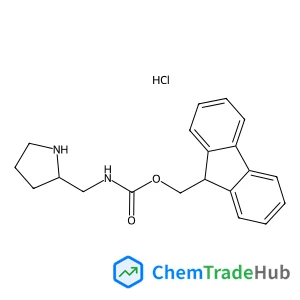
(S)-(9H-Fluoren-9-yl)methyl (pyrrolidin-2-ylmethyl)carbamate hydrochloride
CAS番号:
1217813-15-4
分子式:
C20H23ClN2O2
Z. Tang, S. Mandal, N. D. Paul, M. Lutz, P. Li, J. I. van der Vlugt, B. de Bruin
Ketene synthesis involving catalytic carbonylation of carbenes is an interesting alternative to traditional synthetic protocols, offering milder conditions to diversified products. Analogous catalytic ketene imine production from carbenes and isocyanides is also a promising reaction. However, both methods are underdeveloped. Rhodium carbonyl complexes B and E, based on (6-(phosphinomethyl)pyridin-2-yl)methan-sec-amine type PNN ligand scaffolds, reveal good catalytic activities in ketene and ketene imine production using ethyl diazoacetate (EDA, 1) or sodium 2-benzylidene-1-tosylhydrazin-1-ide (5) as the carbene precursors, as demonstrated by in situ amide/imidamide and β-lactam synthesis. DFT calculations suggest that diazo activation is the rate-determining step and that NH-deprotonation of the ligand produces a more active rhodium complex. The ketene formation step likely proceeds via an outer-sphere CO insertion mechanism. Subsequent stepwise and concerted [2 + 2] cyclization mechanisms have comparable barriers. The complexes are the first rhodium catalysts reported for catalytic ketene/ketene imine production from carbenoids. The higher affinity of rhodium for binding ketene or ketene imine intermediates as compared to other reported metal catalysts (i.e. Pd, Co) may provide opportunities for future enantioselective reactions when using chiral ligands.

Russian Journal of Bioorganic Chemistry

Acta Materialia

Russian Chemical Bulletin

Crystallography Reports

Russian Journal of Organic Chemistry

Russian Journal of General Chemistry

Current Opinion in Colloid & Interface Science

Journal of Natural Medicines

Chemical Communications

Journal of Saudi Chemical Society
Carlos Randino, Marcin Ziółek, Ricard Gelabert, Juan Angel Organero, Michal Gil, Miquel Moreno, José M. Lluch, Abderrazzak Douhal
DOI: 10.1039/C1CP21039D
I. A. K. Young, C. Murray, C. M. Blaum, R. A. Cox, R. L. Jones, F. D. Pope
DOI: 10.1039/C1CP21337G
Yong Zhao
DOI: 10.1039/C1CP21813A
Yufang Liu, Kai Jiang, Deheng Shi, Jinfeng Sun
DOI: 10.1039/C1CP20729F
J.M. Granadino-Roldán, M. Fernández-Gómez, Lin-Wang Wang
DOI: 10.1039/C1CP20329K
Dvira Segal, Andrew J. Millis, David R. Reichman
DOI: 10.1039/C1CP20702D
N. Crivillers, A. Liscio, F. Di Stasio, C. Van Dyck, S. Osella, D. Cornil, S. Mian, G. M. Lazzerini, O. Fenwick, E. Orgiu, F. Reinders, S. Braun, M. Fahlman, J. Cornil, V. Palermo, F. Cacialli, P. Samorì
DOI: 10.1039/C1CP20851A
Tomoya Uruga, Hajime Tanida, Yasuko Terada, Yasuhiro Iwasawa, Shin-ichi Ohkoshi
DOI: 10.1039/C1CP20895K
Rodrigo Galindo-Murillo, Joseelyne Hernandez-Lima, Mayra González-Rendón, Lena Ruíz-Azuara, Rafael Moreno-Esparza
DOI: 10.1039/C1CP20183B
Johan Scheers, Jagath Pitawala, Frederic Thebault, Jae-Kwang Kim, Jou-Hyeon Ahn, Aleksandar Matic, Per Jacobsson
DOI: 10.1039/C1CP21062A
6-苄基-6,7-二氢-5H-吡咯并3,4-b吡啶は、CAS番号109966-30-5の化合物です。これは、6-ベンジル基を持つ6,7-二氢-5H-吡咯並みの化...
半硫酸奎宁单水水合物は、乾燥した涼しい場所に保管し、直射日光や湿気を避ける必要があります。保存温度は常温(15〜25℃)が適切で、湿度は40%以下を維持すること...
D-核糖-5-リン酸二ナトリウムは、CAS番号18265-46-8を有する化合物で、D-核糖の5位付加部位にリン酸基が結合した化合物です。この化合物は、水溶性で...
3-乙酰基-4-羟基喹啉-2(1H)-酮は、ハイドロキノンと酢酸アセトイルアミドのアミド化反応により合成されます。この反応は塩基触媒を用いて行われ、選択性は良好...
5-溴-4-甲基-1H-吲唑は、CAS番号1082041-34-6の化学物質で、化学式はC10H9BrNです。この化合物は淡黄色の結晶性粉末で、吸湿性があります...
3-(4メトキシフェニル)オキテナン-3カーボイル酸の代替品は、その用途により異なりますが、例えば4-(メトキシフェニル)オキテナン-3カーボイル酸や、他のオキ...
3-イリドオキシピロロ[2,3-b]ピリジン-5-カルボキシlic酸は危険な化合物ではありませんが、適切な手袋や保護眼鏡の使用を推奨します。誤って摂取または接触...
3-氟-4- iodobenolは可燃性を有し、強力な反応性を持つため、取り扱いには注意が必要です。PPE(個人保護具)の着用、ドラフトチャンバーの使用、漏洩時...

Organic Chemistry Frontiers publishes high-quality research from across organic chemistry. Emphases are placed on studies that make significant contributions to the field of organic chemistry by reporting either new or significantly improved protocols or methodologies. Topics include, but are not limited to the following: Organic synthesis Development of synthetic methodologies Catalysis Natural products Functional organic materials Supramolecular and macromolecular chemistry Physical and computational organic chemistry
![2-(7,7-Difluorobicyclo[4.1.0]hept-1-yl)ethanamine structure](https://static.chemtradehub.com/structs/209/2098065-08-6-ff24.webp "2-(7,7-Difluorobicyclo[4.1.0]hept-1-yl)ethanamine structure")
![4-Chloro-2-{[(2-chlorophenoxy)acetyl]amino}benzoic acid structure](https://static.chemtradehub.com/structs/351/351424-20-9-9467.webp "4-Chloro-2-{[(2-chlorophenoxy)acetyl]amino}benzoic acid structure")