


PNIPAM-based heteroarm star-graft quarterpolymers: synthesis, characterization and pH-dependent thermoresponsiveness in aqueous media
文献情報
出版日
2015-04-13
DOI
10.1039/C5PY00393H
インパクトファクター
5.582
著者
Zacharoula Iatridi, M. M. Soledad Lencina
原文を見る
要旨
Heteroarm star-graft quarterpolymers PSn[P2VP-b-(PAA-g-PNIPAM)]n bearing two different kinds of arms: a short polystyrene (PS) and a longer poly(2-vinyl pyridine)-b-poly(acrylic acid) (P2VP-b-PAA) block copolymer arm, grafted by PNIPAM chains onto the outer PAA segments, were synthesized by a three-pot multi-step reaction procedure. Thanks to the pH dependent ionization of P2VP and PAA blocks, as well as the thermo-sensitivity of the PNIPAM grafting chains, these star-graft quarterpolymers exhibited multifunctional responsive behavior in aqueous media. Upon heating the aqueous star-graft solutions, intermolecular hydrophobic association was observed above a critical temperature, defined as Tass, which was affected by the electrostatic interactions exerted by the weak polyelectrolyte P2VP and PAA segments. This effect led to the appearance of a gel phase at concentrated solutions (CP = 3 wt%). All the observed phenomena depend strongly on the solution conditions and the macromolecular characteristics, namely pH and ionic strength along with the number of arms and the PNIPAM grafting density. The promising preliminary results of this study show that aqueous formulations of these star-graft macromolecules, either in low or high polymer concentrations, could find potential applications as “smart” multi-compartmentalized nanocarriers and/or hydrogels.
おすすめジャーナル

Angewandte Chemie International Edition

Coloration Technology

Foundations of Chemistry

Molecules

Journal of Enzyme inhibition and Medicinal Chemistry

Mini-Reviews in Medicinal Chemistry

Contact Lens & Anterior Eye

Molecular Diversity

Environmental Toxicology and Pharmacology

Photochemical & Photobiological Sciences
関連文献
A non-metallic SERS-based immunoassay founded by light-harvesting effect and strengthened chemical enhancement
Jiali Ma, Wenxin Dong, Tao Xu, Guodong Wei, Chenjie Gu, Tao Jiang
2023-03-23
Paper
DOI: 10.1039/D3AN00171G
A machine learning based approach for quantitative evaluation of cell migration in Transwell assays based on deformation characteristics
Fei Zhang, Rongbiao Zhang, Mingji Wei, Guoxiao Li
2023-02-14
Paper
DOI: 10.1039/D2AN01882A
Rapid and sensitive detection of chlordimeform in cucumber and tomato samples using an immunochromatographic assay
Yingyue Zhu
2023-01-10
Paper
DOI: 10.1039/D2AN01923J
A fluorescent aptasensor for ATP based on functional DNAzyme/walker and terminal deoxynucleotidyl transferase-assisted formation of DNA-AgNCs
Shixin Cai, Xin Chen, Haohan Chen, Yuting Zhang, Xiaoli Wang, Nandi Zhou
2023-01-16
Paper
DOI: 10.1039/D2AN02006H
Reflective epoxy resin/chitosan/PAA composite-functionalized fiber-optic interferometric probe sensor for sensitive heavy metal ion detection
Minglu Yan, Yang Li, Xin Kang, Zaikun Zhang, Yangyang Li, Man Jiang
2023-01-21
Paper
DOI: 10.1039/D2AN01740G
Monitoring bacterial spore metabolic activity using heavy water-induced Raman peak evolution
Rasmus Öberg, Tobias Dahlberg, Dmitry Malyshev
2023-04-04
Paper
DOI: 10.1039/D2AN02047E
Efficient large-scale screening of viral pathogens by fragment length identification of pooled nucleic acid samples (FLIPNAS)
Xianzhen Feng, Xinyu Zhuang, Grace Lui, I-Ming Hsing
2023-03-09
Paper
DOI: 10.1039/D3AN00058C
Mobile multi-configuration clinical translational Raman system for oral cancer application
Siddra Maryam, Sanathana Konugolu Venkata Sekar, M. Daniyal Ghauri, Edward Fahy, Marcelo Saito Nogueira, Huihui Lu, Flavien Beffara, Georges Humbert, Patrick Sheahan, Ray Burke, Kiang Wei Kho, Rekha Gautam, Stefan Andersson-Engels
2023-03-06
Paper
DOI: 10.1039/D2AN01921C
Efficient analysis of pharmaceutical drug substances and products using a solid-state NMR CryoProbe
Yong Du, Jochem Struppe, Barbara Perrone, Alia Hassan, Anna Codina, Yongchao Su
2023-01-06
Paper
DOI: 10.1039/D2AN01903E
Overview and considerations in bottom-up proteomics
Rachel M. Miller, Lloyd M. Smith
2022-11-14
Tutorial Review
DOI: 10.1039/D2AN01246D
こちらもおすすめ
28770-01-62-(2-Isopropyl-1,3-o...
化合物よくある質問
「邻羟基阿托伐他汀内酯标准品」に適用される法規ガイドelinesは何ですか?
CAS番号163217-74-1の「邻羟基阿托伐他汀内酯标准品」は、GHS分類では危険物に分類されず、主にREACH規則とFDA/EPAの管理対象となります。R...
163217-74-1ortho-Hydroxy Atorva...
化合物よくある質問
メチル(3R)-3-アミノ-2,3-ジヒドロ-1-ベンゾファンラニン-5-カルボイル酸塩塩酸塩の主な用途は何ですか?
メチル(3R)-3-アミノ-2,3-ジヒドロ-1-ベンゾファンラニン-5-カルボイル酸塩塩酸塩は、医薬品や合成化学の研究に広く用いられます。また、特定の薬物の前...
2241594-15-8Methyl (3R)-3-amino-...
化合物よくある質問
トランス-4-メチルピロリジン-3-オール塩酸塩はどのように合成されますか?
トランス-4-メチルピロリジン-3-オール塩酸塩は、4-メチルピロリジンの塩酸塩化によって合成されます。一般的な合成方法では、4-メチルピロリジンを塩酸に加えて...
265108-42-7trans-4-Methylpyrrol...
化合物よくある質問
硫雜環丁烷-1,1-二氧化物は安全ですか?
硫雜環丁烷-1,1-二氧化物は安全ではありません。毒性は報告されていませんが、高温下で分解し、可燃性があるため、高圧ガスは注意が必要です。密閉した容器で保管し、...
5687-92-3Thietane 1,1-dioxide
6054-10-02H, 8H-Benzo[1,2-b
化合物よくある質問
9-ヒドロキシエリプチシネ塩酸塩はどのように合成されますか?
9-ヒドロキシエリプチシネ塩酸塩は、エリプチシネから塩酸を添加することで合成されます。選択性は高いですが、収率は約70%です。
52238-35-49-Hydroxyellipticine...
化合物よくある質問
5-塩素-2-(メチルアミノ)フェニル-(2-塩素フェニル)メタン酮の物理化学的性質は何ですか?
5-塩素-2-(メチルアミノ)フェニル-(2-塩素フェニル)メタン酮のCAS番号は5621-86-3です。この化合物は白色の結晶性粉末で、分子量は415.03で...
5621-86-3[5-Chloro-2-(methyla...
化合物よくある質問
1-[2-(4-甲氧基-苯氧基)-乙基]-哌嗪はどのように保存すればよいですか?
1-[2-(4-甲氧基-苯氧基)-乙基]-哌嗪は、直射日光を避けて暗所に、室温(15-25℃)で保管し、密閉容器に入れることで安定性を保つことができます。
117132-44-21-[2-(4-Methoxy-phen...
化合物よくある質問
2-[3-(4-甲氧基フェニル)プロピル]-4,4,5,5-四メチル-1,3,2-ドイボロロールアンの主な用途は何ですか?
2-[3-(4-甲氧基フェニル)プロピル]-4,4,5,5-四メチル-1,3,2-ドイボロロールアンは、医薬品の合成、有機合成化学、および新材料の研究で使用され...
1073371-72-82-[3-(4-Methoxypheny...
掲載誌
Polymer Chemistry

CiteScore:
8.6
自己引用率:
7.3%
年間論文数:
457
Polymer Chemistry welcomes submissions in all areas of polymer science that have a strong focus on macromolecular chemistry. Manuscripts may cover a broad range of fields, yet no direct application focus is required.
おすすめ化合物
![(3R,5R)-1-[(Benzyloxy)carbonyl]-5-methyl-3-piperidinecarboxylic acid structure](https://static.chemtradehub.com/structs/126/1269757-29-0-c552.webp "(3R,5R)-1-[(Benzyloxy)carbonyl]-5-methyl-3-piperidinecarboxylic acid structure")
(3R,5R)-1-[(Benzyloxy)carbonyl]-5-methyl-3-piperidinecarboxylic acid
CAS番号:
1269757-29-0
分子式:
C15H19NO4
![[(1S,2S,3R,4S,7R,9S,10S,12R,15S)-4,12-Diacetyloxy-15-[(2R,3S)-3-benzamido-3-phenyl-2-(2,2,2-trichloroethoxycarbonyloxy)propanoyl]oxy-1,9-dihydroxy-10,14,17,17-tetramethyl-11-oxo-6-oxatetracyclo[11.3.1.03,10.04,7]heptadec-13-en-2-yl] benzoate structure](https://static.chemtradehub.com/structs/100/100431-55-8-7104.webp "[(1S,2S,3R,4S,7R,9S,10S,12R,15S)-4,12-Diacetyloxy-15-[(2R,3S)-3-benzamido-3-phenyl-2-(2,2,2-trichloroethoxycarbonyloxy)propanoyl]oxy-1,9-dihydroxy-10,14,17,17-tetramethyl-11-oxo-6-oxatetracyclo[11.3.1.03,10.04,7]heptadec-13-en-2-yl] benzoate structure")
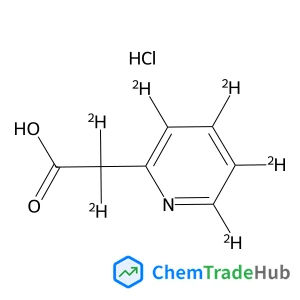
2,2-dideuterio-2-(3,4,5,6-tetradeuterio-2-pyridyl)acetic acid;hydrochloride
CAS番号:
1329799-67-8
分子式:
C7H2ClD6NO2
おすすめサプライヤー




免責事項
このページに表示される学術雑誌情報は、参考および研究目的のみを目的としています。当社は雑誌出版社とは提携しておらず、投稿の取り扱いも行っておりません。出版に関するお問い合わせは、各雑誌出版社に直接ご連絡ください。
表示されている情報に誤りがある場合は、support@chemtradehub.com までご連絡ください。迅速に確認し、対応いたします。