












Phase transition characteristics in the conductivity of VO2(A) nanowires: size and surface effects
文献情報
出版日
2016-03-09
DOI
10.1039/C5CP07903A
インパクトファクター
3.676
著者
原文を見る
要旨
Transition-metal oxides have fascinating characteristics, and have been exploited for various applications, such as Mott transistors, optical switches and strain sensors, etc. Vanadium dioxide is a special and important transition-metal oxide, and exhibits the significant behavior of metal–insulator transition. In this work, single crystalline VO2(A) nanowires have been synthesized by a facile hydrothermal method. Due to the size and surface effects, the nanowires with different widths show great disparities in their hysteresis loops, phase transition temperatures and electrical conductivities. Our results show that the phase transition temperature is linearly dependent on the inverse of the nanowire widths, and a similar relationship between the electrical conductivity and the width of the nanowires has also been found. More interestingly, the first-order phase transition of the nanowire even coverts into high-order continuous phase transition when the width is below a critical size. To explore the intrinsic influence of the size and surface effects, the analysis of the transmission electron microscopy measurements showed that the rough surface structure of the nanowire is very different to the internal structure, and the thickness of this rough surface structure almost remains unchanged as the with of the nanowire decreases. Our results indicated that the surface structure has a remarkable effect on the phase transition characteristics decreasing nanowire width, and the suitable heterogeneous nucleation originating from the rough surface structure should play a crucial role in properties of the VO2(A) nanowires. Size-dependent phase transition features of the VO2(A) nanowires also suggest that the size and surface effects must be taken into consideration when designing VO2 nanodevices.
関連文献
Exploring experimental fitness landscapes for chemical synthesis and property optimization
Katharine Moore Tibbetts, Xiao-Jiang Feng, Herschel Rabitz
2017-01-18
Paper
DOI: 10.1039/C6CP06187G
Molecular dynamics simulations of the effect of waviness and agglomeration of CNTs on interface strength of thermoset nanocomposites
A. R. Alian, S. A. Meguid
2017-01-13
Paper
DOI: 10.1039/C6CP07464B
Anions coordinating anions: analysis of the interaction between anionic Keplerate nanocapsules and their anionic ligands
Josep Bonet Avalos
2017-01-25
Paper
DOI: 10.1039/C6CP08511C
An insight into the communication between β-olefin/phenyl olefin-mediated acceptors and porphyrin π-system: a way to establish porphyrin based chemodosimeters and chemosensors
Mandeep K. Chahal, Muniappan Sankar, Ray J. Butcher
2017-01-04
Paper
DOI: 10.1039/C6CP08396J
Investigations on Zr incorporation into Li3V2(PO4)3/C cathode materials for lithium ion batteries
Hua-Bin Sun, Ying-Xian Zhou, Lu-Lu Zhang, Xue-Lin Yang, Xing-Zhong Cao, Hanu Arave, Hui Fang, Gan Liang
2017-01-13
Paper
DOI: 10.1039/C6CP07760A
Hydration of the simplest α-keto acid: a rotational spectroscopic and ab initio study of the pyruvic acid–water complex
Elijah G. Schnitzler, Nathan A. Seifert, Supriya Ghosh, Javix Thomas, Yunjie Xu, Wolfgang Jäger
2017-01-17
Paper
DOI: 10.1039/C6CP08741H
Structural and magneto-electronic properties and electric field-mediated effects for transition metal-terminated zigzag h-BN nanoribbons
J. Liu, Z. H. Zhang, P. F. Yuan, Z. Q. Fan
2017-01-04
Paper
DOI: 10.1039/C6CP06909F
The role of π-linkers in tuning the optoelectronic properties of triphenylamine derivatives for solar cell applications – A DFT/TDDFT study‡
Arunkumar Kathiravan, Rajadurai Vijay Solomon
2017-01-26
Paper
DOI: 10.1039/C6CP07768D
Conformational and electronic effects on the formation of anti cyclobutane pyrimidine dimers in G-quadruplex structures
Wook Lee, Spiridoula Matsika
2016-12-08
Paper
DOI: 10.1039/C6CP05604K
こちらもおすすめ
化合物よくある質問
2-ブロモ-9,9-ジフェニル-9H-フルオレンの主な用途は何ですか?
2-溴-9,9-二苯基芴は、医薬品、工業材料、有機合成の研究分野で応用されます。特に、レーザー材料や機能性ポリマーの合成に使用されることがあります。また、蛍光色...
474918-32-62-Bromo-9,9-diphenyl...
化合物よくある質問
四氯化铱の市場動向や研究トレンドはどうですか?
四氯化铱の市場は研究開発分野で注目されており、特にナノ技術や金属有機框架(MOFs)の分野での需要が増加傾向にあります。価格は安定しており、中国や韓国での生産が...
207399-11-9Tetrachloroiridium h...
882-06-44-Nitrocinnamic acid
化合物よくある質問
1-(4-溴-3-氟苯基)-2-氯乙酮を含む廃棄物はどのように処理すべきですか?
1-(4-溴-3-氟苯基)-2-氯乙酮 (CAS番号: 1260857-14-4) の廃棄物は専門的な廃棄処理が必要です。まず、廃棄物は密閉された容器に収集し、...
1260857-14-41-(4-Bromo-3-fluorop...
化合物よくある質問
苦参酚Kとは何ですか?
苦参酚Kは、CAS番号101236-49-1を持つ化合物で、主に天然由来の生薬から抽出されます。この化合物は、抗炎症作用や抗癌作用を持つことが報告されています。
101236-49-1Kushenol K
化合物よくある質問
POTASSIUM (1-(TERTBUTOXYCARBONYL)AZETIDIN-3-YL)TRIFLUOROBORATE を含む廃棄物はどのように処理すべきですか?
POTASSIUM (1-(TERTBUTOXYCARBONYL)AZETIDIN-3-YL)TRIFLUOROBORATE を含む廃棄物は、まず安全なエント...
1430219-73-0Potassium (1-(tert-b...
化合物よくある質問
4-庚基-4’-联苯羧酸の市場動向や研究トレンドはどうですか?
4-庚基-4’-聯苯羧酸は、特殊化学品や合成化学の分野で用いられる化学物質ですが、市場動向としては、研究開発の進展とともに需要が増加しています。また、環境配慮型...
58573-94-74'-Heptyl-4-biphenyl...
化合物よくある質問
6-ブロモ-3-メトキシ-1-フェニル-1H-インドゾールを含む廃棄物はどのように処理すべきですか?
6-ブロモ-3-メトキシ-1-フェニル-1H-インドゾールを含む廃棄物は、適切な化学廃棄処理が必要です。通常、廃棄物は密閉容器に収集され、専門の廃棄処理業者に引...
1332527-03-36-Bromo-3-methoxy-1-...
化合物よくある質問
4,4-二甲基-2-吡咯烷酮はどの業界で使用されていますか?
4,4-二甲基-2-吡咯烷酮は医薬、ポリマー、センサー、半導体などの業界で広く使用されています。特に溶媒としての性能が高く評価されています。
66899-02-34,4-dimethylpyrrolid...
51312-42-6Sodium Phosphotungst...
掲載誌
Physical Chemistry Chemical Physics

CiteScore:
5.5
自己引用率:
10.3%
年間論文数:
3036
Physical Chemistry Chemical Physics (PCCP) is an international journal co-owned by 19 physical chemistry and physics societies from around the world. This journal publishes original, cutting-edge research in physical chemistry, chemical physics and biophysical chemistry. To be suitable for publication in PCCP, articles must include significant innovation and/or insight into physical chemistry; this is the most important criterion that reviewers and Editors will judge against when evaluating submissions. The journal has a broad scope and welcomes contributions spanning experiment, theory, computation and data science. Topical coverage includes spectroscopy, dynamics, kinetics, statistical mechanics, thermodynamics, electrochemistry, catalysis, surface science, quantum mechanics, quantum computing and machine learning. Interdisciplinary research areas such as polymers and soft matter, materials, nanoscience, energy, surfaces/interfaces, and biophysical chemistry are welcomed if they demonstrate significant innovation and/or insight into physical chemistry. Joined experimental/theoretical studies are particularly appreciated when complementary and based on up-to-date approaches.
おすすめ化合物
![[4-Amino-2-(methylsulfanyl)-5-pyrimidinyl]methanol structure](https://static.chemtradehub.com/structs/588/588-36-3-fc73.webp "[4-Amino-2-(methylsulfanyl)-5-pyrimidinyl]methanol structure")
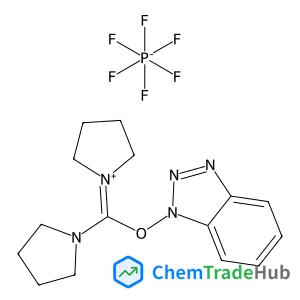
(1H-Benzotriazol-1-yloxy)(di-1-pyrrolidinyl)methylium hexafluorophosphate
CAS番号:
105379-24-6
分子式:
C15H21F6N5OP

おすすめサプライヤー



免責事項
このページに表示される学術雑誌情報は、参考および研究目的のみを目的としています。当社は雑誌出版社とは提携しておらず、投稿の取り扱いも行っておりません。出版に関するお問い合わせは、各雑誌出版社に直接ご連絡ください。
表示されている情報に誤りがある場合は、support@chemtradehub.com までご連絡ください。迅速に確認し、対応いたします。