












Photodissociation of aniline N–H bonds in clusters of different nature
文献情報
出版日
2015-09-01
DOI
10.1039/C5CP04485E
インパクトファクター
3.676
著者
Viktoriya Poterya, Dana Nachtigallová, Jozef Lengyel, Michal Fárník
原文を見る
要旨
We investigated the solvent effects on the N–H bond photodisociation dynamics of aniline (PhNH2) in clusters using velocity map imaging (VMI). The VMI experiment was accompanied by a time-of-flight mass spectrometry after electron ionization to reveal the cluster nature. The H-fragment images were recorded at 243 nm in various expansion regimes corresponding to different species: isolated molecules; small (PhNH2)N, N ≤ 3, clusters; larger (PhNH2)N, N ≥ 10; small mixed PhNH2·(H2O)N, N ≤ 10, clusters; and individual PhNH2 molecules deposited on large (H2O)N, = 430. The H-fragment kinetic energy distributions exhibit fast fragments around 0.8 eV (A) assigned previously to a direct dissociation along a repulsive πσ* state potential, and slow statistical fragments peaking near 0.2 eV (B). In the aniline clusters the contribution of fast fragments (A) decreases relatively to (B) with increasing cluster size. A similar effect is observed when aniline is solvated with water molecules. The experimental data are interpreted with ab initio calculations. Cluster structures were calculated with both N–H bonds of an aniline molecule participating in hydrogen bonding, as well as the ones with free N–H bonds. The latter ones yield preferentially the fast fragments as the isolated molecule. For N–H engaged in hydrogen bonding a barrier increased along the N–H coordinate on the dissociative πσ* state potential surface, and also the energy of πσ*/S0 conical intersection increased. Thus the fast dissociation channel was closed stabilizing the molecule in clusters. The population could be funnelled through other conical intersections into the hot ground state which decayed statistically, yielding the slow H-fragments.
関連文献
Glycerol based solvents: synthesis, properties and applications
José I. García, Héctor García-Marín, Elísabet Pires
2013-12-05
Critical Review
DOI: 10.1039/C3GC41857J
A continuous process for glyoxal valorisation using tailored Lewis-acid zeolite catalysts
Pierre Y. Dapsens, Cecilia Mondelli, Bright T. Kusema, René Verel, Javier Pérez-Ramírez
2013-12-13
Paper
DOI: 10.1039/C3GC42353K
A molybdenum based metallomicellar catalyst for controlled and selective sulfoxidation reactions in aqueous medium
Rajan Deepan Chakravarthy, Venkatachalam Ramkumar, Dillip Kumar Chand
2014-01-07
Paper
DOI: 10.1039/C3GC42245C
Water at elevated temperatures (WET): reactant, catalyst, and solvent in the selective hydrolysis of protecting groups
Wilmarie Medina-Ramos, Mike A. Mojica, Elizabeth D. Cope, Ryan J. Hart
2014-02-04
Paper
DOI: 10.1039/C3GC42569J
Lignin extraction from biomass with protic ionic liquids
Ezinne C. Achinivu, Reagan M. Howard, Guoqing Li, Hanna Gracz, Wesley A. Henderson
2013-12-05
Communication
DOI: 10.1039/C3GC42306A
Hydrolysis of green-tide forming Ulva spp. by microwave irradiation with polyoxometalate clusters
Shuntaro Tsubaki, Kiriyo Oono, Masanori Hiraoka, Tadaharu Ueda, Ayumu Onda, Kazumichi Yanagisawa, Jun-ichi Azuma
2013-12-12
Paper
DOI: 10.1039/C3GC42027B
Palladium-catalyzed synthesis of benzoxazoles by the cleavage reaction of carbon–carbon triple bonds with o-aminophenol
Ying Liang, Heng-Shan Wang, Ying-Ming Pan
2014-01-17
Communication
DOI: 10.1039/C3GC42499E
Catalyst- and solvent-free, pot, atom and step economic synthesis of tetrahydroquinazolines by an aza-Diels–Alder reaction strategy
Debajyoti Bhuyan, Rupam Sarma, Yuvaraj Dommaraju, Dipak Prajapati
2014-01-02
Communication
DOI: 10.1039/C3GC42389A
Organocatalysis in biorefining for biomass conversion and upgrading
Eugene Y.-X. Chen
2013-11-12
Critical Review
DOI: 10.1039/C3GC41934G
Trifluoromethylation of heterocycles in water at room temperature
James C. Fennewald, Bruce H. Lipshutz
2013-12-05
Communication
DOI: 10.1039/C3GC42119H
こちらもおすすめ
化合物よくある質問
4-アミノフェノール酸ナトリウム水和物とは何ですか?
4-アミノフェノール酸ナトリウム水和物は、CAS番号206557-08-6の化合物で、4-アミノフェノールとナトリウムが結合した塩と水和物です。この化合物は、白...
206557-08-64-Aminobenzoic acid ...
化合物よくある質問
Methyl 3-methyl-N-{[(2-methyl-2-propanyl)oxy]carbonyl}-L-histidinateの代替品はありますか?
この化合物は特定の合成プロセスに使用される可能性がありますが、代替品として、他の类似的な化合物、例えばMethyl 3-methyl-N-{[(2-methyl...
72212-51-2Methyl 3-methyl-N-{[...
化合物よくある質問
4-Boc-2-哌嗪甲酸の市場動向や研究トレンドはどうですか?
4-Boc-2-哌嗪甲酸は、薬品開発や合成化学分野で広く使用されており、その需要は継続的に推移しています。特に、新薬開発における合成化学分野での需要が高まってい...
192330-11-3(2R)-4-[(tert-butoxy...
化合物よくある質問
4,4'-二羟甲基联苯の物理化学的性質は何ですか?
4,4'-二羟甲基联苯のCAS番号は1667-12-5です。この化合物は白色の結晶粉末で、分子量は154.20です。水にわずかに溶けますが、アルコールや有機溶媒...
1667-12-54,4'-Biphenyldiyldim...
化合物よくある質問
5-甲硫基戊腈はどの業界で使用されていますか?
5-甲硫基戊腈は医薬品産業で使用される可能性があります。また、ポリマー合成の触媒として、センサー製造の一部として、半導体製造のプロセス改善に使用される可能性があ...
59121-25-45-(Methylsulfanyl)pe...
化合物よくある質問
CAS番号1311961-50-8の化合物はどのように合成されますか?
この化合物は、1-abieta-8,11,13-trien-19-イルと6'-メトキシシンコナナン-9-基を含有する窒素含有化合物から合成されます。一般的な合成...
1311961-50-81-Abieta-8,11,13-tri...
化合物よくある質問
6-ブロモベンジジミダゾール-2-カルビルデオキシドはどのように保存すればよいですか?
6-ブロモベンジジミダゾール-2-カルビルデオキシドは、避光・乾燥した容器(密閉容器)で-20℃~4℃の低温で保存してください。高温や直射日光、湿気は避けてくだ...
885280-26-25-Bromo-1H-benzimida...
化合物よくある質問
Boc-N-甲基氨甲环酸とは何ですか?
621-65-8のCAS番号を持つBoc-N-甲基氨甲环酸は、化学式C7H13NO5を有する化合物です。この化合物は白色の結晶性粉末で、吸湿性があります。
621-65-83-Hydroxy-1,2-propan...
化合物よくある質問
乙基三氟硼酸钾はどのように合成されますか?
乙基三氟硼酸钾は、トリフLUオール酸カリウムとエチルブロミドを反応させて合成されます。この反応は高い選択性と収率を持ち、触媒を用いることで効率的に進行します。
882871-21-8Potassium ethyltrifl...
化合物よくある質問
2-フロウロ-5-クロロ-4-アミノフェノールはどのように保存すればよいですか?
2-フロウロ-5-クロロ-4-アミノフェノールは、直射日光を避けて冷却された暗所で保存し、密閉容器に保管してください。温度は常温か低温が適しています。
847872-10-04-Amino-5-chloro-2-f...
掲載誌
Physical Chemistry Chemical Physics

CiteScore:
5.5
自己引用率:
10.3%
年間論文数:
3036
Physical Chemistry Chemical Physics (PCCP) is an international journal co-owned by 19 physical chemistry and physics societies from around the world. This journal publishes original, cutting-edge research in physical chemistry, chemical physics and biophysical chemistry. To be suitable for publication in PCCP, articles must include significant innovation and/or insight into physical chemistry; this is the most important criterion that reviewers and Editors will judge against when evaluating submissions. The journal has a broad scope and welcomes contributions spanning experiment, theory, computation and data science. Topical coverage includes spectroscopy, dynamics, kinetics, statistical mechanics, thermodynamics, electrochemistry, catalysis, surface science, quantum mechanics, quantum computing and machine learning. Interdisciplinary research areas such as polymers and soft matter, materials, nanoscience, energy, surfaces/interfaces, and biophysical chemistry are welcomed if they demonstrate significant innovation and/or insight into physical chemistry. Joined experimental/theoretical studies are particularly appreciated when complementary and based on up-to-date approaches.
おすすめ化合物
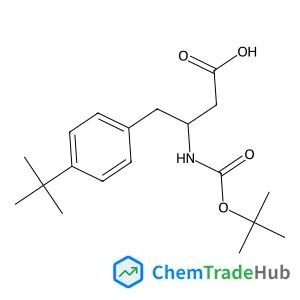
(S)-3-((tert-Butoxycarbonyl)amino)-4-(4-(tert-butyl)phenyl)butanoic acid
CAS番号:
403661-85-8
分子式:
C19H29NO4
おすすめサプライヤー



免責事項
このページに表示される学術雑誌情報は、参考および研究目的のみを目的としています。当社は雑誌出版社とは提携しておらず、投稿の取り扱いも行っておりません。出版に関するお問い合わせは、各雑誌出版社に直接ご連絡ください。
表示されている情報に誤りがある場合は、support@chemtradehub.com までご連絡ください。迅速に確認し、対応いたします。