












Thermal evolution of cobalt deposits on Co3O4(111): atomically dispersed cobalt, two-dimensional CoO islands, and metallic Co nanoparticles
文献情報
出版日
2015-08-18
DOI
10.1039/C5CP03922C
インパクトファクター
3.676
著者
S. Mehl, P. Ferstl, M. Schuler, O. Brummel, L. Hammer, M. A. Schneider
原文を見る
要旨
Cobalt oxide nanomaterials show high activity in several catalytic reactions thereby offering the potential to replace noble metals in some applications. We have developed a well-defined model system for partially reduced cobalt oxide materials aiming at a molecular level understanding of cobalt-oxide-based catalysis. Starting from a well-ordered Co3O4(111) film on Ir(100), we modified the surface by deposition of metallic cobalt. Growth, structure, and adsorption properties of the cobalt-modified surface were investigated by scanning tunneling microscopy (STM), low-energy electron diffraction (LEED), and infrared reflection absorption spectroscopy (IRAS) using CO as a probe molecule. The deposition of a submonolayer of cobalt at 300 K leads to the formation of atomically dispersed cobalt ions distorting the surface layer of the Co3O4 film. Upon annealing to 500 K the Co ions are incorporated into the surface layer forming ordered two-dimensional CoO islands on the Co3O4 grains. At 700 K, Co ions diffuse from the CoO islands into the bulk and the ordered Co3O4(111) surface is restored. Deposition of larger amounts of Co at 300 K leads to formation of metallic Co aggregates on the dispersed cobalt phase. The metallic particles sinter at 500 K and diffuse into the bulk at 700 K. Depending on the degree of bulk reduction, extended Co3O4 grains switch to the CoO(111) structure. All above structures show characteristic CO adsorption behavior and can therefore be identified by IR spectroscopy of adsorbed CO.
関連文献
In situ high pressure NMR study of the direct synthesis of NaAlH4
Terry D. Humphries, Derek Birkmire, Bjørn C. Hauback, G. Sean McGrady, Craig M. Jensen
2013-03-04
Communication
DOI: 10.1039/C3CP50777G
Modeling environment effects on spectroscopies through QM/classical models
Benedetta Mennucci
2013-01-08
Perspective
DOI: 10.1039/C3CP44417A
Microscopic effects of the bonding configuration of nitrogen-doped graphene on its reactivity toward hydrogen peroxide reduction reaction
Ping Wu, Pan Du, Hui Zhang, Chenxin Cai
2013-03-15
Paper
DOI: 10.1039/C3CP50900A
Nature of proton transport in a water-filled carbon nanotube and in liquid water
Ji Chen, Qianfan Zhang, Angelos Michaelides, Enge Wang
2013-03-07
Paper
DOI: 10.1039/C3CP50218J
Linking interfacial chemistry of CO2 to surface structures of hydrated metal oxide nanoparticles: hematite
Irina V. Chernyshova, Sathish Ponnurangam, Ponisseril Somasundaran
2013-03-18
Paper
DOI: 10.1039/C3CP44264K
Low-lying excited-states of 5-benzyluracil
Marco Micciarelli, Carlo Altucci, Bartolomeo Della Ventura, Raffaele Velotta, Valer Toşa, Adán B. Gónzalez Pérez, Martin Pérez Rodríguez, Ángel R. de Lera, Attila Bende
2013-03-19
Paper
DOI: 10.1039/C3CP50343G
Benchmark quantum-chemical calculations on a complete set of rotameric families of the DNA sugar–phosphate backbone and their comparison with modern density functional theory
Arnošt Mládek, Miroslav Krepl, Michal Otyepka, Pavel Banáš, Marie Zgarbová, Petr Jurečka
2013-03-18
Paper
DOI: 10.1039/C3CP44383C
Interaction of CO2 with oxygen adatoms on rutile TiO2(110)
Xiao Lin, Zhi-Tao Wang, Igor Lyubinetsky, Bruce D. Kay, Zdenek Dohnálek
2013-01-10
Paper
DOI: 10.1039/C3CP44040K
The effect of axial ligand on the oxidation of syringyl alcohol by Co(salen) adducts
Thomas Elder, Joseph J. Bozell, Diana Cedeno
2013-04-03
Paper
DOI: 10.1039/C3CP44404J
こちらもおすすめ
化合物よくある質問
2-ブロモ-9,9-ジフェニル-9H-フルオレンの主な用途は何ですか?
2-溴-9,9-二苯基芴は、医薬品、工業材料、有機合成の研究分野で応用されます。特に、レーザー材料や機能性ポリマーの合成に使用されることがあります。また、蛍光色...
474918-32-62-Bromo-9,9-diphenyl...
化合物よくある質問
四氯化铱の市場動向や研究トレンドはどうですか?
四氯化铱の市場は研究開発分野で注目されており、特にナノ技術や金属有機框架(MOFs)の分野での需要が増加傾向にあります。価格は安定しており、中国や韓国での生産が...
207399-11-9Tetrachloroiridium h...
882-06-44-Nitrocinnamic acid
化合物よくある質問
1-(4-溴-3-氟苯基)-2-氯乙酮を含む廃棄物はどのように処理すべきですか?
1-(4-溴-3-氟苯基)-2-氯乙酮 (CAS番号: 1260857-14-4) の廃棄物は専門的な廃棄処理が必要です。まず、廃棄物は密閉された容器に収集し、...
1260857-14-41-(4-Bromo-3-fluorop...
化合物よくある質問
苦参酚Kとは何ですか?
苦参酚Kは、CAS番号101236-49-1を持つ化合物で、主に天然由来の生薬から抽出されます。この化合物は、抗炎症作用や抗癌作用を持つことが報告されています。
101236-49-1Kushenol K
化合物よくある質問
POTASSIUM (1-(TERTBUTOXYCARBONYL)AZETIDIN-3-YL)TRIFLUOROBORATE を含む廃棄物はどのように処理すべきですか?
POTASSIUM (1-(TERTBUTOXYCARBONYL)AZETIDIN-3-YL)TRIFLUOROBORATE を含む廃棄物は、まず安全なエント...
1430219-73-0Potassium (1-(tert-b...
化合物よくある質問
4-庚基-4’-联苯羧酸の市場動向や研究トレンドはどうですか?
4-庚基-4’-聯苯羧酸は、特殊化学品や合成化学の分野で用いられる化学物質ですが、市場動向としては、研究開発の進展とともに需要が増加しています。また、環境配慮型...
58573-94-74'-Heptyl-4-biphenyl...
化合物よくある質問
6-ブロモ-3-メトキシ-1-フェニル-1H-インドゾールを含む廃棄物はどのように処理すべきですか?
6-ブロモ-3-メトキシ-1-フェニル-1H-インドゾールを含む廃棄物は、適切な化学廃棄処理が必要です。通常、廃棄物は密閉容器に収集され、専門の廃棄処理業者に引...
1332527-03-36-Bromo-3-methoxy-1-...
化合物よくある質問
4,4-二甲基-2-吡咯烷酮はどの業界で使用されていますか?
4,4-二甲基-2-吡咯烷酮は医薬、ポリマー、センサー、半導体などの業界で広く使用されています。特に溶媒としての性能が高く評価されています。
66899-02-34,4-dimethylpyrrolid...
51312-42-6Sodium Phosphotungst...
掲載誌
Physical Chemistry Chemical Physics

CiteScore:
5.5
自己引用率:
10.3%
年間論文数:
3036
Physical Chemistry Chemical Physics (PCCP) is an international journal co-owned by 19 physical chemistry and physics societies from around the world. This journal publishes original, cutting-edge research in physical chemistry, chemical physics and biophysical chemistry. To be suitable for publication in PCCP, articles must include significant innovation and/or insight into physical chemistry; this is the most important criterion that reviewers and Editors will judge against when evaluating submissions. The journal has a broad scope and welcomes contributions spanning experiment, theory, computation and data science. Topical coverage includes spectroscopy, dynamics, kinetics, statistical mechanics, thermodynamics, electrochemistry, catalysis, surface science, quantum mechanics, quantum computing and machine learning. Interdisciplinary research areas such as polymers and soft matter, materials, nanoscience, energy, surfaces/interfaces, and biophysical chemistry are welcomed if they demonstrate significant innovation and/or insight into physical chemistry. Joined experimental/theoretical studies are particularly appreciated when complementary and based on up-to-date approaches.
おすすめ化合物
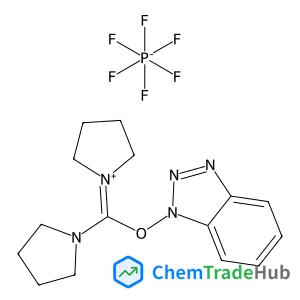
(1H-Benzotriazol-1-yloxy)(di-1-pyrrolidinyl)methylium hexafluorophosphate
CAS番号:
105379-24-6
分子式:
C15H21F6N5OP
おすすめサプライヤー





免責事項
このページに表示される学術雑誌情報は、参考および研究目的のみを目的としています。当社は雑誌出版社とは提携しておらず、投稿の取り扱いも行っておりません。出版に関するお問い合わせは、各雑誌出版社に直接ご連絡ください。
表示されている情報に誤りがある場合は、support@chemtradehub.com までご連絡ください。迅速に確認し、対応いたします。