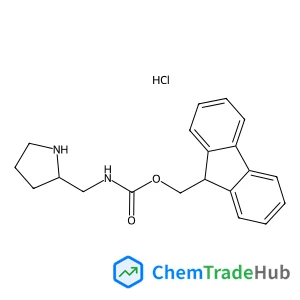
(S)-(9H-Fluoren-9-yl)methyl (pyrrolidin-2-ylmethyl)carbamate hydrochloride
CAS番号:
1217813-15-4
分子式:
C20H23ClN2O2
Šimon Budzák, Pavel Mach, Miroslav Medved', Ondrej Kysel'
Applications of contemporary polarisable continuum model (PCM) quantum chemical approaches to account for the solvent shifts of UV-Vis absorption charge transfer (CT) transitions in electron donor–acceptor (EDA) complexes (as well as to account for their stability and other properties in solvents) have been rather rare until now. In this study, we systematically applied different – mainly state-specific – PCM approaches to examine excited state properties, namely, solvatochromic excitation energy shifts in a series of EDA complexes of a tetracyanoethylene (TCNE) acceptor with methyl substituted benzenes with different degrees of methylation N (NMB). For these complexes, representative and reliable experimental data exist both for the gas phase and in solution (dichloromethane). We have found that the linear response (LR) solvent shifts are too small compared to the experimental values, while self-consistent SS approaches give values that are too large. The best agreement with experimental values was obtained by corrected LR (cLR). The transition energies were calculated by means of TD-DFT methodology with PBE0, CAM-B3LYP and M06-2X functionals as well as the wave function CC2 method for the gas phase, and the PCM solvent shifts were added to account for the solvent effects. The best results for transition energies in solvents were obtained using the CC2 method complemented by CAM-B3LYP/cLR for the gas phase transition energy red solvent shift, while all three TD-DFT approaches used gave insufficient values (ca. 50%) of the slope of the dependence of the transition energies on N compared to experimental values.
Takashi Jin, Fumihiko Fujii, Hiroshi Sakata, Mamoru Tamura, Masataka Kinjo
DOI: 10.1039/B506608E
Raja Kaliappan, Lakshmi S. Kaanumalle, V. Ramamurthy
DOI: 10.1039/B507517C
Herbert W. Roesky, S. Shravan Kumar
DOI: 10.1039/B505307B
Edel M. Minogue, Tammy P. Taylor, Anthony K. Burrell, George J. Havrilla, Benjamin P. Warner, Michael T. Janicke
DOI: 10.1039/B506044C
Peter B. Hitchcock, Gareth J. Rowlands, Rakesh Parmar
DOI: 10.1039/B507394D
Maurilio Galletta, Sebastiano Campagna, Manuel Quesada, Gilles Ulrich, Raymond Ziessel
DOI: 10.1039/B507196H
Nagendra K. Sharma, Krishna N. Ganesh
DOI: 10.1039/B506870C
Hiroyuki Katayama, Hiroshi Yari, Masaki Tanaka, Fumiyuki Ozawa
DOI: 10.1039/B504436G
Seigo Ito, Paul Liska, Pascal Comte, Raphaël Charvet, Peter Péchy, Udo Bach, Lukas Schmidt-Mende, Shaik Mohammed Zakeeruddin, Andreas Kay, Mohammad K. Nazeeruddin, Michael Grätzel
DOI: 10.1039/B505718C
Christian Helbig, Rudolf Herrmann, Franz Mayr, Ernst-Wilhelm Scheidt, Klaus Tröster, Jan Hanss, Hans-Albrecht Krug von Nidda, Gunter Heymann, Hubert Huppertz, Wolfgang Scherer
DOI: 10.1039/B506088E
2-メトキシ-4-(メチルスルフィニル)アミンは、主に医薬品および農薬の製造に使用されます。また、合成化学の一部として研究用材料としても利用されます。
代替品としては、4,6-二クロロピラミジンアミンや他のピラミジン系化合物が考えられます。ただし、目的と用途によって最適な代替品は異なります。
6-氯-4-甲基-1H-吲哚の廃棄物は、適切な容器に収集し、密閉して保管します。温度は常温、湿度は低く、直射日光を避けて保管することを推奨します。廃棄処理は専門...
2-フローユロ-4-(トリフルオロメチル)ベンゾイドのCAS番号は207974-08-1です。この化合物はGHS分類で毒性物質と有害な反応物質として分類されます...
4-ニトロフェニルN-[(ベンゼルオキシルカーボンイル]グリシングリシングリシン酸は、室温で暗所に保管し、乾燥した環境で保存することを推奨します。容器は密閉性の...
イソデスロラタドリンの代替品としては、デスロラタドリンや他の抗ヒスタミン薬が挙げられます。具体的には、デスロラタドリン、ラセカミド、フェルタドリンなどが、症状や...
5-甲氧基-1,2,3,4-四氢异喹啉盐酸盐の一般的な合成方法は、メタノール中で5-メトキシ-1,2,3,4-四ヒュドロイソキシンを塩酸で塩化します。この反応で...
CAS番号6471-78-9の4-アミノ-5-メトキシ-2-トルエンサルホニック酸は、GHS分類では corrosive(腐食性)と識別されます。EUのREAC...
甲基孕酮の取り扱いは、PPE(個人保護具)の使用が必要な重要な安全事項を伴います。防塵マスク、ゴーグル、手袋を着用することが推奨されます。ドラフトチャンバーを使...

Physical Chemistry Chemical Physics (PCCP) is an international journal co-owned by 19 physical chemistry and physics societies from around the world. This journal publishes original, cutting-edge research in physical chemistry, chemical physics and biophysical chemistry. To be suitable for publication in PCCP, articles must include significant innovation and/or insight into physical chemistry; this is the most important criterion that reviewers and Editors will judge against when evaluating submissions. The journal has a broad scope and welcomes contributions spanning experiment, theory, computation and data science. Topical coverage includes spectroscopy, dynamics, kinetics, statistical mechanics, thermodynamics, electrochemistry, catalysis, surface science, quantum mechanics, quantum computing and machine learning. Interdisciplinary research areas such as polymers and soft matter, materials, nanoscience, energy, surfaces/interfaces, and biophysical chemistry are welcomed if they demonstrate significant innovation and/or insight into physical chemistry. Joined experimental/theoretical studies are particularly appreciated when complementary and based on up-to-date approaches.