


![19-[Chloro(dideuterio)methyl]-19-deuterio-20,20-dideuteriooxyoctatriacontane-18,21-dione structure](https://static.chemtradehub.com/structs/124/1246818-85-8-6244.webp "19-[Chloro(dideuterio)methyl]-19-deuterio-20,20-dideuteriooxyoctatriacontane-18,21-dione structure")
CO2 conversion to methanol on Cu(i) oxide nanolayers and clusters: an electronic structure insight into the reaction mechanism
文献情報
出版日
2015-03-24
DOI
10.1039/C5CP01267H
インパクトファクター
3.676
著者
Ellie L. Uzunova, Nicola Seriani, Hans Mikosch
原文を見る
要旨
The mechanism of carbon dioxide reduction to methanol on Cu(I) oxide nanolayers and clusters using water as the source of hydrogen was traced using density functional theory. The nature of the active sites is revealed, namely the role of surface copper dimers, which are present on the Cu2O(001) surface and in the nanoclusters of size Cu32O16 and Cu14O7. The major difference between metal catalysts and Cu2O is outlined: the CO2 molecule interacts strongly with the oxide and undergoes bending prior to hydrogenation. The first step of CO2 hydrogenation results in the formation of a stable carboxyl intermediate, –CO(OH), which in the following steps is converted to methanol via formic acid and formaldehyde intermediates. The consumption of hydrogen from water leaves surface peroxo- and hydroperoxo-species. The peroxides easily desorb molecular oxygen, while for hydroperoxides the reaction of oxygen evolution requires an activation energy of 130 kJ mol−1. The maxima in the absorption spectra correspond well with the required activation energies in the elementary steps.
おすすめジャーナル

Russian Journal of Organic Chemistry

Nature Medicine

Saudi Pharmaceutical Journal

Acta Materialia

Russian Journal of Applied Chemistry

Journal of Saudi Chemical Society

Current Opinion in Solid State & Materials Science

Russian Journal of General Chemistry

Journal of Peptide Science

Organic Process Research & Development
関連文献
Theoretical insight into the wavelength-dependent photodissociation mechanism of nitric acid
Satoshi Maeda
2016-08-08
Paper
DOI: 10.1039/C6CP04713K
Lithium ion solvation by ethylene carbonates in lithium-ion battery electrolytes, revisited by density functional theory with the hybrid solvation model and free energy correction in solution
Wei Cui, Yves Lansac, Hochun Lee, Seung-Tae Hong
2016-07-29
Paper
DOI: 10.1039/C6CP01667G
A strategy to achieve enhanced electromagnetic interference shielding at low concentration with a new generation of conductive carbon black in a chlorinated polyethylene elastomeric matrix
Subhadip Mondal, Sayan Ganguly, Mostafizur Rahaman, Ali Aldalbahi, Tapan K. Chaki, Dipak Khastgir, Narayan Ch. Das
2016-08-19
Paper
DOI: 10.1039/C6CP04274K
Solvent H-bond accepting ability induced conformational change and its influence towards fluorescence enhancement and dual fluorescence of hydroxy meta-GFP chromophore analogue
Tanmay Chatterjee, Mrinal Mandal, Prasun K. Mandal
2016-08-05
Paper
DOI: 10.1039/C6CP04219H
Insight into the pseudo π-hole interactions in the M3H6⋯(NCF)n (M = C, Si, Ge, Sn, Pb; n = 1, 2, 3) complexes
Yanli Zeng, Xiaoyan Li, Zheng Sun, Lingpeng Meng
2016-08-08
Paper
DOI: 10.1039/C6CP03713E
The photochemistry of sodium ion pump rhodopsin observed by watermarked femto- to submillisecond stimulated Raman spectroscopy
Yusaku Hontani, Miroslav Kloz, Yoshitaka Kato, John T. M. Kennis
2016-08-17
Paper
DOI: 10.1039/C6CP05240A
A self-consistent GW approach to the van der Waals potential for a helium dimer
Toru Shoji, Riichi Kuwahara, Kaoru Ohno
2016-08-12
Paper
DOI: 10.1039/C6CP04678A
Study of the binding mechanism between aptamer GO18-T-d and gonyautoxin 1/4 by molecular simulation
Shunxiang Gao, Xin Zheng, Dejing Liu, Mingjuan Sun, Jiaxiang Qin, Hao Zhou, Lianghua Wang
2016-04-13
Communication
DOI: 10.1039/C6CP00777E
How do random superficial defects influence the electro-oxidation of glycerol on Pt(111) surfaces?
Pablo S. Fernández, Polina Tereshchuk, Camilo A. Angelucci, Janaina F. Gomes, Amanda C. Garcia, Cauê A. Martins, Giuseppe A. Camara, María E. Martins, Juarez L. F. Da Silva, Germano Tremiliosi-Filho
2016-08-16
Paper
DOI: 10.1039/C6CP04768H
こちらもおすすめ
化合物よくある質問
4'-ブロモビフェニル-3-メトークシーディ.ActionBarはどのように保存すればよいですか?
4'-ブロモビフェニル-3-メトークシーディ.ActionBarは、冷暗所で、直射日光を避け、密栓の容器に保存し、遠隔場所に保管してください。温度は常温(0〜2...
149506-25-24'-Bromo-biphenyl-3-...
2947-60-6(3-Methylphenyl)acet...
化合物よくある質問
2-異丙基フェニルヒドラジン塩酸塩とは何ですか?
2-異丙基フェニルヒドラジン塩酸塩は、CAS番号58928-82-8を有する化合物で、構造式はC11H14N2HClです。これは塩基性化合物であり、水に溶けやす...
58928-82-8(2-Isopropylphenyl)h...
化合物よくある質問
5-(4-クロロフェニル)-4H-1,2,4-三氮唑-3-アミンを取り扱う際の実験室安全事項は何ですか?
5-(4-クロロフェニル)-4H-1,2,4-三氮唑-3-アミンは取り扱いに注意が必要です。PPEとして防塵マスク、ゴーグル、手袋を使用し、ドラフトチャンバーを...
98554-00-85-(4-Chlorophenyl)-1...
化合物よくある質問
去甲基雷贝拉唑硫醚はどのように合成されますか?
去甲基雷贝拉唑硫醚は、ベンジミダゾール硫化物と3-メチル-4-ピリジノールの反応によって合成されます。具体的には、2-チオキシドベンジミダゾールと3-メチル-4...
117976-91-73-({2-[(1H-Benzimida...
化合物よくある質問
2-ブロモ-5-フロロ-N-(2-フェノールメチル)ベンゼンウレアは安全ですか?
2-ブロモ-5-フロロ-N-(2-フェノールメチル)ベンゼンウレアは、毒性や刺激性の実験データに基づき、適切な取扱いと防護措置を講じることで安全に使用できます。...
923722-86-52-Bromo-5-fluoro-N-(...
化合物よくある質問
対甲苯磺酸酯-四聚乙二醇-四氢吡喃醚の物理化学的性質は何ですか?
対甲苯磺酸酯-四聚乙二醇-四氢吡喃醚のCAS番号は86259-89-4です。この化合物は無色の液体で、分子量は約724.8です。高濃度では溶血性が報告されており...
86259-89-42-(2-{2-[2-(Tetrahyd...
化合物よくある質問
2-(3-(二氟甲基)-4-氟苯基)-4,4,5,5-四甲基-1,3,2-二噁硼戊環はどのように保存すればよいですか?
2-(3-(二氟甲基)-4-氟苯基)-4,4,5,5-四甲基-1,3,2-二噁硼戊環は、室温で暗い場所に保管し、直射日光から遠ざけ、容器は密閉状態で保存してくだ...
445303-65-12-[3-(difluoromethyl...
化合物よくある質問
6-アミノ-5-クロロ-2-シクロプロピルピリミジンカルボン酸の代替品はありますか?
この化合物の代替品には、ピロリミジン酸やその類似物、またピロリミジンカルボン酸の他の異性体があります。これらの代替品は、特定の化学反応や目的に応じて選択すること...
858956-08-86-Amino-5-chloro-2-c...
化合物よくある質問
5-クロロベンゾ[1,3]二オキセイン-4-アミンに適用される法規ガイドラインは何ですか?
5-クロロベンゾ[1,3]二オキセイン-4-アミンはCAS番号379228-45-2に該当します。この化合物はGHS分類でH314(接触により急性毒性がある)と...
379228-45-25-Chloro-1,3-benzodi...
掲載誌
Physical Chemistry Chemical Physics

CiteScore:
5.5
自己引用率:
10.3%
年間論文数:
3036
Physical Chemistry Chemical Physics (PCCP) is an international journal co-owned by 19 physical chemistry and physics societies from around the world. This journal publishes original, cutting-edge research in physical chemistry, chemical physics and biophysical chemistry. To be suitable for publication in PCCP, articles must include significant innovation and/or insight into physical chemistry; this is the most important criterion that reviewers and Editors will judge against when evaluating submissions. The journal has a broad scope and welcomes contributions spanning experiment, theory, computation and data science. Topical coverage includes spectroscopy, dynamics, kinetics, statistical mechanics, thermodynamics, electrochemistry, catalysis, surface science, quantum mechanics, quantum computing and machine learning. Interdisciplinary research areas such as polymers and soft matter, materials, nanoscience, energy, surfaces/interfaces, and biophysical chemistry are welcomed if they demonstrate significant innovation and/or insight into physical chemistry. Joined experimental/theoretical studies are particularly appreciated when complementary and based on up-to-date approaches.
おすすめ化合物
![Heptadecanoic Acid 3-[2-[4-(6-Fluoro-1,2-benzisoxazol-3-yl)-1-piperidinyl]ethyl]-6,7,8,9-tetrahydro-2-methyl-4-oxo-4H-pyrido[1,2-a]pyrimidin-9-yl Ester structure](https://static.chemtradehub.com/structs/140/1404053-62-8-9da4.webp "Heptadecanoic Acid 3-[2-[4-(6-Fluoro-1,2-benzisoxazol-3-yl)-1-piperidinyl]ethyl]-6,7,8,9-tetrahydro-2-methyl-4-oxo-4H-pyrido[1,2-a]pyrimidin-9-yl Ester structure")
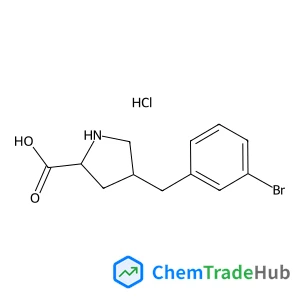
(2S,4R)-4-(3-Bromobenzyl)pyrrolidine-2-carboxylic acid hydrochloride
CAS番号:
1049734-10-2
分子式:
C12H15BrClNO2
おすすめサプライヤー





免責事項
このページに表示される学術雑誌情報は、参考および研究目的のみを目的としています。当社は雑誌出版社とは提携しておらず、投稿の取り扱いも行っておりません。出版に関するお問い合わせは、各雑誌出版社に直接ご連絡ください。
表示されている情報に誤りがある場合は、support@chemtradehub.com までご連絡ください。迅速に確認し、対応いたします。