












![4-Chloro-3-(trifluoromethyl)-1H-pyrrolo[2,3-b]pyridine structure](https://static.chemtradehub.com/structs/869/869335-75-1-a9d0.webp "4-Chloro-3-(trifluoromethyl)-1H-pyrrolo[2,3-b]pyridine structure")
Chip-based platform for dynamic analysis of NK cell cytolysis mediated by a triplebody
文献情報
出版日
2016-03-09
DOI
10.1039/C5AN02585K
インパクトファクター
4.616
著者
Elisavet I. Chatzopoulou, Claudia C. Roskopf, Farzad Sekhavati, Todd A. Braciak, Nadja C. Fenn, Karl-Peter Hopfner, Fuat S. Oduncu, Georg H. Fey, Joachim O. Rädler
原文を見る
要旨
Cancer therapy via redirected lysis mediated by antibodies and antibody-derived agents relies on the availability of substantial numbers of sufficiently active immune effector cells. To monitor antitumor responses before and during therapy, sensitive methods are needed, capable of quantitating specific lysis of target cells. Here we present a chip-based single-cell cytometric assay, which uses adherent human target cells arrayed in structured micro-fields. Using a fluorescent indicator of cell death and time-lapse microscopy in an automated high-throughput mode, we measured specific target cell lysis by activated human NK cells, mediated by the therapeutic single chain triplebody SPM-2 (33-16-123). This antibody-derived tri-specific fusion protein carries binding sites for the myeloid antigens CD33 and CD123 and recruits NK cells via a binding site for the Fc-receptor CD16. Specific lysis increased with increasing triplebody concentration, and the single-cell assay was validated by direct comparison with a standard calcein-release assay. The chip-based approach allowed measurement of lysis events over 16 hours (compared to 4 hours for the calcein assay) and required far smaller numbers of primary cells. In addition, dynamic properties inaccessible to conventional methods provide new details about the activation of cytolytic effector cells by antibody-derived agents. Thus, the killing rate exhibited a dose-dependent maximum during the reaction interval. In clinical applications ex vivo monitoring of NK activity of patient's endogenous cells will likely help to choose appropriate therapy, to detect impaired or recovered NK function, and possibly to identify rare subsets of cancer cells with particular sensitivity to effector-cell mediated lysis.
関連文献
Computational modelling of atomic layer etching of chlorinated germanium surfaces by argon
Shenli Zhang, Yihan Huang, Gulcin Tetiker, Saravanapriyan Sriraman, Alex Paterson, Roland Faller
2019-02-20
Communication
DOI: 10.1039/C9CP00125E
Evidence of the O–Pd–O and Pd–O4 structure units as oxide seeds and their origin on Pd(211): revealing the mechanism of surface oxide formation
Xiran Cheng, Ziyun Wang, Yu Mao, P. Hu
2019-02-19
Paper
DOI: 10.1039/C8CP06224B
Temperature dependence of the ultrafast vibrational echo spectroscopy of OD modes in liquid water from first principles simulations
Deepak Ojha, Amalendu Chandra
2019-02-25
Paper
DOI: 10.1039/C8CP07121G
The maximum occupancy condition for the localized property-optimized orbitals
2019-02-12
Paper
DOI: 10.1039/C8CP07276K
Bile acid derivative-based catanionic mixtures: versatile tools for superficial charge modulation of supramolecular lamellae and nanotubes
Maria Chiara di Gregorio, Emilia Severoni, Leana Travaglini, Marta Gubitosi, Simona Sennato, Francesco Mura, Carlos Redondo-Gómez, Aida Jover, Nicolae Viorel Pavel, Luciano Galantini
2018-06-26
Paper
DOI: 10.1039/C8CP02745E
Neural network force fields for simple metals and semiconductors: construction and application to the calculation of phonons and melting temperatures
Mário R. G. Marques, Jakob Wolff, Conrad Steigemann, Miguel A. L. Marques
2019-03-07
Paper
DOI: 10.1039/C8CP05771K
Strained hydrogen bonding in imidazole trimer: a combined infrared, Raman, and theory study
Thomas Forsting, Julia Zischang, Martin A. Suhm, Marco Eckhoff, Benjamin Schröder, Ricardo A. Mata
2019-02-25
Paper
DOI: 10.1039/C9CP00399A
Luminescence spectroscopy of oxazine dye cations isolated in vacuo
Christina Kjær, Steen Brøndsted Nielsen
2019-02-04
Paper
DOI: 10.1039/C8CP07340F
Rotational (de)-excitation of linear C3O by collision with He
Fehmi Khadri, Kamel Hammami
2019-01-29
Paper
DOI: 10.1039/C8CP07409G
こちらもおすすめ
化合物よくある質問
2-ブロモ-9,9-ジフェニル-9H-フルオレンの主な用途は何ですか?
2-溴-9,9-二苯基芴は、医薬品、工業材料、有機合成の研究分野で応用されます。特に、レーザー材料や機能性ポリマーの合成に使用されることがあります。また、蛍光色...
474918-32-62-Bromo-9,9-diphenyl...
化合物よくある質問
四氯化铱の市場動向や研究トレンドはどうですか?
四氯化铱の市場は研究開発分野で注目されており、特にナノ技術や金属有機框架(MOFs)の分野での需要が増加傾向にあります。価格は安定しており、中国や韓国での生産が...
207399-11-9Tetrachloroiridium h...
882-06-44-Nitrocinnamic acid
化合物よくある質問
1-(4-溴-3-氟苯基)-2-氯乙酮を含む廃棄物はどのように処理すべきですか?
1-(4-溴-3-氟苯基)-2-氯乙酮 (CAS番号: 1260857-14-4) の廃棄物は専門的な廃棄処理が必要です。まず、廃棄物は密閉された容器に収集し、...
1260857-14-41-(4-Bromo-3-fluorop...
化合物よくある質問
苦参酚Kとは何ですか?
苦参酚Kは、CAS番号101236-49-1を持つ化合物で、主に天然由来の生薬から抽出されます。この化合物は、抗炎症作用や抗癌作用を持つことが報告されています。
101236-49-1Kushenol K
化合物よくある質問
POTASSIUM (1-(TERTBUTOXYCARBONYL)AZETIDIN-3-YL)TRIFLUOROBORATE を含む廃棄物はどのように処理すべきですか?
POTASSIUM (1-(TERTBUTOXYCARBONYL)AZETIDIN-3-YL)TRIFLUOROBORATE を含む廃棄物は、まず安全なエント...
1430219-73-0Potassium (1-(tert-b...
化合物よくある質問
4-庚基-4’-联苯羧酸の市場動向や研究トレンドはどうですか?
4-庚基-4’-聯苯羧酸は、特殊化学品や合成化学の分野で用いられる化学物質ですが、市場動向としては、研究開発の進展とともに需要が増加しています。また、環境配慮型...
58573-94-74'-Heptyl-4-biphenyl...
化合物よくある質問
6-ブロモ-3-メトキシ-1-フェニル-1H-インドゾールを含む廃棄物はどのように処理すべきですか?
6-ブロモ-3-メトキシ-1-フェニル-1H-インドゾールを含む廃棄物は、適切な化学廃棄処理が必要です。通常、廃棄物は密閉容器に収集され、専門の廃棄処理業者に引...
1332527-03-36-Bromo-3-methoxy-1-...
化合物よくある質問
4,4-二甲基-2-吡咯烷酮はどの業界で使用されていますか?
4,4-二甲基-2-吡咯烷酮は医薬、ポリマー、センサー、半導体などの業界で広く使用されています。特に溶媒としての性能が高く評価されています。
66899-02-34,4-dimethylpyrrolid...
51312-42-6Sodium Phosphotungst...
掲載誌
Analyst

CiteScore:
7.8
自己引用率:
5.6%
年間論文数:
653
Analyst publishes analytical and bioanalytical research that reports premier fundamental discoveries and inventions, and the applications of those discoveries, unconfined by traditional discipline barriers.
おすすめ化合物
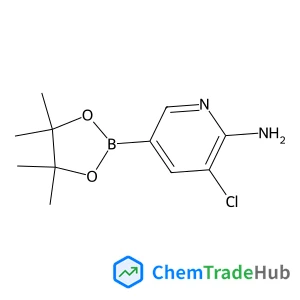
3-Chloro-5-(4,4,5,5-tetramethyl-1,3,2-dioxaborolan-2-yl)-2-pyridinamine
CAS番号:
1032758-99-8
分子式:
C11H16BClN2O2
おすすめサプライヤー


免責事項
このページに表示される学術雑誌情報は、参考および研究目的のみを目的としています。当社は雑誌出版社とは提携しておらず、投稿の取り扱いも行っておりません。出版に関するお問い合わせは、各雑誌出版社に直接ご連絡ください。
表示されている情報に誤りがある場合は、support@chemtradehub.com までご連絡ください。迅速に確認し、対応いたします。