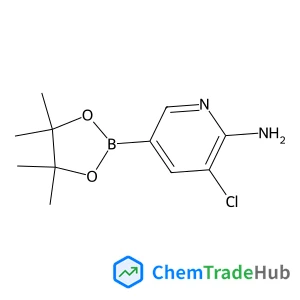
3-Chloro-5-(4,4,5,5-tetramethyl-1,3,2-dioxaborolan-2-yl)-2-pyridinamine
CAS番号:
1032758-99-8
分子式:
C11H16BClN2O2
K M Mohibul Kabir, Ylias M. Sabri, Ahmad Esmaielzadeh Kandjani, Suresh K. Bhargava
Piezoelectric acoustic wave devices integrated with noble metal surfaces provide exciting prospects for the direct measurement of toxic gas species such as mercury (Hg) in the atmosphere. Even though gold (Au) based acoustic wave sensors have been utilized extensively for detecting Hg, the potential of using other metal surfaces such as silver (Ag) is yet to be thoroughly studied. Here, we developed Ag sensitive layer-based surface acoustic wave (SAW) and quartz crystal microbalance (QCM) sensors and focused on their comparative analysis for Hg sensing applications with parameters such as the sensor sensitivity, selectivity, adsorption/desorption isotherm and Hg diffusion into the surface thoroughly studied. The SAW sensor was fabricated with nickel (Ni) interdigitated transducer (IDT) electrodes and a Ag thin film on the delay line of the device. In the case of the QCM sensor, the electrodes were constructed of Ag thin film and simultaneously employed as a sensitive layer. Mercury sensing experiments were conducted for a range of concentrations between 24–365 ppbv without/with the presence of some common industrial interfering gas species (i.e. ammonia, acetaldehyde, ethyl mercaptan, dimethyl disulphide, methyl ethyl ketone and humidity) at various operating temperatures in the range of 35–95 °C. The SAW sensor was found to possess up to 70 times higher response magnitudes than its QCM counterpart at 35 °C while up to 30 and 23 times higher response magnitudes were observed for the SAW sensor at elevated temperatures of 75 and 95 °C, respectively. Furthermore, the SAW sensor showed good selectivity (>89%) toward Hg0 vapor in the presence of all the interferents tested at an operating temperature of 75 °C while the QCM sensor exhibited significant cross-sensitivity when ethyl mercaptan was introduced along with Hg0 vapor. Overall, it is indicative that Ag-based acoustic wave sensors do have great potential for Hg sensing applications, given that right operating conditions are applied.
Darren M. Driscoll, Diego Troya, Pavel M. Usov, Andrew J. Maynes, Amanda J. Morris, John R. Morris
DOI: 10.1039/C8CP07778A
Yan Chen, Xiangbiao Liao, Xiaoyang Shi, Yilun Liu
DOI: 10.1039/C8CP05260C
Junhui Weng, Shang-Peng Gao
DOI: 10.1039/C8CP04743J
Arijit Gupta, Rishabh Gupta
DOI: 10.1039/C8CP03516D
Mauro Boero, Kazuki Tamai
DOI: 10.1039/C8CP04314K
Shenli Zhang, Yihan Huang, Gulcin Tetiker, Saravanapriyan Sriraman, Alex Paterson, Roland Faller
DOI: 10.1039/C9CP00125E
Mário R. G. Marques, Jakob Wolff, Conrad Steigemann, Miguel A. L. Marques
DOI: 10.1039/C8CP05771K
Francis Kirby B. Burnea, Kyoung Chul Ko
DOI: 10.1039/C8CP03689F
Bertrand Morel, Maria Paz Carrasco, Samuel Jurado, Carmen Marco, Francisco Conejero-Lara
DOI: 10.1039/C8CP02685H
Maxim V. Ivanov, Denan Wang, Depeng Zhang, Rajendra Rathore, Scott A. Reid
DOI: 10.1039/C8CP02936A
2-溴-9,9-二苯基芴は、医薬品、工業材料、有機合成の研究分野で応用されます。特に、レーザー材料や機能性ポリマーの合成に使用されることがあります。また、蛍光色...
四氯化铱の市場は研究開発分野で注目されており、特にナノ技術や金属有機框架(MOFs)の分野での需要が増加傾向にあります。価格は安定しており、中国や韓国での生産が...
1-(4-溴-3-氟苯基)-2-氯乙酮 (CAS番号: 1260857-14-4) の廃棄物は専門的な廃棄処理が必要です。まず、廃棄物は密閉された容器に収集し、...
苦参酚Kは、CAS番号101236-49-1を持つ化合物で、主に天然由来の生薬から抽出されます。この化合物は、抗炎症作用や抗癌作用を持つことが報告されています。
POTASSIUM (1-(TERTBUTOXYCARBONYL)AZETIDIN-3-YL)TRIFLUOROBORATE を含む廃棄物は、まず安全なエント...
4-庚基-4’-聯苯羧酸は、特殊化学品や合成化学の分野で用いられる化学物質ですが、市場動向としては、研究開発の進展とともに需要が増加しています。また、環境配慮型...
6-ブロモ-3-メトキシ-1-フェニル-1H-インドゾールを含む廃棄物は、適切な化学廃棄処理が必要です。通常、廃棄物は密閉容器に収集され、専門の廃棄処理業者に引...
4,4-二甲基-2-吡咯烷酮は医薬、ポリマー、センサー、半導体などの業界で広く使用されています。特に溶媒としての性能が高く評価されています。

Analyst publishes analytical and bioanalytical research that reports premier fundamental discoveries and inventions, and the applications of those discoveries, unconfined by traditional discipline barriers.