


Highly ordered surfactant micelles function as the extraction matrix for direct electrochemical detection of halonitrobenzenes at the ppb level
文献情報
出版日
2016-02-05
DOI
10.1039/C5AN02439K
インパクトファクター
4.616
著者
Lina Yao, Fei Yan, Bin Su
原文を見る
要旨
Halonitrobenzenes (HNBs) are a class of molecules that are highly toxic to human health and the ecological environment. Thus, effective and efficient approaches capable of monitoring and detecting HNBs are greatly desired. We report herein a simple and sensitive method for the detection of HNBs. The detection was based on the indium tin oxide (ITO) electrodes modified with a binary assembly of highly ordered surfactant micelles (OSMs) and silica mesochannels (SMs). The SMs have a diameter of 2–3 nm and a vertical orientation, which provide a hard support to stabilize soft OSMs. Moreover, each OSM consists of a hydrophobic core due to the organized assembly of surfactant hydrocarbon chains, which can selectively extract and concentrate lipophilic HNBs from aqueous media, allow their transport to the underlying ITO electrode surface and therein their detection by voltammetry. As a proof-of-concept experiment, 1-chloro-3-nitrobenzene, 1-chloro-4-nitrobenzene, 1-bromo-4-nitrobenzene and 2,4-dinitrobromobenzene were analyzed in aqueous solutions. A simple and fast detection was achieved in all cases, with a wide linear dynamic range, a high sensitivity and a low limit of detection at the ppb level. Apart from the extraction ability, the OSMs also prohibited the access of and surface contamination by unwanted substances, showing excellent anti-fouling and anti-interference power. Indeed, as we demonstrated, the sensor could be employed for direct electrochemical detection of HNBs in complex samples, such as lake water and soil dispersion, without any pre-treatment, indicating its potential usefulness in practical analysis.
おすすめジャーナル

Molecular Pharmacology

Russian Chemical Reviews

Journal of Catalysis

Fibre Chemistry

Helvetica Chimica Acta

Pure and Applied Chemistry

Journal of Organometallic Chemistry

Planta Medica

Organic Preparations and Procedures International

Proceedings of the National Academy of Sciences of the United States of America
関連文献
Neural network force fields for simple metals and semiconductors: construction and application to the calculation of phonons and melting temperatures
Mário R. G. Marques, Jakob Wolff, Conrad Steigemann, Miguel A. L. Marques
2019-03-07
Paper
DOI: 10.1039/C8CP05771K
Effect of intermediate phases on the optical properties of PbI2-rich CH3NH3PbI3 organic–inorganic hybrid perovskite
Alonso W. P. Sanches, Marco A. T. da Silva, Neusmar J. A. Cordeiro, Alexandre Urbano, Sidney A. Lourenço
2019-02-11
Paper
DOI: 10.1039/C8CP06916F
UPS and UV spectroscopies combined to position the energy levels of TiO2 anatase and rutile nanopowders
Clément Maheu, Luis Cardenas, Eric Puzenat, Pavel Afanasiev, Christophe Geantet
2018-09-17
Paper
DOI: 10.1039/C8CP04614J
Geometry and energetics of CO adsorption on hydroxylated UiO-66
Darren M. Driscoll, Diego Troya, Pavel M. Usov, Andrew J. Maynes, Amanda J. Morris, John R. Morris
2019-02-05
Paper
DOI: 10.1039/C8CP07778A
Significant effects of vibrational excitation of reactant in K + H2 → H + KH reaction based on a new neural network potential energy surface
Jiuchuang Yuan, Zhixin Duan, Shufen Wang, Jianyong Liu, Keli Han
2018-07-16
Paper
DOI: 10.1039/C8CP03310B
Transition metal-containing molecular devices: controllable single-spin negative differential thermoelectric resistance effects under gate voltages
Xifeng Yang, Fangxin Tan, Yaojun Dong, Hailin Yu, Yushen Liu
2019-02-07
Paper
DOI: 10.1039/C8CP07049K
Thermoelectric properties of the tetrahedrite–tennantite solid solutions Cu12Sb4−xAsxS13 and Cu10Co2Sb4−yAsyS13 (0 ≤ x, y ≤ 4)
Christophe Candolfi, Anne Dauscher, Janusz Tobola, Jiří Hejtmánek, Bertrand Lenoir
2019-01-31
Paper
DOI: 10.1039/C9CP00213H
Thermophysical properties of glyceline–water mixtures investigated by molecular modelling
Jörg Baz, Christoph Held, Jürgen Pleiss, Niels Hansen
2019-02-25
Paper
DOI: 10.1039/C9CP00036D
Towards high-level theoretical studies of large biodiesel molecules: an ONIOM/RRKM/Master-equation approach to the isomerization and dissociation kinetics of methyl decanoate radicals
Yicheng Chi, Lidong Zhang, Peng Zhang, Liusi Sheng
2019-02-06
Paper
DOI: 10.1039/C8CP05593A
Effect of an external electric field on capillary filling of water in hydrophilic silica nanochannels
Andres Rojano Crisson, Enrique Wagemann, Harvey A. Zambrano
2018-06-22
Paper
DOI: 10.1039/C8CP03186J
こちらもおすすめ
化合物よくある質問
2-ブロモ-9,9-ジフェニル-9H-フルオレンの主な用途は何ですか?
2-溴-9,9-二苯基芴は、医薬品、工業材料、有機合成の研究分野で応用されます。特に、レーザー材料や機能性ポリマーの合成に使用されることがあります。また、蛍光色...
474918-32-62-Bromo-9,9-diphenyl...
化合物よくある質問
四氯化铱の市場動向や研究トレンドはどうですか?
四氯化铱の市場は研究開発分野で注目されており、特にナノ技術や金属有機框架(MOFs)の分野での需要が増加傾向にあります。価格は安定しており、中国や韓国での生産が...
207399-11-9Tetrachloroiridium h...
882-06-44-Nitrocinnamic acid
化合物よくある質問
1-(4-溴-3-氟苯基)-2-氯乙酮を含む廃棄物はどのように処理すべきですか?
1-(4-溴-3-氟苯基)-2-氯乙酮 (CAS番号: 1260857-14-4) の廃棄物は専門的な廃棄処理が必要です。まず、廃棄物は密閉された容器に収集し、...
1260857-14-41-(4-Bromo-3-fluorop...
化合物よくある質問
苦参酚Kとは何ですか?
苦参酚Kは、CAS番号101236-49-1を持つ化合物で、主に天然由来の生薬から抽出されます。この化合物は、抗炎症作用や抗癌作用を持つことが報告されています。
101236-49-1Kushenol K
化合物よくある質問
POTASSIUM (1-(TERTBUTOXYCARBONYL)AZETIDIN-3-YL)TRIFLUOROBORATE を含む廃棄物はどのように処理すべきですか?
POTASSIUM (1-(TERTBUTOXYCARBONYL)AZETIDIN-3-YL)TRIFLUOROBORATE を含む廃棄物は、まず安全なエント...
1430219-73-0Potassium (1-(tert-b...
化合物よくある質問
4-庚基-4’-联苯羧酸の市場動向や研究トレンドはどうですか?
4-庚基-4’-聯苯羧酸は、特殊化学品や合成化学の分野で用いられる化学物質ですが、市場動向としては、研究開発の進展とともに需要が増加しています。また、環境配慮型...
58573-94-74'-Heptyl-4-biphenyl...
化合物よくある質問
6-ブロモ-3-メトキシ-1-フェニル-1H-インドゾールを含む廃棄物はどのように処理すべきですか?
6-ブロモ-3-メトキシ-1-フェニル-1H-インドゾールを含む廃棄物は、適切な化学廃棄処理が必要です。通常、廃棄物は密閉容器に収集され、専門の廃棄処理業者に引...
1332527-03-36-Bromo-3-methoxy-1-...
化合物よくある質問
4,4-二甲基-2-吡咯烷酮はどの業界で使用されていますか?
4,4-二甲基-2-吡咯烷酮は医薬、ポリマー、センサー、半導体などの業界で広く使用されています。特に溶媒としての性能が高く評価されています。
66899-02-34,4-dimethylpyrrolid...
51312-42-6Sodium Phosphotungst...
掲載誌
Analyst

CiteScore:
7.8
自己引用率:
5.6%
年間論文数:
653
Analyst publishes analytical and bioanalytical research that reports premier fundamental discoveries and inventions, and the applications of those discoveries, unconfined by traditional discipline barriers.
おすすめ化合物
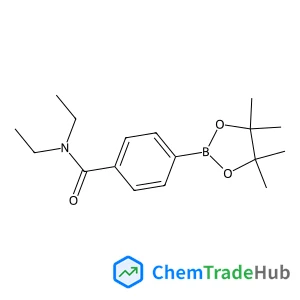
N,N-Diethyl-4-(4,4,5,5-tetramethyl-1,3,2-dioxaborolan-2-yl)benzamide
CAS番号:
325142-99-2
分子式:
C17H26BNO3
おすすめサプライヤー




免責事項
このページに表示される学術雑誌情報は、参考および研究目的のみを目的としています。当社は雑誌出版社とは提携しておらず、投稿の取り扱いも行っておりません。出版に関するお問い合わせは、各雑誌出版社に直接ご連絡ください。
表示されている情報に誤りがある場合は、support@chemtradehub.com までご連絡ください。迅速に確認し、対応いたします。