


![[(1S,2S,3R,4S,7R,9S,10S,12R,15S)-4,12-Diacetyloxy-15-[(2R,3S)-3-benzamido-3-phenyl-2-(2,2,2-trichloroethoxycarbonyloxy)propanoyl]oxy-1,9-dihydroxy-10,14,17,17-tetramethyl-11-oxo-6-oxatetracyclo[11.3.1.03,10.04,7]heptadec-13-en-2-yl] benzoate structure](https://static.chemtradehub.com/structs/100/100431-55-8-7104.webp "[(1S,2S,3R,4S,7R,9S,10S,12R,15S)-4,12-Diacetyloxy-15-[(2R,3S)-3-benzamido-3-phenyl-2-(2,2,2-trichloroethoxycarbonyloxy)propanoyl]oxy-1,9-dihydroxy-10,14,17,17-tetramethyl-11-oxo-6-oxatetracyclo[11.3.1.03,10.04,7]heptadec-13-en-2-yl] benzoate structure")
In situ single molecule detection of insulin receptors on erythrocytes from a type 1 diabetes ketoacidosis patient by atomic force microscopy
文献情報
出版日
2015-09-11
DOI
10.1039/C5AN01417D
インパクトファクター
4.616
著者
Lu Zhang, Qiping Shi, Peihui Yang, Zhihong Liang
原文を見る
要旨
Type 1 diabetes is an insulin-dependent metabolic disorder always associated with ketoacidosis and a high morbidity rate in teenagers. The in situ single molecule detection of insulin receptors on healthy and diseased erythrocytes is helpful to understand the pathomechanism of type 1 diabetes ketoacidosis (T1-DKA), which would also benefit the diagnosis and treatment of T1-DKA. Here, we demonstrated, for the first time, the single molecule interaction between insulin and insulin receptor on erythrocytes from a healthy volunteer and a T1-DKA patient using high sensitivity atomic force microscopy (AFM) in PBS solution. The single molecule force results demonstrated the decreased binding force and binding probability between insulin and insulin receptor on T1-DKA erythrocytes, implying the deficit of insulin receptor functions in T1-DKA. The binding kinetic parameters calculated from dynamic force spectroscopy indicated that the insulin–insulin receptor complexes on T1-DKA erythrocytes were less stable than those from healthy volunteer. Using high resolution AFM imaging, a decreased roughness was found both in intact T1-DKA erythrocytes and in the purified membrane of T1-DKA erythrocytes, and an increased stiffness was also found in T1-DKA erythrocytes. Moreover, AFM, which was used to investigate the single molecule interactions between insulin–insulin receptor, cell surface ultrastructure and stiffness in healthy and diseased erythrocytes, was expected to develop into a potential nanotool for pathomechanism studies of clinical samples at the nanoscale.
おすすめジャーナル

Molecular Pharmacology

Proceedings of the National Academy of Sciences of the United States of America

Organic Preparations and Procedures International

Russian Chemical Reviews

Journal of Heterocyclic Chemistry

Journal of Medicinal Chemistry

Journal of Physics and Chemistry of Solids

Kinetics and Catalysis

European Journal of Wood and Wood Products

Pure and Applied Chemistry
関連文献
Exciton transfer free energy from Car–Parrinello molecular dynamics
Christian Schwermann, Nikos L. Doltsinis
2020-01-16
Paper
DOI: 10.1039/C9CP06419B
Quantum kinetic energy and isotope fractionation in aqueous ionic solutions
Lu Wang, Michele Ceriotti, Thomas E. Markland
2020-01-08
Paper
DOI: 10.1039/C9CP06483D
Electrochemical oxidation mechanisms for selective products due to C–O and C–C cleavages of β-O-4 linkages in lignin model compounds
Jing Chen, Hanling Yang, Hongquan Fu, Hongyan He, Qiang Zeng, Xuehui Li
2020-04-28
Paper
DOI: 10.1039/D0CP01091J
Mixed uranyl and neptunyl cation–cation interaction-driven clusters: structures, energetic stability, and nuclear quadrupole interactions
Paweł Tecmer, Frank Schindler, Aleksandra Leszczyk, Katharina Boguslawski
2020-05-02
Paper
DOI: 10.1039/D0CP01068E
Sulfur hydrogen bonding and internal dynamics in the monohydrates of thenyl mercaptan and thenyl alcohol
Marcos Juanes, Rizalina Tama Saragi, Ruth Pinacho, José E. Rubio, Alberto Lesarri
2020-05-12
Paper
DOI: 10.1039/D0CP01706J
Photon-mediated charge exchange reactions between 39K atoms and 40Ca+ ions in a hybrid trap
Hui Li, S. Jyothi, Ming Li, Kenneth R Brown, Svetlana Kotochigova
2020-04-22
Paper
DOI: 10.1039/D0CP01131B
Interface hybridization and spin filter effect in metal-free phthalocyanine spin valves
Xiannian Yao, Lianqun Zhou, Fubo Tian
2020-04-28
Paper
DOI: 10.1039/D0CP00651C
New structural model of a chiral cubic liquid crystalline phase
Joanna Matraszek, Martin Vogrin, Damian Pociecha, Ewa Gorecka
2020-05-19
Paper
DOI: 10.1039/D0CP01579B
Introducing mesoscopic charge transfer rates into molecular electronics
Adriano Santos, Ushula M. Tefashe, Richard L. McCreery, Paulo R. Bueno
2020-04-27
Communication
DOI: 10.1039/D0CP01621G
こちらもおすすめ
28770-01-62-(2-Isopropyl-1,3-o...
化合物よくある質問
「邻羟基阿托伐他汀内酯标准品」に適用される法規ガイドelinesは何ですか?
CAS番号163217-74-1の「邻羟基阿托伐他汀内酯标准品」は、GHS分類では危険物に分類されず、主にREACH規則とFDA/EPAの管理対象となります。R...
163217-74-1ortho-Hydroxy Atorva...
化合物よくある質問
メチル(3R)-3-アミノ-2,3-ジヒドロ-1-ベンゾファンラニン-5-カルボイル酸塩塩酸塩の主な用途は何ですか?
メチル(3R)-3-アミノ-2,3-ジヒドロ-1-ベンゾファンラニン-5-カルボイル酸塩塩酸塩は、医薬品や合成化学の研究に広く用いられます。また、特定の薬物の前...
2241594-15-8Methyl (3R)-3-amino-...
化合物よくある質問
トランス-4-メチルピロリジン-3-オール塩酸塩はどのように合成されますか?
トランス-4-メチルピロリジン-3-オール塩酸塩は、4-メチルピロリジンの塩酸塩化によって合成されます。一般的な合成方法では、4-メチルピロリジンを塩酸に加えて...
265108-42-7trans-4-Methylpyrrol...
化合物よくある質問
硫雜環丁烷-1,1-二氧化物は安全ですか?
硫雜環丁烷-1,1-二氧化物は安全ではありません。毒性は報告されていませんが、高温下で分解し、可燃性があるため、高圧ガスは注意が必要です。密閉した容器で保管し、...
5687-92-3Thietane 1,1-dioxide
6054-10-02H, 8H-Benzo[1,2-b
化合物よくある質問
9-ヒドロキシエリプチシネ塩酸塩はどのように合成されますか?
9-ヒドロキシエリプチシネ塩酸塩は、エリプチシネから塩酸を添加することで合成されます。選択性は高いですが、収率は約70%です。
52238-35-49-Hydroxyellipticine...
化合物よくある質問
5-塩素-2-(メチルアミノ)フェニル-(2-塩素フェニル)メタン酮の物理化学的性質は何ですか?
5-塩素-2-(メチルアミノ)フェニル-(2-塩素フェニル)メタン酮のCAS番号は5621-86-3です。この化合物は白色の結晶性粉末で、分子量は415.03で...
5621-86-3[5-Chloro-2-(methyla...
化合物よくある質問
1-[2-(4-甲氧基-苯氧基)-乙基]-哌嗪はどのように保存すればよいですか?
1-[2-(4-甲氧基-苯氧基)-乙基]-哌嗪は、直射日光を避けて暗所に、室温(15-25℃)で保管し、密閉容器に入れることで安定性を保つことができます。
117132-44-21-[2-(4-Methoxy-phen...
化合物よくある質問
2-[3-(4-甲氧基フェニル)プロピル]-4,4,5,5-四メチル-1,3,2-ドイボロロールアンの主な用途は何ですか?
2-[3-(4-甲氧基フェニル)プロピル]-4,4,5,5-四メチル-1,3,2-ドイボロロールアンは、医薬品の合成、有機合成化学、および新材料の研究で使用され...
1073371-72-82-[3-(4-Methoxypheny...
掲載誌
Analyst

CiteScore:
7.8
自己引用率:
5.6%
年間論文数:
653
Analyst publishes analytical and bioanalytical research that reports premier fundamental discoveries and inventions, and the applications of those discoveries, unconfined by traditional discipline barriers.
おすすめ化合物
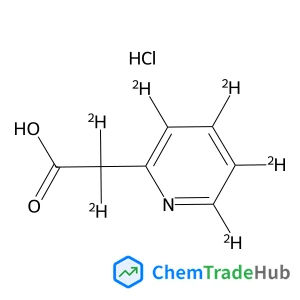
2,2-dideuterio-2-(3,4,5,6-tetradeuterio-2-pyridyl)acetic acid;hydrochloride
CAS番号:
1329799-67-8
分子式:
C7H2ClD6NO2
おすすめサプライヤー




免責事項
このページに表示される学術雑誌情報は、参考および研究目的のみを目的としています。当社は雑誌出版社とは提携しておらず、投稿の取り扱いも行っておりません。出版に関するお問い合わせは、各雑誌出版社に直接ご連絡ください。
表示されている情報に誤りがある場合は、support@chemtradehub.com までご連絡ください。迅速に確認し、対応いたします。