












Synthesis of well-defined α,ω-telechelic multiblock copolymers in aqueous medium: in situ generation of α,ω-diols
文献情報
出版日
2015-01-16
DOI
10.1039/C4PY01802H
インパクトファクター
5.582
著者
Alexandre Simula, Vasiliki Nikolaou, Athina Anastasaki, Fehaid Alsubaie, Gabit Nurumbetov
原文を見る
要旨
The synthesis of well-defined α,ω-dihydroxyl telechelic multiblock copolymers by sequential in situ chain extensions via aqueous Cu(0) mediated living radical polymerization (SET-LRP) is reported. The rapid disproportionation of Cu(I)Br in the presence of Me6-TREN in water has been exploited to generate Cu(0) and [Cu(II)Br2/Me6-TREN] in situ, resulting in rapid reaction rate and narrow molecular weight distributions. Under optimized conditions, a telechelic heptablock copolymer was obtained within 2 hours with a final dispersity of ∼1.1 while the monomer conversion was >99% for each block. A range of acrylamides and acrylates have been successfully incorporated within the same polymer backbone, including N-isopropylacrylamide (NIPAAm), N,N-diethylacrylamide (DEA) and N,N-dimethylacrylamide (DMA) and poly(ethylene glycol) methyl ether acrylate (PEGA480). The thermo-responsive nature of these materials was subsequently demonstrated via cloud point measurements as both a function of molecular weight and backbone functionality. In addition, the typically unwanted hydrolysis of the α- and ω-end groups in aqueous media was further exploited via isocyanate post-polymerization modifications to alter the end group functionality.
関連文献
Chemoenzymatic syntheses of carbasugar analogues of nucleoside diphosphate sugars: UDP-carba-Gal, UDP-carba-GlcNAc, UDP-carba-Glc, and GDP-carba-Man‡
Kyung-Chang Seo, Young-Geol Kwon, Dae-Hee Kim, In-Sook Jang, Jin-Won Cho, Sung-Kee Chung
2009-02-06
Communication
DOI: 10.1039/B821058F
Linking high anisotropy Dy3 triangles to create a Dy6 single-molecule magnet
Bashir Hussain, Didier Savard, Tara J. Burchell, Wolfgang Wernsdorfer, Muralee Murugesu
2009-01-07
Communication
DOI: 10.1039/B818295G
Marriage of porphyrin chemistry with metal-catalysed reactions
Hiroshi Shinokubo, Atsuhiro Osuka
2009-01-14
Feature Article
DOI: 10.1039/B817941G
Fluorescent gold nanoparticles-based fluorescence sensor for Cu2+ ions
Wenbin Chen, Xijuan Tu, Xiangqun Guo
2009-02-11
Communication
DOI: 10.1039/B820145E
Formation and dissolution of hen egg white lysozyme amyloid fibrils in protic ionic liquids
Nolene Byrne, C. Austen Angell
2009-02-02
Communication
DOI: 10.1039/B817590J
Multiply reconfigurable ‘plug and play’ molecular logic via self-assembly
A. Prasanna de Silva, Catherine M. Dobbin, Thomas P. Vance
2009-02-11
Communication
DOI: 10.1039/B822181B
Glucose sensing via polyanion formation and induced pyrene excimer emission
Cong Yu, Vivian Wing-Wah Yam
2009-02-10
Communication
DOI: 10.1039/B820397K
Transition metalborylene complexes: boron analogues of classical organometallic systems
Dragoslav Vidovic, Glesni A. Pierce, Simon Aldridge
2009-01-07
Feature Article
DOI: 10.1039/B816042B
A ratiometric fluorescent sensor with a large Stokes shift for imaging zinc ions in living cells
Chun Liu, Hua Jiang
2008-12-24
Communication
DOI: 10.1039/B814501F
Exceptionally high H2storage by a metal–organic polyhedral framework
Yong Yan, Xiang Lin, Sihai Yang, Alexander J. Blake, Anne Dailly, Neil R. Champness, Peter Hubberstey, Martin Schröder
2009-01-27
Communication
DOI: 10.1039/B900013E
こちらもおすすめ
化合物よくある質問
オステニ二甲磺酸塩に適用される法規ガイドラインは何ですか?
オステニ二甲磺酸塩は、GHS分類に基づき corrosive 物質として分類されます。REACH規則では、該当物質の登録が要求される可能性があります。また、FD...
2070014-82-1N-(2-{[2-(Dimethylam...
化合物よくある質問
環丁基肼盐酸盐は安全ですか?
環丁基肼盐酸盐は毒性があり、吸入や皮膚接触は有害です。使用時の安全対策として、密閉システムを使用し、適切な排気設備を備えた場所で作業することが推奨されます。
1156980-49-2Cyclobutylhydrazine ...
化合物よくある質問
N-(4-パリドン基ソニルフェニル)硫代イソシアネートを取り扱う際の実験室安全事項は何ですか?
N-(4-パリドン基ソニルフェニル)硫代イソシアネートは高毒性で、皮膚や吸入による毒性があります。取り扱う際は防毒マスク、保護用手袋、保護眼鏡などのPPEを着用...
7356-55-01-[(4-Isothiocyanato...
化合物よくある質問
5-ヒドロキシ-1,3-ジヒドロ-2H-インドン-2-酮の物理化学的性質は何ですか?
CAS番号3416-18-0の5-ヒドロキシ-1,3-ジヒドロ-2H-インドン-2-酮は、結晶性の白色粉末です。分子量は228.25であり、 aqueous m...
3416-18-05-Hydroxy-1,3-dihydr...
化合物よくある質問
O-苄基-D-丝氨醇はどのように合成されますか?
O-苄基-D-丝氨醇は、D-アミノ酸とベンゼン環の経由で合成されます。触媒としてジメチルアミノピリジンが使用され、選択性は高いです。一般的な収率は約90%です。
58577-88-1(s)-2-Amino-3-benzyl...
化合物よくある質問
ナトリウム3-ヒドロキシbutano酸とは何ですか?
ナトリウム3-ヒドロキシbutano酸は、CAS番号13613-65-5で登録されている化合物です。この化合物は、(3R)-3-ヒドロキシbutano酸とナトリ...
13613-65-5sodium;(3R)-3-hydrox...
化合物よくある質問
1-(二苯甲基)-4-甲基ベンゼンの物理化学的性質は何ですか?
CAS番号603-37-2の1-(二苯甲基)-4-甲基ベンゼンは、結晶性の固体で、分子量は244.28であり、水中的には微溶です。この化合物は有機反応において中...
603-37-21-(Diphenylmethyl)-4...
化合物よくある質問
ネアミン塩酸塩の物理化学的性質は何ですか?
ネアミン塩酸塩の分子量は321.19であり、結晶性の白色粉末です。この化合物は水に溶けやすく、pHが低くなると不溶性になります。反応活性は高く、水溶液中の酸化還...
15446-43-2NEAMINE HYDROCHLORID...
化合物よくある質問
偶氮二甲酰二哌啶の主な用途は何ですか?
偶氮二甲酰二哌啶は、医薬品、染料、高 Então 剤、触媒、溶媒、量論試薬など、様々な分野で使用されています。特に、高 Enough 反応において、グリコール酸...
10465-81-3(E)-1,2-Diazenediylb...
664969-54-44-[(2E)-3-Phenyl-2-p...
掲載誌
Polymer Chemistry

CiteScore:
8.6
自己引用率:
7.3%
年間論文数:
457
Polymer Chemistry welcomes submissions in all areas of polymer science that have a strong focus on macromolecular chemistry. Manuscripts may cover a broad range of fields, yet no direct application focus is required.
おすすめ化合物
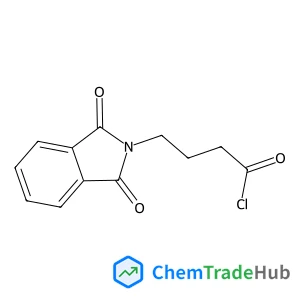
![4,10-Dihydroxy-3H-pyrano[3,4,5-kl]xanthen-3-one structure](https://static.chemtradehub.com/structs/125/1259330-61-4-de48.webp "4,10-Dihydroxy-3H-pyrano[3,4,5-kl]xanthen-3-one structure")
おすすめサプライヤー





免責事項
このページに表示される学術雑誌情報は、参考および研究目的のみを目的としています。当社は雑誌出版社とは提携しておらず、投稿の取り扱いも行っておりません。出版に関するお問い合わせは、各雑誌出版社に直接ご連絡ください。
表示されている情報に誤りがある場合は、support@chemtradehub.com までご連絡ください。迅速に確認し、対応いたします。