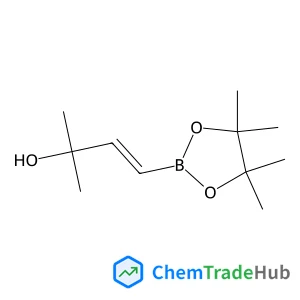
(E)-2-methyl-4-(4,4,5,5-tetramethyl-1,3,2-dioxaborolan-2-yl)but-3-en-2-ol
CAS番号:
581802-26-8
分子式:
C11H21BO3
Huili Liu, Dongyu Bai, Qin Zhang, Ke Wang, Hua Deng, Feng Chen, Qiang Fu
Stereocomplexation between poly(L-lactide) (PLLA) and poly(D-lactide) (PDLA) provides a feasible route for improving the performance of polylactide (PLA), including mechanical strength, thermal stability and hydrolysis resistance. In recent years, several effective methods have been developed to prepare polylactide stereocomplexes (sc-PLA) from commercially available, linear, high-molecular-weight PLLA and PDLA. However, it is still a big challenge to attain pure sc-PLA in the melt-processed products because the prepared sc-PLA has a very poor melt stability, that is the ability to trigger the reformulation of stereocomplex (sc) crystallites after complete melting is significantly depressed, resulting in the formation of mixed homochiral (hc) and sc crystallites. Here we present a facile strategy to fabricate sc-PLA with good melt stability by low-temperature (180 °C) melt-blending of equimolar PLLA and PDLA in the presence of a trace amount (0.1–0.5 wt%) of a cross-linker. During the blending process, sc crystallites form rapidly, followed by a slight cross-linking of PLLA and PDLA chain couples in the mobile amorphous phase, whereas the chain couples in the crystalline phase hardly participate in the cross-linking reaction. The exclusive cross-linking of PLA chains in the amorphous phase not only allows for the introduction of abundant cross-linking points at the ends of the chain couples to prevent them from completely decoupling upon melting but also retains large amounts of long crystallizable PLA segments existing in the initially formed sc crystallites to impart the resulting sc-PLA with an excellent recrystallization ability upon cooling. The formation or reformulation of sc crystallites in the continuous melting and recrystallization process is found to be perfectly reversible, without any trace of hc crystallites.
Jisu Hur, Wonwoong Lee, Beom Hee Kim, Hyun Ji Kim, Do Hee Lee, Ji Hyun Lee, Yong Moon Lee, Han Bin Oh, Jongki Hong
DOI: 10.1039/C9AY01517E
Rui Gusmão, Cristina Ariño, José Manuel Díaz-Cruz, Miquel Esteban
DOI: 10.1039/B918293D
Masato Suzuki, Satoshi Arimoto, Tsuguhiro Korenaga, Tomoyuki Yasukawa
DOI: 10.1039/D0AN00100G
Yang Hu, Jinlong Wang
DOI: 10.1039/C9AY01506J
Xichuan Wei, Haizhu Zhang, Ming Niu, Dingkun Zhang
DOI: 10.1039/C9AY01310E
Jia-Ming Liu, Li-ping Lin, Xin-Xing Wang, Shao-Qin Lin, Wen-Lian Cai, Li-Hong Zhang, Zhi-Yong Zheng
DOI: 10.1039/C2AN35130G
Jitraporn Vongsvivut, Philip Heraud, Adarsha Gupta, Munish Puri, Don McNaughton, Colin J. Barrow
DOI: 10.1039/C3AN00485F
Jiawei Li, Ping Yang, Jing Zhang, Zhengfan Shui, Danqun Huo, Changjun Hou
DOI: 10.1039/C9AY01804B
6- bromo-1-cyclopropyl-1H-benzimidazoleは、抗炎症、抗ウイルス作用を持つことが報告されており、新薬開発の研究対象として注目...
取り扱う際には、防護眼鏡と手袋を使用し、ドラフトチャンバー内で操作することを推奨します。漏洩時には適切な手順で処理し、安全データシートを常に参照してください。
2,2’-ジメチル-3,3’-ビピリジンは、ピリジンと2-メチルアクリルアミドを有機合成反応で合成します。この反応では、ピリジンと2-メチルアクリルアミドを含有...
6-甲基ピリジン-2-ボリック酸は、合成化学、医薬品合成、以及研究用途などに広く使用され、特に組換えDNA技術や分子生物学の研究において重要な役割を果たします。
(R)-3-(1-甲基-2-氧環己基)プロpano酸メチルは一定の安全性がありますが、直接的な皮膚接触や吸入は避けるべきです。使用する際は適切な個々の安全データ...
ketorolacは、密封して遮光容器に保管し、直射日光や高温を避けて保存してください。温度は常温で保存し、湿度をなるべく低く保つことが推奨されます。
L-2,3-二氨基丙酸二盐酸盐は腐食性が強く、皮膚や粘膜に刺激を与える可能性があります。取り扱う際は、防塵マスク、ゴーグル、手袋を使用し、適切な排気設備を使用し...
2-(4-溴ピリジン-2-基)乙腈のCAS番号は312325-73-8です。主に結晶形態で存在し、分子量は159.01 g/molです。この化合物は水に溶けやす...
この化合物は毒性は低いですが、直接的な接触や吸入に注意が必要です。PPE(個人防護具)を着用し、ドラフトチャンバーを使用して操作することを推奨します。また、漏洩...
3-(1-氧代-1,3-二氢-2H-2-异吲哚)丙酸は、薬理学研究や医薬品製造において広く用いられる化合物です。また、工業的な用途でも一部の化学反応の触媒や助剤...

Polymer Chemistry welcomes submissions in all areas of polymer science that have a strong focus on macromolecular chemistry. Manuscripts may cover a broad range of fields, yet no direct application focus is required.