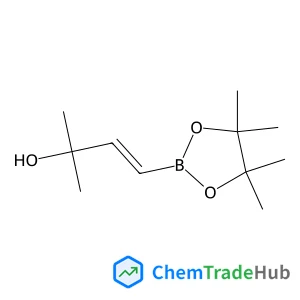
(E)-2-methyl-4-(4,4,5,5-tetramethyl-1,3,2-dioxaborolan-2-yl)but-3-en-2-ol
CAS番号:
581802-26-8
分子式:
C11H21BO3
Matthew R. Gadinski, Chalatorn Chanthad, Kuo Han, Lijie Dong, Qing Wang
A series of copolymers composed of vinylidene fluoride (VDF) and bromotrifluoroethylene (BTFE) have been synthesized via suspension polymerization up to crystallinity inhibition. P(VDF-co-BTFE) copolymers exhibit different regioregularity in comparison to previously reported PVDF based copolymers owing to differences in size and reactivity of BTFE. The polymerization of the comonomers result in molecular defects that are shown to be both included (single BTFE defects) and excluded (runs of BTFE monomers) from the crystalline phase. The effects of increasing defect concentrations determined by 19F NMR were evaluated on the resulting microstructures by using Fourier transformed infrared spectroscopy, differential scanning calorimetry, and wide-angle X-ray diffraction. Dielectric properties have been investigated in terms of complex permittivity as a function of frequency and temperature. The results indicate that the single BTFE defects are incorporated into the crystalline phase and destabilize the ferroelectric β phase, while the excluded defects reduce both lamellar and lateral crystallite sizes though also resulting in a significant drop in crystallinity. The excluded defects are found to expand the interlamellar region of the crystalline phase, which increases both temperature and frequency dependence of the dielectric β relaxation.
Rita Nissim, Richard G. Compton
DOI: 10.1039/C3CP51732B
Iakov Polyak, Eliot Boulanger, Kakali Sen, Walter Thiel
DOI: 10.1039/C3CP51669E
Martin J. Hollamby
DOI: 10.1039/C3CP50293G
David P. Anderson, Jason F. Alvino, Oliver Shipper, Baira Donoeva, Jan-Yves Ruzicka, Hassan Al Qahtani, Hugh H. Harris, Bruce Cowie, Jade B. Aitken, Vladimir B. Golovko, Gregory F. Metha, Gunther G. Andersson
DOI: 10.1039/C3CP52497C
Jhenny F. Galan, Chi Ngong Tang, Shubhashis Chakrabarty, Zhiwei Liu, Vojislava Pophristic
DOI: 10.1039/C3CP50353D
Anita Gollmer, Johannes Regensburger, Tim Maisch, Wolfgang Bäumler
DOI: 10.1039/C3CP50841B
Je Hyun Bae, Yang-Rae Kim, R. Soyoung Kim, Taek Dong Chung
DOI: 10.1039/C3CP50175B
Deya Das, Seungchul Kim, Kwang-Ryeol Lee, Abhishek K. Singh
DOI: 10.1039/C3CP52891J
Masato Morita, Kaito Takahashi
DOI: 10.1039/C3CP51903A
Esther Rebollar, Javier R. Vázquez de Aldana, Ignacio Martín-Fabiani, Margarita Hernández, Daniel R. Rueda, Tiberio A. Ezquerra, Concepción Domingo, Pablo Moreno, Marta Castillejo
DOI: 10.1039/C3CP51523K
6- bromo-1-cyclopropyl-1H-benzimidazoleは、抗炎症、抗ウイルス作用を持つことが報告されており、新薬開発の研究対象として注目...
取り扱う際には、防護眼鏡と手袋を使用し、ドラフトチャンバー内で操作することを推奨します。漏洩時には適切な手順で処理し、安全データシートを常に参照してください。
2,2’-ジメチル-3,3’-ビピリジンは、ピリジンと2-メチルアクリルアミドを有機合成反応で合成します。この反応では、ピリジンと2-メチルアクリルアミドを含有...
6-甲基ピリジン-2-ボリック酸は、合成化学、医薬品合成、以及研究用途などに広く使用され、特に組換えDNA技術や分子生物学の研究において重要な役割を果たします。
(R)-3-(1-甲基-2-氧環己基)プロpano酸メチルは一定の安全性がありますが、直接的な皮膚接触や吸入は避けるべきです。使用する際は適切な個々の安全データ...
ketorolacは、密封して遮光容器に保管し、直射日光や高温を避けて保存してください。温度は常温で保存し、湿度をなるべく低く保つことが推奨されます。
L-2,3-二氨基丙酸二盐酸盐は腐食性が強く、皮膚や粘膜に刺激を与える可能性があります。取り扱う際は、防塵マスク、ゴーグル、手袋を使用し、適切な排気設備を使用し...
2-(4-溴ピリジン-2-基)乙腈のCAS番号は312325-73-8です。主に結晶形態で存在し、分子量は159.01 g/molです。この化合物は水に溶けやす...
この化合物は毒性は低いですが、直接的な接触や吸入に注意が必要です。PPE(個人防護具)を着用し、ドラフトチャンバーを使用して操作することを推奨します。また、漏洩...
3-(1-氧代-1,3-二氢-2H-2-异吲哚)丙酸は、薬理学研究や医薬品製造において広く用いられる化合物です。また、工業的な用途でも一部の化学反応の触媒や助剤...

Polymer Chemistry welcomes submissions in all areas of polymer science that have a strong focus on macromolecular chemistry. Manuscripts may cover a broad range of fields, yet no direct application focus is required.
![2-{[(1R,2S)-2-Aminocyclohexyl]amino}-4-{[3-(2H-1,2,3-triazol-2-yl)phenyl]amino}-5-pyrimidinecarboxamide structure](https://static.chemtradehub.com/structs/137/1370261-96-3-40df.webp "2-{[(1R,2S)-2-Aminocyclohexyl]amino}-4-{[3-(2H-1,2,3-triazol-2-yl)phenyl]amino}-5-pyrimidinecarboxamide structure")