












Controlled synthesis of β-sheet polymers based on side-chain amyloidogenic short peptide segments via RAFT polymerization
文献情報
出版日
2014-07-01
DOI
10.1039/C4PY00620H
インパクトファクター
5.582
著者
Sonu Kumar, Rituparna Acharya, Urmi Chatterji, Priyadarsi De
原文を見る
要旨
A strategy is documented that exploits the controlled synthesis of side-chain peptide based stimuli-responsive hybrid macromolecules inspired by amyloid based β-sheet forming peptides. Well-defined side-chain peptidic polymers have been synthesized via the reversible addition–fragmentation chain transfer (RAFT) polymerization technique using a representative methacrylate monomer with a short peptide segment (Leu-Val-Phe) corresponding to the amyloid β-peptide Aβ1–42. Furthermore, the monomethoxy poly(ethylene glycol) (mPEG) macro-chain transfer agent is employed for RAFT polymerization of this peptidic monomer to prepare peptide based amphiphilic nano-carriers, a promising reservoir for hydrophobic Nile red dye or doxorubicin based anticancer drug molecules. These hybrid materials can easily produce primary amino groups in terminals of side-chains that can be protonated or deprotonated by changing the pH of the aqueous medium, thus providing “smart” pH-responsiveness, cationic characteristics and complexation capabilities with DNA to form polyplexes. Circular dichroism (CD) spectroscopy demonstrates the formation of a secondary structure from these peptidic polymers and they adopted the β-sheet conformation, which were stable against heat in the experimental temperature range and solvent polarity. Solid-state FT-IR spectroscopy has been performed to understand the formation of β-sheets as well as to distinguish between their parallel and antiparallel propensity. In vitro cytotoxicity testing indicates the biocompatible nature of these peptidic materials, and confocal laser scanning microscopy (CLSM) images revealed cellular uptake of their drug/dye loaded micelles, which potentially offers them as a suitable candidate with dual bioapplications for drug delivery as well as gene transfer.
関連文献
Interaction of electrolyte molecules with carbon materials of well-defined porosity: characterization by solid-state NMR spectroscopy
Lars Borchardt, Martin Oschatz, Silvia Paasch, Stefan Kaskel, Eike Brunner
2013-07-19
Paper
DOI: 10.1039/C3CP52283K
Dye-sensitized solar cells based on hydroquinone/benzoquinone as bio-inspired redox couple with different counter electrodes
Ming Cheng, Xichuan Yang, Cheng Chen, Jianghua Zhao, Fuguo Zhang
2013-06-24
Paper
DOI: 10.1039/C3CP51980E
A low-cost bio-inspired integrated carbon counter electrode for high conversion efficiency dye-sensitized solar cells
Chunlei Wang, Fanning Meng, Mingxing Wu, Xiao Lin, Tonghua Wang, Jieshan Qiu, Tingli Ma
2013-06-27
Communication
DOI: 10.1039/C3CP52525B
Multidimensional local mode calculations for the vibrational spectra of OH−(H2O)2 and OH−(H2O)2·Ar
Masato Morita, Kaito Takahashi
2013-07-01
Paper
DOI: 10.1039/C3CP51903A
Enhanced electrochemical reactions of 1,4-benzoquinone at nanoporous electrodes
Je Hyun Bae, Yang-Rae Kim, R. Soyoung Kim, Taek Dong Chung
2013-04-12
Paper
DOI: 10.1039/C3CP50175B
Highly soluble energy relay dyes for dye-sensitized solar cells
George Y. Margulis, Bogyu Lim, Brian E. Hardin, Eva L. Unger, Jun-Ho Yum, Johann M. Feckl, Dina Fattakhova-Rohlfing, Thomas Bein, Michael Grätzel, Alan Sellinger, Michael D. McGehee
2013-05-28
Paper
DOI: 10.1039/C3CP51018B
Multiphoton photoelectron emission microscopy of single Au nanorods: combined experimental and theoretical study of rod morphology and dielectric environment on localized surface plasmon resonances
Andrej Grubisic, Volker Schweikhard, Thomas A. Baker, David J. Nesbitt
2013-01-31
Paper
DOI: 10.1039/C3CP44385J
Chitosan conjugates for DNA delivery
Diana Paiva, Galya Ivanova, Maria do Carmo Pereira, Sandra Rocha
2013-06-13
Paper
DOI: 10.1039/C3CP51215K
Structure and Li+ dynamics of Sb-doped Li7La3Zr2O12 fast lithium ion conductors
S. Ramakumar, L. Satyanarayana, Sunkara V. Manorama, Ramaswamy Murugan
2013-05-15
Paper
DOI: 10.1039/C3CP50991E
こちらもおすすめ
化合物よくある質問
6- bromo-1-cyclopropyl-1H-benzimidazoleの市場動向や研究トレンドはどうですか?
6- bromo-1-cyclopropyl-1H-benzimidazoleは、抗炎症、抗ウイルス作用を持つことが報告されており、新薬開発の研究対象として注目...
1416713-53-56-Bromo-1-cyclopropy...
化合物よくある質問
環氧プロpanol-d5を取り扱う際の実験室安全事項は何ですか?
取り扱う際には、防護眼鏡と手袋を使用し、ドラフトチャンバー内で操作することを推奨します。漏洩時には適切な手順で処理し、安全データシートを常に参照してください。
1246819-20-4Glycidol-d5
化合物よくある質問
2,2’-ジメチル-3,3’-ビピリジンはどのように合成されますか?
2,2’-ジメチル-3,3’-ビピリジンは、ピリジンと2-メチルアクリルアミドを有機合成反応で合成します。この反応では、ピリジンと2-メチルアクリルアミドを含有...
86156-55-02,2’-Dimethyl-3,3’-b...
化合物よくある質問
6-甲基ピリジン-2-ボリック酸の主な用途は何ですか?
6-甲基ピリジン-2-ボリック酸は、合成化学、医薬品合成、以及研究用途などに広く使用され、特に組換えDNA技術や分子生物学の研究において重要な役割を果たします。
372963-50-3(6-Methyl-2-pyridiny...
化合物よくある質問
(R)-3-(1-甲基-2-氧環己基)プロpano酸メチルは安全ですか?
(R)-3-(1-甲基-2-氧環己基)プロpano酸メチルは一定の安全性がありますが、直接的な皮膚接触や吸入は避けるべきです。使用する際は適切な個々の安全データ...
94089-47-1methyl 3-[(1R)-1-met...
化合物よくある質問
ketorolacはどのように保存すればよいですか?
ketorolacは、密封して遮光容器に保管し、直射日光や高温を避けて保存してください。温度は常温で保存し、湿度をなるべく低く保つことが推奨されます。
74103-06-3rac Ketorolac
化合物よくある質問
L-2,3-二氨基丙酸二盐酸盐を取り扱う際の実験室安全事項は何ですか?
L-2,3-二氨基丙酸二盐酸盐は腐食性が強く、皮膚や粘膜に刺激を与える可能性があります。取り扱う際は、防塵マスク、ゴーグル、手袋を使用し、適切な排気設備を使用し...
19777-68-5(S)-2,3-Diaminopropa...
化合物よくある質問
2-(4-溴ピリジン-2-基)乙腈の物理化学的性質は何ですか?
2-(4-溴ピリジン-2-基)乙腈のCAS番号は312325-73-8です。主に結晶形態で存在し、分子量は159.01 g/molです。この化合物は水に溶けやす...
312325-73-8(4-Bromo-2-pyridinyl...
化合物よくある質問
3-フローロ-[1,1-ベンジレン]-3,4-ジカルボン酸を取り扱う際の実験室安全事項は何ですか?
この化合物は毒性は低いですが、直接的な接触や吸入に注意が必要です。PPE(個人防護具)を着用し、ドラフトチャンバーを使用して操作することを推奨します。また、漏洩...
1261915-32-53'-Fluoro-[1,1'-biph...
化合物よくある質問
3-(1-氧代-1,3-二氢-2H-2-异吲哚)丙酸の主な用途は何ですか?
3-(1-氧代-1,3-二氢-2H-2-异吲哚)丙酸は、薬理学研究や医薬品製造において広く用いられる化合物です。また、工業的な用途でも一部の化学反応の触媒や助剤...
83747-30-23-(1-Oxo-1,3-dihydro...
掲載誌
Polymer Chemistry

CiteScore:
8.6
自己引用率:
7.3%
年間論文数:
457
Polymer Chemistry welcomes submissions in all areas of polymer science that have a strong focus on macromolecular chemistry. Manuscripts may cover a broad range of fields, yet no direct application focus is required.
おすすめ化合物
![6-Bromo-2,3-dihydro-1H-pyrido[2,3-b][1,4]oxazine structure](https://static.chemtradehub.com/structs/120/1203499-17-5-b4d1.webp "6-Bromo-2,3-dihydro-1H-pyrido[2,3-b][1,4]oxazine structure")
![2-{[(1R,2S)-2-Aminocyclohexyl]amino}-4-{[3-(2H-1,2,3-triazol-2-yl)phenyl]amino}-5-pyrimidinecarboxamide structure](https://static.chemtradehub.com/structs/137/1370261-96-3-40df.webp "2-{[(1R,2S)-2-Aminocyclohexyl]amino}-4-{[3-(2H-1,2,3-triazol-2-yl)phenyl]amino}-5-pyrimidinecarboxamide structure")
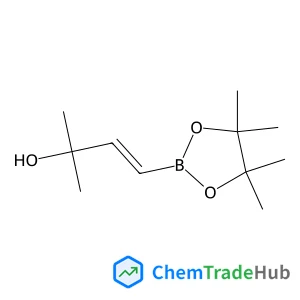
(E)-2-methyl-4-(4,4,5,5-tetramethyl-1,3,2-dioxaborolan-2-yl)but-3-en-2-ol
CAS番号:
581802-26-8
分子式:
C11H21BO3
おすすめサプライヤー




免責事項
このページに表示される学術雑誌情報は、参考および研究目的のみを目的としています。当社は雑誌出版社とは提携しておらず、投稿の取り扱いも行っておりません。出版に関するお問い合わせは、各雑誌出版社に直接ご連絡ください。
表示されている情報に誤りがある場合は、support@chemtradehub.com までご連絡ください。迅速に確認し、対応いたします。