



Trehalose-functionalized block copolymers form serum-stable micelles
文献情報
出版日
2014-04-29
DOI
10.1039/C4PY00399C
インパクトファクター
5.582
著者
Swapnil R. Tale, Ligeng Yin, Theresa M. Reineke
原文を見る
要旨
Well-defined amphiphilic diblock terpolymers of poly(ethylene-alt-propylene)–poly[(N,N′-dimethylacrylamide)-grad-poly(6-deoxy-6-methacrylamido trehalose)] (denoted as PEP–poly(DMA-grad-MAT, or PT) have been synthesized using a PEP macromolecular chain transfer agent by reversible addition–fragmentation chain transfer (RAFT) polymerization. The content of MAT was varied from 5 to 14 mole percent in the hydrophilic block of the amphiphilic polymers yielding a family of diblock terpolymers. The reactivity ratios of DMA and trimethyl silyl protected MAT were determined to be r1 = 0.09 ± 0.01 and r2 = 1.6 ± 0.1 and thus, the hydrophilic block was a gradient copolymer consisting of a higher DMA ratio (closer to the PEP) that was terminated with a higher MAT ratio. The silyl groups were subsequently deprotected and micellar dispersions were prepared by two different techniques: nanoprecipitation (NP) and direct dissolution (DD). Micelles formed by the two methods were characterized by dynamic light scattering (DLS) and cryo-transmission electron microscopy (cryo-TEM). These PT diblock terpolymers self-assembled into spherical nanostructures in aqueous media with hydrodynamic radii of ca. 16 nm in the dispersions formed by nanoprecipitation. Micellar dispersions with greater MAT content (11 mole percent in the hydrophilic block) exhibited sufficient contrast in cryoTEM images and the corona were clearly seen as gray halos around the micellar cores. The stability of each micellar dispersion in different biological media was examined over a period of 14 h using DLS. These results indicated that micellar dispersions are stable in 100 percent fetal bovine serum (FBS), which offer promise for in vivo actives delivery applications.
おすすめジャーナル

Current Opinion in Solid State & Materials Science

Organic Process Research & Development

Russian Journal of Organic Chemistry

Saudi Pharmaceutical Journal

Acta Materialia

Russian Journal of Coordination Chemistry

Current Opinion in Colloid & Interface Science

Chemical Communications

Russian Chemical Bulletin

Drug Discovery Today
関連文献
Quantum phase transitions in skewed ladder systems
Sambunath Das, Dayasindhu Dey, Rajamani Raghunathan, Zoltan G. Soos, Manoranjan Kumar, S. Ramasesha
2023-12-09
Review Article
DOI: 10.1039/D3CP04179D
Degradation analysis of inverted PM6 (PBDB-T-2F):Y7 (BTP-4CI) solar cells with PDINO and MoO3 as the ETL/HTL
Angel Sacramento, José L. Abad, Magaly Ramírez-Como, Victor S. Balderrama, Magali Estrada
2023-11-15
Paper
DOI: 10.1039/D3SE00977G
Quantitative kinetics of the atmospheric reaction between isocyanic acid and hydroxyl radicals: post-CCSD(T) contribution, anharmonicity, recrossing effects, torsional anharmonicity, and tunneling
Dai-Dan Deng
2023-11-23
Paper
DOI: 10.1039/D3CP04385A
An electrospun PVDF-KNN nanofiber based lead-free piezoelectric nanogenerator for mechanical energy scavenging and self-powered force sensing applications
2023-11-10
Paper
DOI: 10.1039/D3SE00880K
Revealing the evolution of local structures in the formation process of alkaline earth metal cation-containing zeolites from glasses
Makiko Deguchi, Kentaro Kobayashi, Sohei Sukenaga, Mariko Ando, Hiroyuki Shibata, Akihiko Machida, Yutaka Yanaba, Tatsuya Okubo
2023-12-07
Paper
DOI: 10.1039/D3CP04954J
Effects of gamma radiation on the electrical properties of InAs/InGaAs quantum dot-based laser structures grown on GaAs and Si substrates by molecular beam epitaxy
D. A. Jameel, Walter M. de Azevedo, Jorlandio F. Felix, N. Al Saqri, O. M. Lemine, S. Abu Alrub, M. Henini
2023-11-25
Paper
DOI: 10.1039/D3CP03865C
The light-dependent pseudo-capacitive charging of conjugated polymer nanoparticles coupled with the depolarization of the neuronal membrane
Riccardo Sacco, Grazia Pertile
2023-11-25
Communication
DOI: 10.1039/D3CP04386J
Development of a QM/MM(ABEEM) method for the deprotonation of neutral and cation radicals in the G-tetrad and GGX(8-oxo-G) tetrad
Yue Wang, Linlin Liu, Yue Gao, Jiayue Zhao, Cui Liu, Lidong Gong, Zhongzhi Yang
2023-11-28
Paper
DOI: 10.1039/D3CP04357F
Conformational preferences of modified nucleobases in RNA aptamers and their effect on Förster resonant energy transfer
David Fischermeier, Christian Steinmetzger, Claudia Höbartner, Roland Mitrić
2023-11-24
Paper
DOI: 10.1039/D3CP04704K
こちらもおすすめ
化合物よくある質問
1-{3-[5-(エチルカルボンイル)-2,4-ジメチル-1H-ピロロール-3-基]プロパニル}ピペリジン-4-カルボン酸について、適用される法規ガイドラインは何ですか?
この化合物はCAS番号1142209-81-1であり、GHS分類では corrosive (腐食性物質) と classified (分類物質) として指定され...
1142209-81-11-{3-[5-(Ethoxycarbo...
化合物よくある質問
2,2-二氟-1,3-ベンゾジオキサン-5-カルボキシlic酸とは何ですか?
2,2-二氟-1,3-ベンゾジオキサン-5-カルボキシlic酸は、CAS番号656-46-2の化合物で、化学式はC8H4F2O4です。この化合物は白色の結晶性粉...
656-46-22,2-Difluoro-1,3-ben...
化合物よくある質問
8-氯-4-色原酮の代替品はありますか?
8-氯-4-色原酮(CAS番号: 49701-11-3)の代替品には、他の色原酮類似物や、構造が似ている化合物があります。例えば、8-メチル-4-色原酮や、他の...
49701-11-38-Chloro-2,3-dihydro...
化合物よくある質問
エチル6,6-ジメチル-4,5,6,7-テトラヒドロ-1H-インドアゼー-3-カルボキシレートとは何ですか?
エチル6,6-ジメチル-4,5,6,7-テトラヒドロ-1H-インドアゼー-3-カルボキシレートは、CAS番号1233243-56-5を有する化合物です。これは有...
1233243-56-5Ethyl 6,6-dimethyl-4...
化合物よくある質問
4-叔丁基-6-氯-嘧啶に適用される法規ガイドラインは何ですか?
4-叔丁基-6-氯-嘧啶はCAS番号3435-24-3で、GHS分類では毒性物質とみなし、GHSの危険性分類が適用されます。REACH規則では登録が必要で、Eu...
3435-24-34-Tert-butyl-6-chlor...
化合物よくある質問
維库溴铵杂质Bはどのように合成されますか?
維库溴铵杂质Bは、アンドロステンデンから始まり、一連の合成反応、包括的な選択性と高い収率で合成されます。具体的には、ブロミド化、酸化、ジマーゼ反応、アミド化など...
50587-95-6(2beta,3alpha,5alpha...
化合物よくある質問
2-(4-氟苄基)-吡咯烷の物理化学的性質は何ですか?
CAS番号350017-04-8の2-(4-氟苄基)-吡咯烷は、結晶性の白色粉末です。分子量は199.17 g/molで、水に溶けにくいです。化学反応では比較的...
350017-04-82-(4-Fluorobenzyl)py...
化合物よくある質問
3-喹啉甲醛(2-チロール-8-エチル)は安全ですか?
3-喹啉甲醛(2-チロール-8-エチル)は一定の毒性を持つため、取扱には注意が必要です。使用する際は適切な防護具を着用し、密閉容器で保管・搬送し、直接的な接触を...
335196-05-92-Chloro-8-ethyl-3-q...
化合物よくある質問
エチル3-(ヒドロキシメチル)-1H-ピロール-2-カルボキシレートはどのように保存すればよいですか?
エチル3-(ヒドロキシメチル)-1H-ピロール-2-カルボキシレートは、室温(25℃)以下で保存し、直射日光を避け、乾燥した環境で保管することが推奨されます。ま...
75448-69-0Ethyl 3-(hydroxymeth...
119410-05-88-Chloro-11-(4-piper...
掲載誌
Polymer Chemistry

CiteScore:
8.6
自己引用率:
7.3%
年間論文数:
457
Polymer Chemistry welcomes submissions in all areas of polymer science that have a strong focus on macromolecular chemistry. Manuscripts may cover a broad range of fields, yet no direct application focus is required.
おすすめ化合物

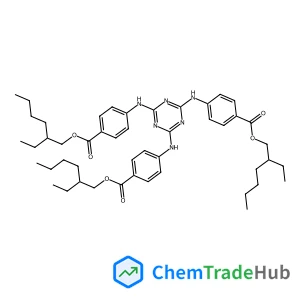
Tris(2-ethylhexyl) 4,4',4''-(1,3,5-triazine-2,4,6-triyltriimino)tribenzoate
CAS番号:
88122-99-0
分子式:
C48H66N6O6

![2-Bromodibenzo[b,d]furan structure](https://static.chemtradehub.com/structs/86-/86-76-0-1814.webp "2-Bromodibenzo[b,d]furan structure")
おすすめサプライヤー





免責事項
このページに表示される学術雑誌情報は、参考および研究目的のみを目的としています。当社は雑誌出版社とは提携しておらず、投稿の取り扱いも行っておりません。出版に関するお問い合わせは、各雑誌出版社に直接ご連絡ください。
表示されている情報に誤りがある場合は、support@chemtradehub.com までご連絡ください。迅速に確認し、対応いたします。